Division of Hematology, Department of Internal Medicine, National Taiwan University Hospital, Taipei, Taiwan.
Department of Internal Medicine, National Taiwan University Hospital Hsin-Chu Branch, Hsinchu, Taiwan.
Blood Cancer J. 2023 Aug 9;13(1):120. doi: 10.1038/s41408-023-00894-8.
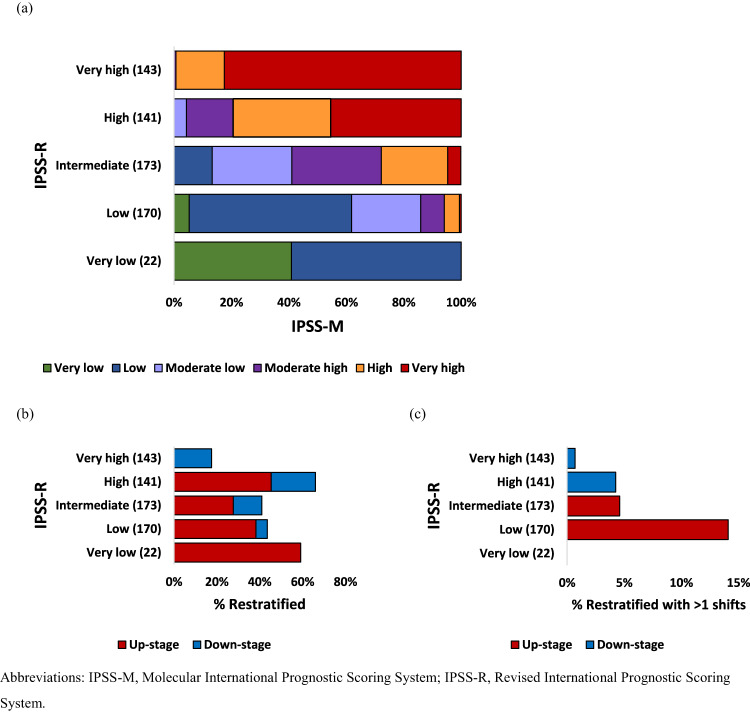
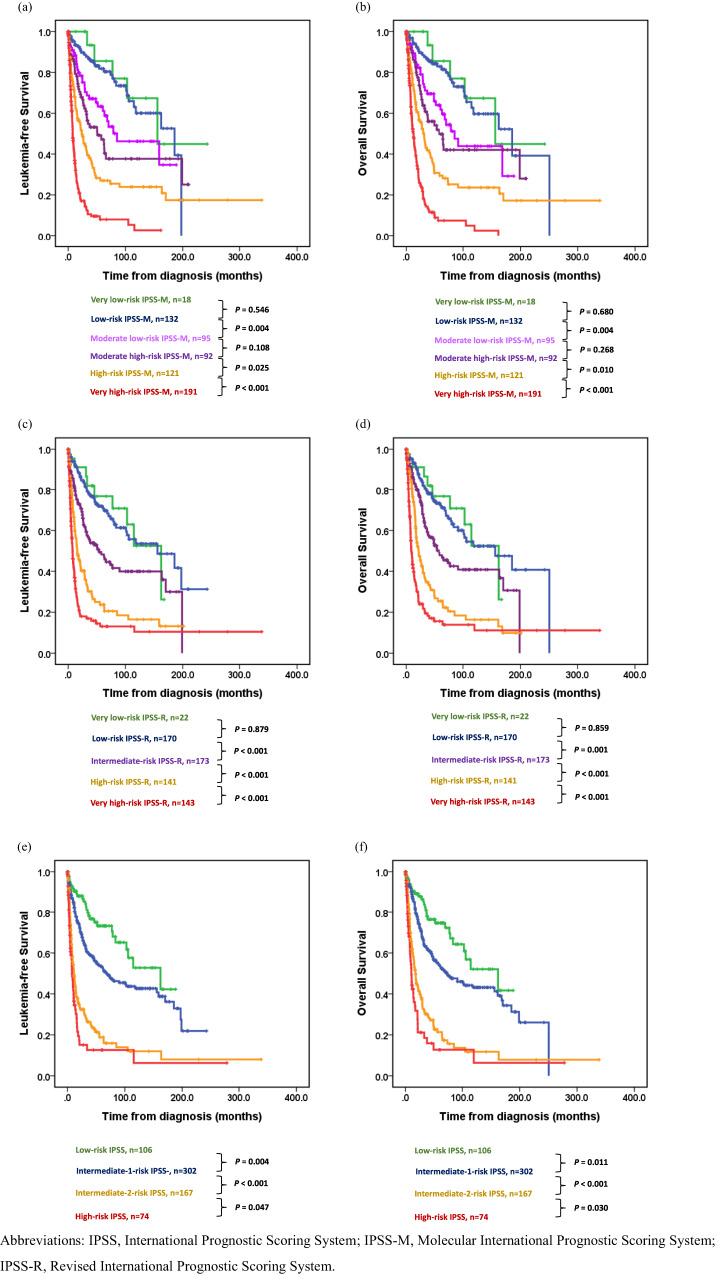
Myelodysplastic syndromes (MDS) have varied prognoses and require a risk-adapted treatment strategy for treatment optimization. Recently, a molecular prognostic model (Molecular International Prognostic Scoring System [IPSS-M]) that combines clinical parameters, cytogenetic abnormalities, and mutation topography was proposed. This study validated the IPSS-M in 649 patients with primary MDS (based on the 2022 International Consensus Classification [ICC]) and compared its prognostic power to those of the IPSS and revised IPSS (IPSS-R). Overall, 42.5% of the patients were reclassified and 29.3% were up-staged from the IPSS-R. After the reclassification, 16.9% of the patients may receive different treatment strategies. The IPSS-M had greater discriminative potential than the IPSS-R and IPSS. Patients with high, or very high-risk IPSS-M might benefit from allogeneic hematopoietic stem cell transplantation. IPSS-M, age, ferritin level, and the 2022 ICC categorization predicted outcomes independently. After analyzing demographic and genetic features, complementary genetic analyses, including KMT2A-PTD, were suggested for accurate IPSS-M categorization of patients with ASXL1, TET2, STAG2, RUNX1, SF3B1, SRSF2, DNMT3A, U2AF1, and BCOR mutations and those classified as MDS, not otherwise specified with single lineage dysplasia/multi-lineage dysplasia based on the 2022 ICC. This study confirmed that the IPSS-M can better risk-stratified MDS patients for optimized therapeutic decision-making.
骨髓增生异常综合征(MDS)具有不同的预后,需要采用风险适应的治疗策略进行优化治疗。最近,提出了一种将临床参数、细胞遗传学异常和突变分布相结合的分子预后模型(分子国际预后评分系统[IPSS-M])。本研究在 649 例原发性 MDS 患者中验证了 IPSS-M(基于 2022 年国际共识分类[ICC]),并将其预后能力与 IPSS 和修订后的 IPSS(IPSS-R)进行了比较。总体而言,42.5%的患者进行了重新分类,29.3%的患者从 IPSS-R 升级。重新分类后,可能会有 16.9%的患者接受不同的治疗策略。IPSS-M 比 IPSS-R 和 IPSS 具有更大的区分能力。高风险或极高风险 IPSS-M 的患者可能受益于异基因造血干细胞移植。IPSS-M、年龄、铁蛋白水平和 2022 年 ICC 分类独立预测结局。在分析人口统计学和遗传特征后,建议对 ASXL1、TET2、STAG2、RUNX1、SF3B1、SRSF2、DNMT3A、U2AF1 和 BCOR 突变患者以及根据 2022 年 ICC 分类为 MDS、非特指伴有单系发育异常/多系发育异常的患者进行补充遗传分析,以进行准确的 IPSS-M 分类。本研究证实,IPSS-M 可以更好地对 MDS 患者进行风险分层,以优化治疗决策。