Gill Harinder, Yim Rita, Lee Paul, Tsai Xavier Cheng-Hong, Li Vivian W K, Leung Garret M K, Ooi Melissa, Hui Tsz-Shing, Raghupathy Radha, Chin Lynn, Au Lester, Zhang Qi, Wu Tony K Y, Lee Carmen Y Y, Chng Wee-Joo, Tien Hwei-Fang, Hou Hsin-An, Kwong Yok-Lam
Department of Medicine, School of Clinical Medicine, LKS Faculty of Medicine, the University of Hong Kong, Hong Kong, Hong Kong.
Division of Hematology, Department of Internal Medicine, National Taiwan University Hospital, Taipei, Taiwan, ROC.
Blood Cancer J. 2025 Jul 31;15(1):128. doi: 10.1038/s41408-025-01339-0.
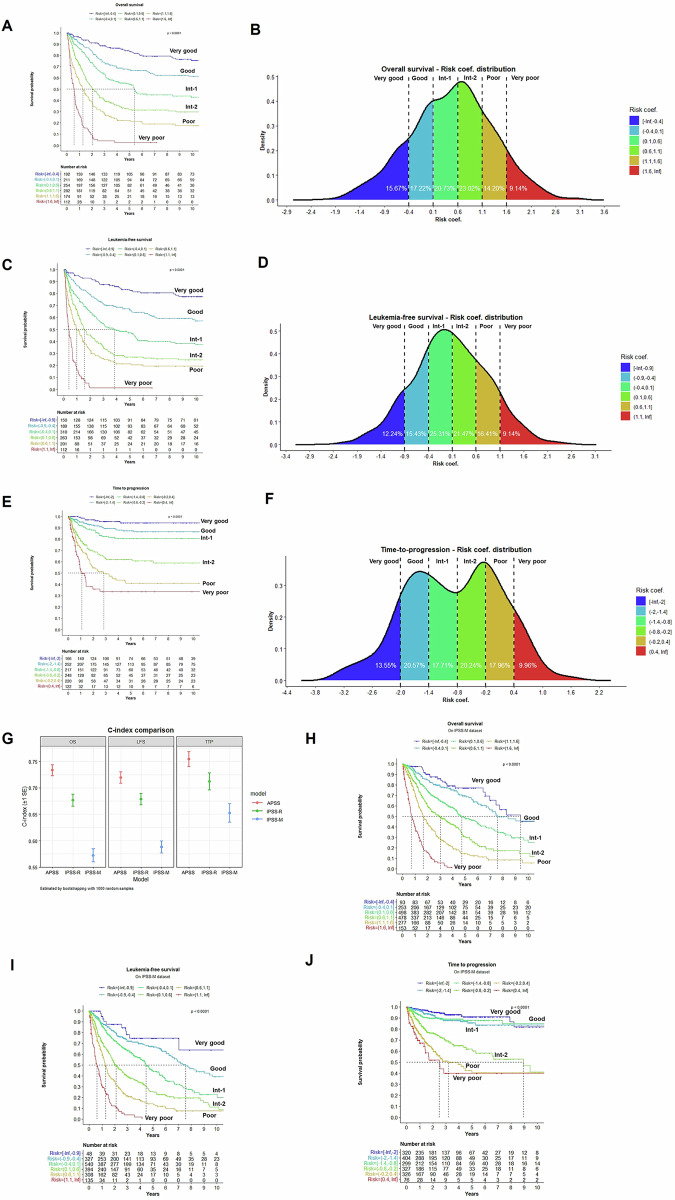
A personalized prognostic model that takes into account the unique molecular features of primary myelodysplastic neoplasm (MDS) in Asia patients is lacking. Diagnostic clinicopathologic features, cytogenetic changes, and gene mutations of ethnic Asian patients with primary MDS were analyzed. Variables were evaluated for associations with overall survival (OS), leukemia-free survival (LFS), and time to progression to secondary AML (TTP-sAML). Prognostic scores were built as a weighted sum of prognostic variables for each patient. The cohort comprised 1225 patients, with at least one gene mutation identified in 1177 patients (96%). Genomic factors associated with inferior outcomes included monosomy 7, del(5q), and GNAS and TP53 mutations for OS; trisomy 19, del(5q), monosomy 7, and GNAS, PTPN11 and TP53 mutations for LFS; and i(17q), del(5q), and NPM1, NRAS, GNAS, IDH2, SF3B1 and RUNX1 mutations for TTP-sAML. The Asian Prognostic Scoring System (APSS) was determined, stratifying patients into six prognostic risk categories. The APSS, compared with the International Prognostic Scoring System molecular (IPSS-M), showed superior concordance indices (C-indices) for OS (0.73 versus 0.57), LFS (0.72 versus 0.59), and TTP-sAML (0.75 versus 0.65) for this Asian cohort. In conclusion, the APSS enhanced prognostication of primary MDS in Asia.
目前尚缺乏一种考虑亚洲原发性骨髓增生异常综合征(MDS)患者独特分子特征的个性化预后模型。对亚洲原发性MDS患者的诊断性临床病理特征、细胞遗传学变化和基因突变进行了分析。评估变量与总生存期(OS)、无白血病生存期(LFS)以及进展为继发性急性髓系白血病(TTP-sAML)时间的相关性。将预后评分构建为每位患者预后变量的加权和。该队列包括1225例患者,1177例患者(96%)至少检测到一种基因突变。与不良预后相关的基因组因素包括:OS方面有7号染色体单体、5号染色体长臂缺失以及GNAS和TP53基因突变;LFS方面有19号染色体三体、5号染色体长臂缺失、7号染色体单体以及GNAS、PTPN11和TP53基因突变;TTP-sAML方面有17号染色体等臂、5号染色体长臂缺失以及NPM1、NRAS、GNAS、IDH2、SF3B1和RUNX1基因突变。确定了亚洲预后评分系统(APSS),将患者分为六个预后风险类别。与国际预后评分系统分子版(IPSS-M)相比,APSS在该亚洲队列的OS(0.73对0.57)、LFS(0.72对0.59)和TTP-sAML(0.75对0.65)方面显示出更高的一致性指数(C指数)。总之,APSS改善了亚洲原发性MDS的预后评估。