Institute for Regenerative Medicine, Shanghai East Hospital, Shanghai Key Laboratory of Signaling and Disease Research, School of Life Sciences and Technology, Tongji University, 200120, Shanghai, China.
Shanghai Key Laboratory of Maternal Fetal Medicine, Shanghai Institute of Maternal-Fetal Medicine and Gynecologic Oncology, Clinical and Translation Research Center, Shanghai First Maternity and Infant Hospital, School of Life Science and Technology, Tongji University, 200092, Shanghai, China.
Nat Commun. 2023 Aug 9;14(1):4807. doi: 10.1038/s41467-023-40496-3.
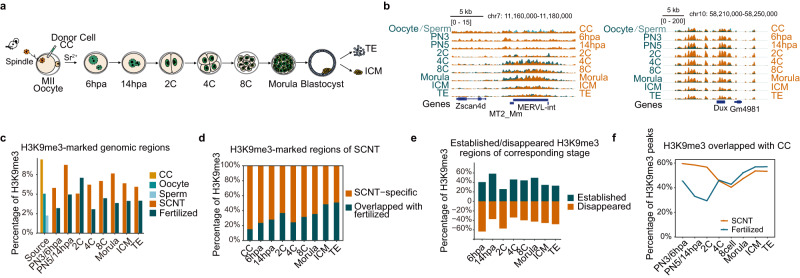
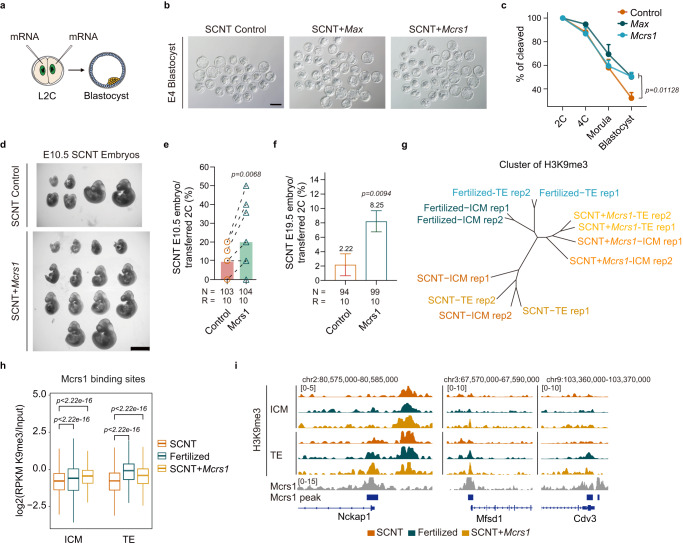
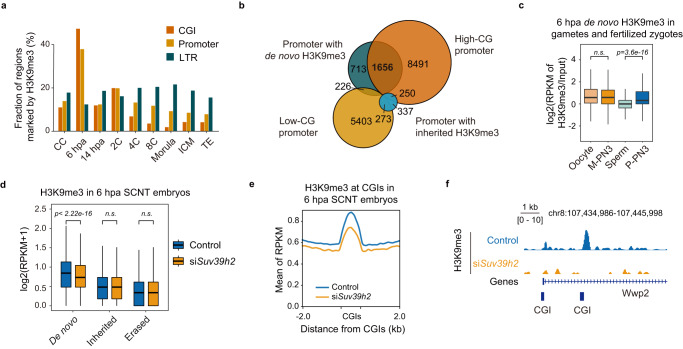
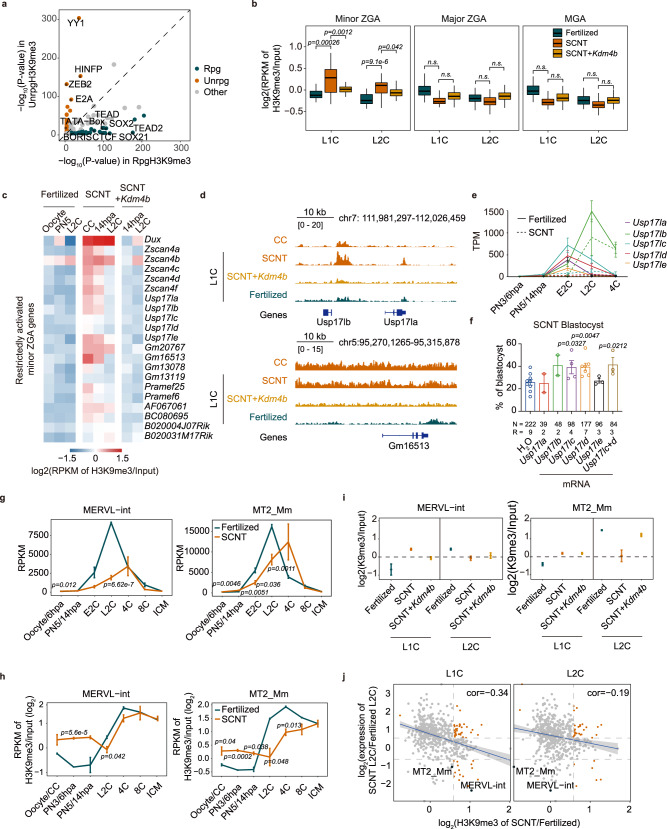
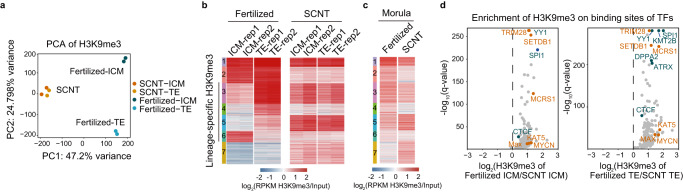
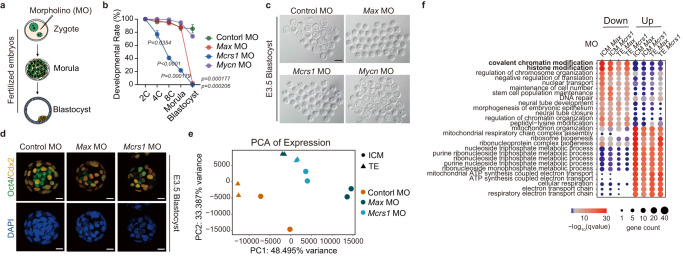
Somatic cell nuclear transfer (SCNT) can be used to reprogram differentiated somatic cells to a totipotent state but has poor efficiency in supporting full-term development. H3K9me3 is considered to be an epigenetic barrier to zygotic genomic activation in 2-cell SCNT embryos. However, the mechanism underlying the failure of H3K9me3 reprogramming during SCNT embryo development remains elusive. Here, we perform genome-wide profiling of H3K9me3 in cumulus cell-derived SCNT embryos. We find redundant H3K9me3 marks are closely related to defective minor zygotic genome activation. Moreover, SCNT blastocysts show severely indistinct lineage-specific H3K9me3 deposition. We identify MAX and MCRS1 as potential H3K9me3-related transcription factors and are essential for early embryogenesis. Overexpression of Max and Mcrs1 significantly benefits SCNT embryo development. Notably, MCRS1 partially rescues lineage-specific H3K9me3 allocation, and further improves the efficiency of full-term development. Importantly, our data confirm the conservation of deficient H3K9me3 differentiation in Sertoli cell-derived SCNT embryos, which may be regulated by alternative mechanisms.
体细胞核移植 (SCNT) 可用于重编程分化的体细胞至全能状态,但在支持胚胎的全期发育方面效率低下。H3K9me3 被认为是 2 细胞 SCNT 胚胎中合子基因组激活的表观遗传障碍。然而,SCNT 胚胎发育过程中 H3K9me3 重编程失败的机制仍不清楚。在此,我们对卵丘细胞来源的 SCNT 胚胎中的 H3K9me3 进行了全基因组分析。我们发现冗余的 H3K9me3 标记与合子基因组激活的缺陷密切相关。此外,SCNT 囊胚表现出严重的、特定谱系的 H3K9me3 沉积不明确。我们鉴定了 MAX 和 MCRS1 作为潜在的 H3K9me3 相关转录因子,它们对早期胚胎发生至关重要。Max 和 Mcrs1 的过表达显著有利于 SCNT 胚胎的发育。值得注意的是,MCRS1 部分挽救了谱系特异性的 H3K9me3 分配,并进一步提高了全期发育的效率。重要的是,我们的数据证实了 Sertoli 细胞来源的 SCNT 胚胎中分化缺陷的 H3K9me3 的保守性,这可能受替代机制调控。