Terterov Ivan, Nettels Daniel, Makarov Dmitrii E, Hofmann Hagen
Department of Chemical and Structural Biology, Weizmann Institute of Science, Rehovot, Israel.
Department of Biochemistry and Department of Physics, University of Zurich, Zurich, Switzerland.
Biophys Rep (N Y). 2023 Jul 7;3(3):100116. doi: 10.1016/j.bpr.2023.100116. eCollection 2023 Sep 13.
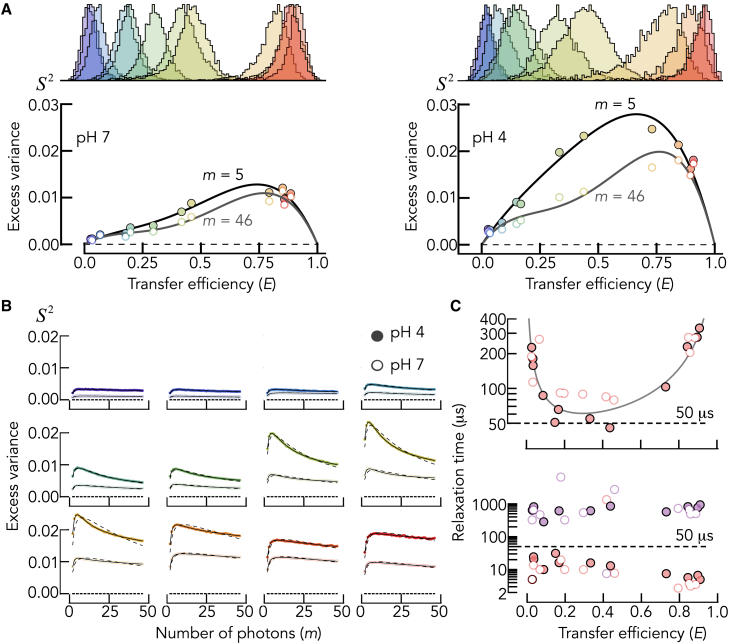
Quantifying biomolecular dynamics has become a major task of single-molecule fluorescence spectroscopy methods. In single-molecule Förster resonance energy transfer (smFRET), kinetic information is extracted from the stream of photons emitted by attached donor and acceptor fluorophores. Here, we describe a time-resolved version of burst variance analysis that can quantify kinetic rates at microsecond to millisecond timescales in smFRET experiments of diffusing molecules. Bursts are partitioned into segments with a fixed number of photons. The FRET variance is computed from these segments and compared with the variance expected from shot noise. By systematically varying the segment size, dynamics at different timescales can be captured. We provide a theoretical framework to extract kinetic rates from the decay of the FRET variance with increasing segment size. Compared to other methods such as filtered fluorescence correlation spectroscopy, recurrence analysis of single particles, and two-dimensional lifetime correlation spectroscopy, fewer photons are needed to obtain reliable timescale estimates, which reduces the required measurement time.
量化生物分子动力学已成为单分子荧光光谱方法的一项主要任务。在单分子荧光共振能量转移(smFRET)中,动力学信息是从附着的供体和受体荧光团发射的光子流中提取的。在此,我们描述了一种爆发方差分析的时间分辨版本,它可以在扩散分子的smFRET实验中,在微秒到毫秒的时间尺度上量化动力学速率。爆发被划分为具有固定光子数的片段。从这些片段计算FRET方差,并与散粒噪声预期的方差进行比较。通过系统地改变片段大小,可以捕捉不同时间尺度上的动力学。我们提供了一个理论框架,用于从随着片段大小增加的FRET方差衰减中提取动力学速率。与其他方法(如滤波荧光相关光谱、单粒子递归分析和二维寿命相关光谱)相比,获得可靠的时间尺度估计所需的光子更少,这减少了所需的测量时间。