Department of Chemical and Structural Biology, Weizmann Institute of Science, 76100 Rehovot, Israel.
Department of Physics, Arizona State University, Tempe, AZ 85287.
Proc Natl Acad Sci U S A. 2021 Sep 14;118(37). doi: 10.1073/pnas.2106690118.
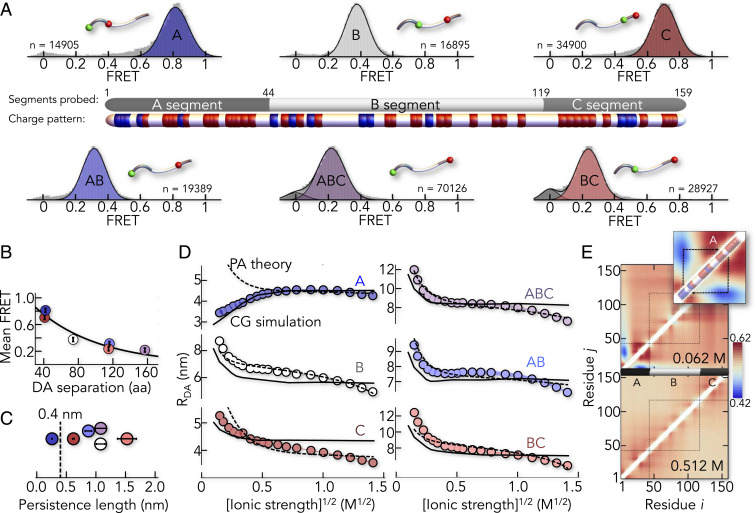
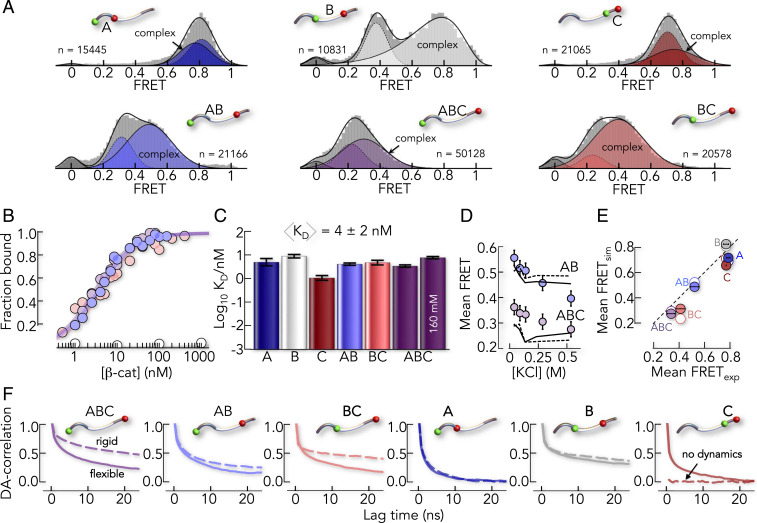
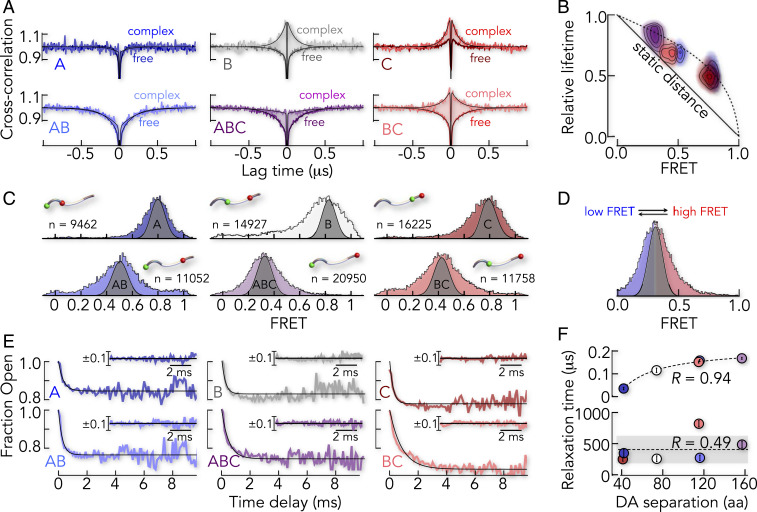
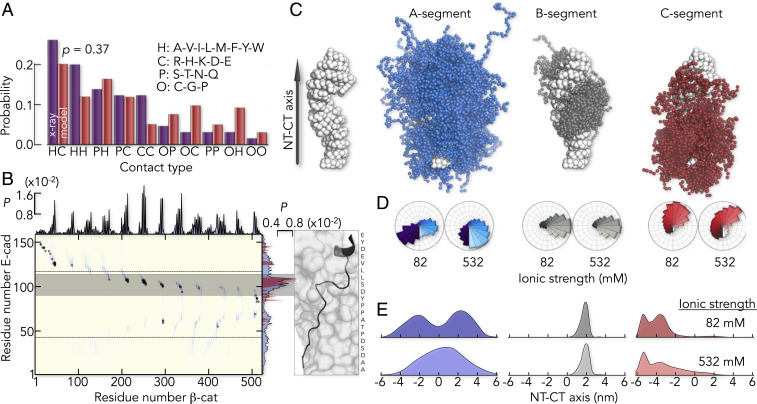
Intrinsically disordered proteins often form dynamic complexes with their ligands. Yet, the speed and amplitude of these motions are hidden in classical binding kinetics. Here, we directly measure the dynamics in an exceptionally mobile, high-affinity complex. We show that the disordered tail of the cell adhesion protein E-cadherin dynamically samples a large surface area of the protooncogene β-catenin. Single-molecule experiments and molecular simulations resolve these motions with high resolution in space and time. Contacts break and form within hundreds of microseconds without a dissociation of the complex. The energy landscape of this complex is rugged with many small barriers (3 to 4 ) and reconciles specificity, high affinity, and extreme disorder. A few persistent contacts provide specificity, whereas unspecific interactions boost affinity.
无规蛋白通常与其配体形成动态复合物。然而,这些运动的速度和幅度隐藏在经典的结合动力学中。在这里,我们直接测量了一个异常活跃、高亲和力复合物中的动力学。我们表明,细胞黏附蛋白 E-钙黏蛋白的无规尾部动态地采样了原癌基因β-连环蛋白的一个大的表面区域。单分子实验和分子模拟以高时空分辨率解决了这些运动。在不使复合物解离的情况下,数百微秒内就会发生接触的断开和形成。该复合物的能量景观具有许多小的障碍(3 到 4 个),这与其特异性、高亲和力和极端无序性相协调。少数持续的接触提供了特异性,而非特异性相互作用则提高了亲和力。