López-Guajardo Ana, Zafar Azeer, Al Hennawi Khairat, Rossi Valentina, Alrwaili Abdulaziz, Medcalf Jessica D, Dunning Mark, Nordgren Niklas, Pettersson Torbjörn, Estabrook Ian D, Hawkins Rhoda J, Gad Annica K B
Department of Oncology and Metabolism, The Medical School, University of Sheffield, Sheffield, United Kingdom.
Immunology and Molecular Oncology Diagnostics, Veneto Institute of Oncology IOV-IRCCS, Padova, Italy.
Front Mol Biosci. 2023 Jul 20;10:1197814. doi: 10.3389/fmolb.2023.1197814. eCollection 2023.
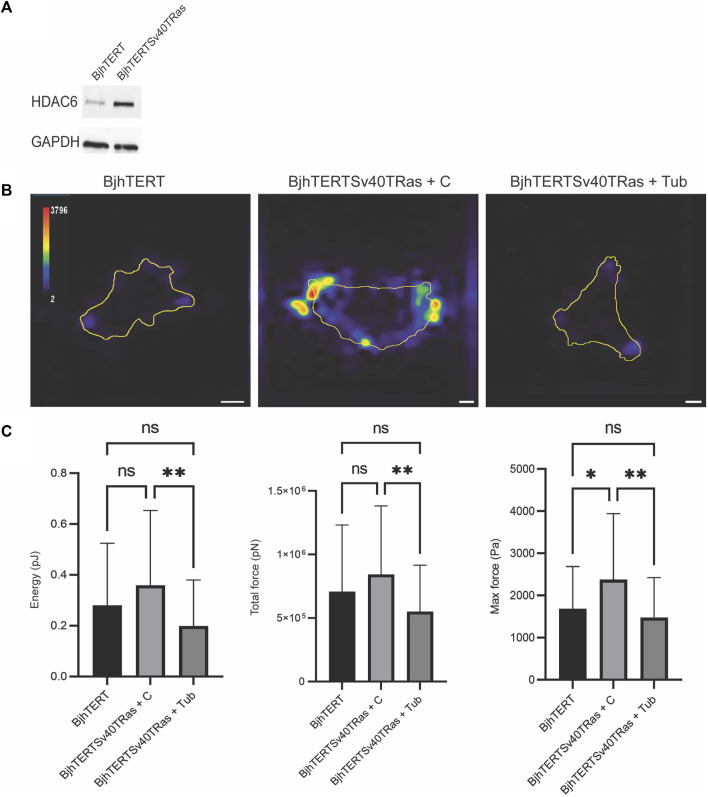
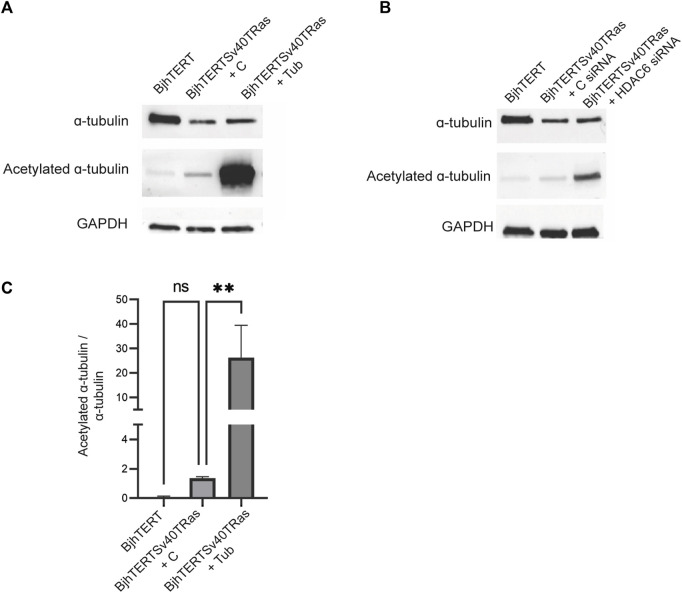
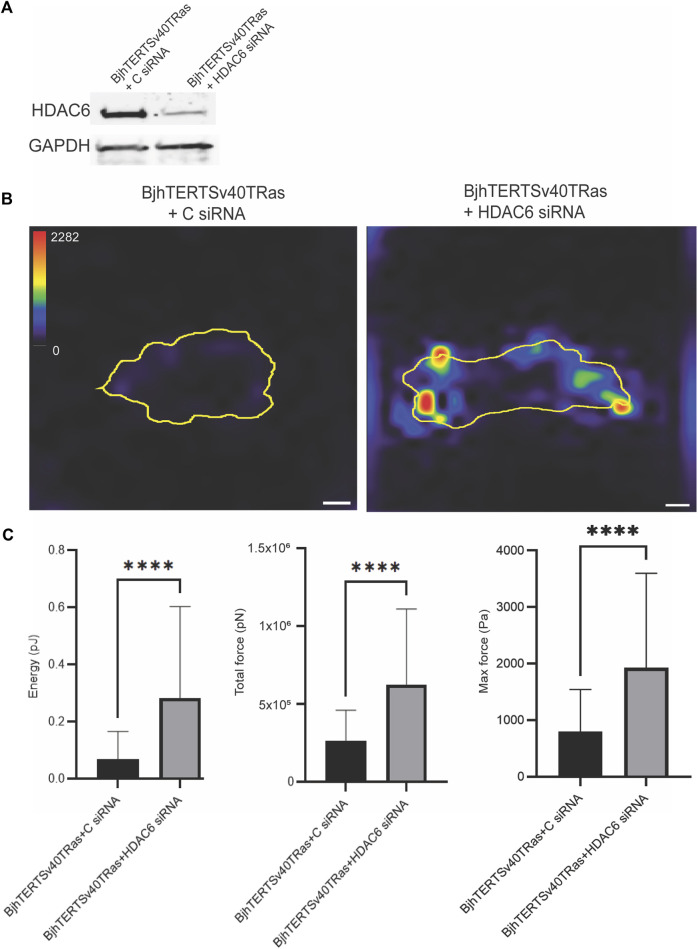
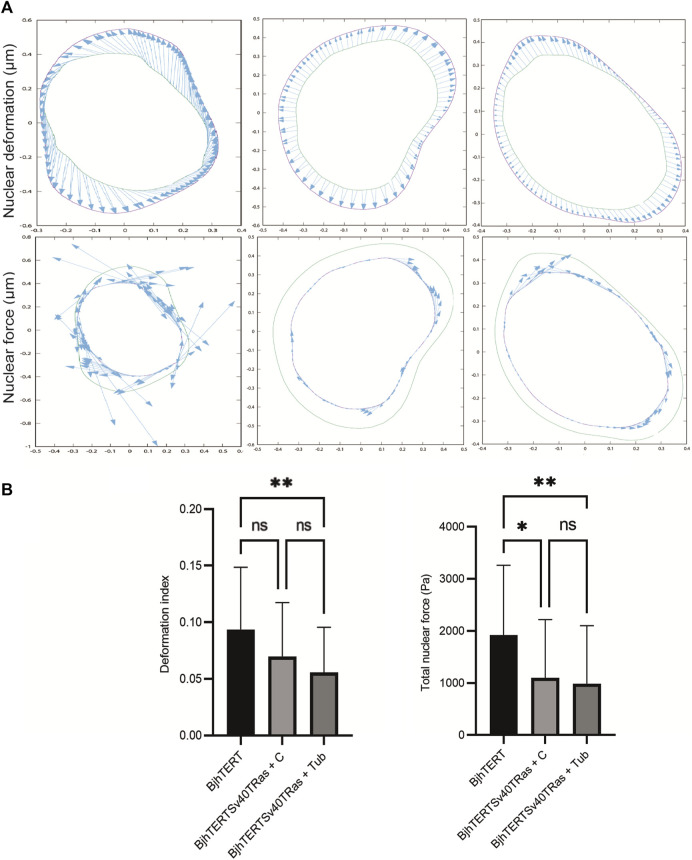
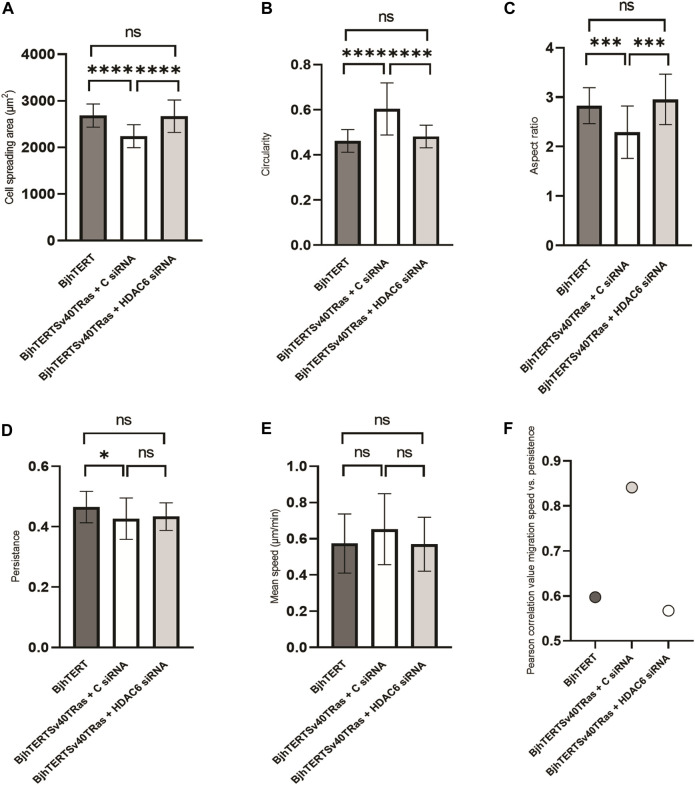
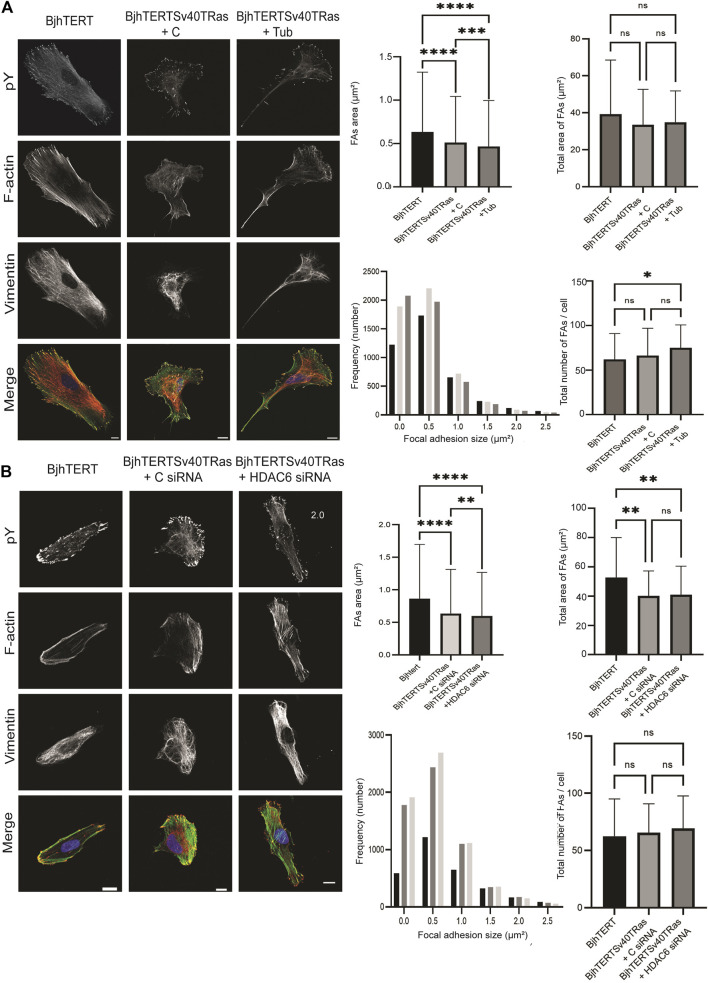
The capacity of cells to adhere to, exert forces upon and migrate through their surrounding environment governs tissue regeneration and cancer metastasis. The role of the physical contractile forces that cells exert in this process, and the underlying molecular mechanisms are not fully understood. We, therefore, aimed to clarify if the extracellular forces that cells exert on their environment and/or the intracellular forces that deform the cell nucleus, and the link between these forces, are defective in transformed and invasive fibroblasts, and to indicate the underlying molecular mechanism of control. Confocal, Epifluorescence and Traction force microscopy, followed by computational analysis, showed an increased maximum contractile force that cells apply on their environment and a decreased intracellular force on the cell nucleus in the invasive fibroblasts, as compared to normal control cells. Loss of HDAC6 activity by tubacin-treatment and siRNA-mediated HDAC6 knockdown also reversed the reduced size and more circular shape and defective migration of the transformed and invasive cells to normal. However, only tubacin-mediated, and not siRNA knockdown reversed the increased force of the invasive cells on their surrounding environment to normal, with no effects on nuclear forces. We observed that the forces on the environment and the nucleus were weakly positively correlated, with the exception of HDAC6 siRNA-treated cells, in which the correlation was weakly negative. The transformed and invasive fibroblasts showed an increased number and smaller cell-matrix adhesions than control, and neither tubacin-treatment, nor HDAC6 knockdown reversed this phenotype to normal, but instead increased it further. This highlights the possibility that the control of contractile force requires separate functions of HDAC6, than the control of cell adhesions, spreading and shape. These data are consistent with the possibility that defective force-transduction from the extracellular environment to the nucleus contributes to metastasis, via a mechanism that depends upon HDAC6. To our knowledge, our findings present the first correlation between the cellular forces that deforms the surrounding environment and the nucleus in fibroblasts, and it expands our understanding of how cells generate contractile forces that contribute to cell invasion and metastasis.
细胞黏附于周围环境、对其施加力并在其中迁移的能力,决定着组织再生和癌症转移。细胞在这一过程中施加的物理收缩力的作用以及潜在的分子机制尚未完全明确。因此,我们旨在阐明细胞施加于周围环境的胞外力和/或使细胞核变形的胞内力,以及这些力之间的联系,在转化型和侵袭性成纤维细胞中是否存在缺陷,并指出其潜在的分子控制机制。共聚焦显微镜、落射荧光显微镜和牵引力显微镜检查,随后进行计算分析,结果显示,与正常对照细胞相比,侵袭性成纤维细胞施加于周围环境的最大收缩力增加,而细胞核上的胞内力降低。用tubacin处理和小干扰RNA(siRNA)介导的组蛋白去乙酰化酶6(HDAC6)基因敲低导致HDAC6活性丧失,也使转化型和侵袭性细胞减小的尺寸、更圆的形状以及有缺陷的迁移恢复正常。然而,只有tubacin介导的处理,而非siRNA基因敲低,使侵袭性细胞对周围环境增加了的力恢复正常,而对核力没有影响。我们观察到,除了HDAC6 siRNA处理的细胞中力的相关性呈弱负相关外,作用于周围环境和细胞核的力呈弱正相关。转化型和侵袭性成纤维细胞与对照相比,细胞 - 基质黏附的数量增加且尺寸更小,tubacin处理和HDAC6基因敲低均未使该表型恢复正常,反而使其进一步增加。这凸显了一种可能性,即与细胞黏附、铺展和形状的控制相比,收缩力的控制需要HDAC6发挥不同的功能。这些数据与以下可能性一致,即从细胞外环境到细胞核的力转导缺陷通过一种依赖于HDAC6的机制促成转移。据我们所知,我们的研究结果首次揭示了成纤维细胞中使周围环境和细胞核变形的细胞力之间的相关性,并拓展了我们对细胞如何产生有助于细胞侵袭和转移的收缩力的理解。