Waechter Christian, Fehse Leon, Welzel Marius, Heider Dominik, Babalija Lek, Cheko Juan, Mueller Julian, Pöling Jochen, Braun Thomas, Pankuweit Sabine, Weihe Eberhard, Kinscherf Ralf, Schieffer Bernhard, Luesebrink Ulrich, Soufi Muhidien, Ruppert Volker
Department of Cardiology, University Hospital Marburg, Philipps University Marburg, Marburg, Germany.
Max Planck Institute for Heart and Lung Research, Bad Nauheim, Germany.
Front Genet. 2023 Jul 26;14:1213829. doi: 10.3389/fgene.2023.1213829. eCollection 2023.
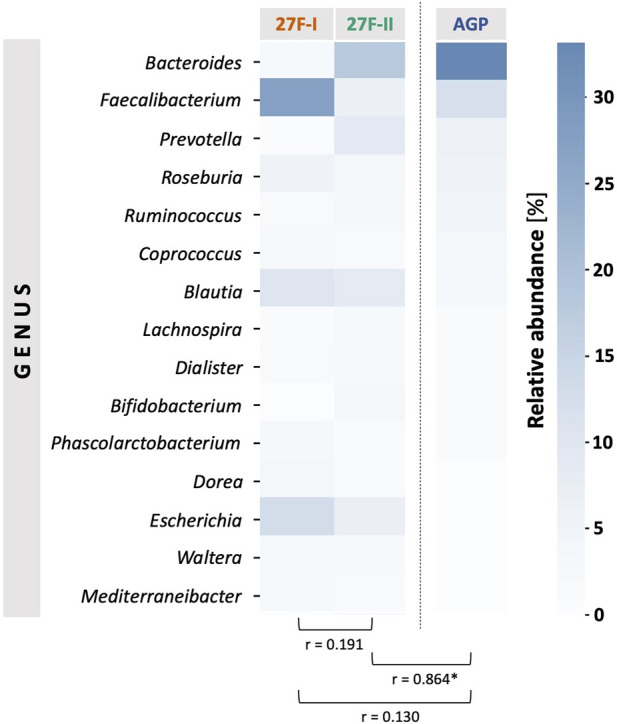
Next-generation sequencing has revolutionized the field of microbiology research and greatly expanded our knowledge of complex bacterial communities. Nanopore sequencing provides distinct advantages, combining cost-effectiveness, ease of use, high throughput, and high taxonomic resolution through its ability to process long amplicons, such as the entire 16s rRNA genome. We examine the performance of the conventional 27F primer (27F-I) included in the 16S Barcoding Kit distributed by Oxford Nanopore Technologies (ONT) and that of a more degenerate 27F primer (27F-II) in the context of highly complex bacterial communities in 73 human fecal samples. The results show striking differences in both taxonomic diversity and relative abundance of a substantial number of taxa between the two primer sets. Primer 27F-I reveals a significantly lower biodiversity and, for example, at the taxonomic level of the phyla, a dominance of and as determined by relative abundances, as well as an unusually high ratio of / when compared to the more degenerate primer set (27F-II). Considering the findings in the context of the gut microbiomes common in Western industrial societies, as reported in the American Gut Project, the more degenerate primer set (27F-II) reflects the composition and diversity of the fecal microbiome significantly better than the 27F-I primer. This study provides a fundamentally relevant comparative analysis of the performance of two primer sets designed for sequencing of the entire 16s rRNA genome and suggests that the more degenerate primer set (27F-II) should be preferred for nanopore sequencing-based analyses of the human fecal microbiome.
新一代测序技术彻底改变了微生物学研究领域,并极大地扩展了我们对复杂细菌群落的认识。纳米孔测序具有独特优势,通过其处理长扩增子(如整个16S rRNA基因组)的能力,兼具成本效益、易于使用、高通量和高分类分辨率。我们研究了牛津纳米孔技术公司(ONT)分发的16S条形码试剂盒中包含的常规27F引物(27F-I)以及更简并的27F引物(27F-II)在73份人类粪便样本中高度复杂细菌群落背景下的性能。结果显示,两组引物在分类多样性和大量分类单元的相对丰度方面存在显著差异。引物27F-I显示出显著更低的生物多样性,例如,在门的分类水平上,根据相对丰度确定, 和 占主导地位,并且与更简并的引物组(27F-II)相比, / 的比例异常高。结合美国肠道项目报告的西方工业社会常见的肠道微生物群的研究结果来看,更简并的引物组(27F-II)比27F-I引物能更好地反映粪便微生物群的组成和多样性。本研究对设计用于整个16S rRNA基因组测序的两组引物的性能进行了具有根本相关性的比较分析,并表明在基于纳米孔测序的人类粪便微生物群分析中,应优先选择更简并的引物组(27F-II)。