Liang Lei, Guo Huadong, Liang Shuang, Li Xichen, Moore John C, Li Xinwu, Cheng Xiao, Wu Wenjin, Liu Yan, Rinke Annette, Jia Gensuo, Pan Feifei, Gong Chen
Key Laboratory of Digital Earth Science, Aerospace Information Research Institute, Chinese Academy of Sciences, Beijing 100094, China.
International Research Center of Big Data for Sustainable Development Goals, Beijing 100094, China.
Natl Sci Rev. 2023 May 27;10(9):nwad157. doi: 10.1093/nsr/nwad157. eCollection 2023 Sep.
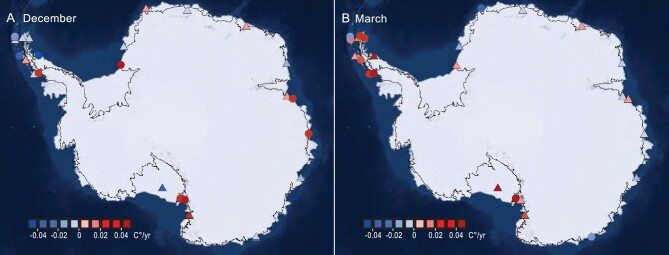
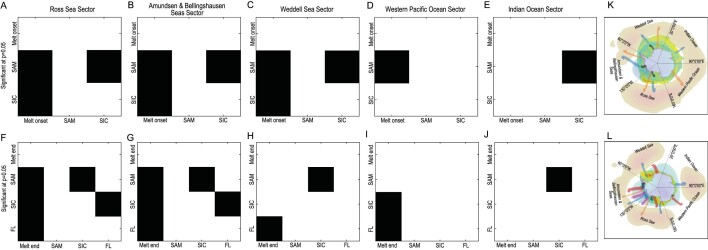
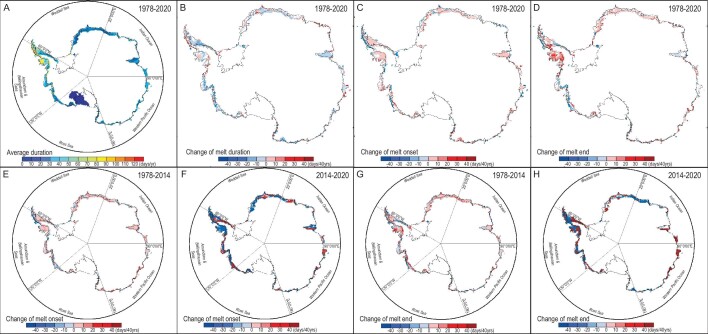
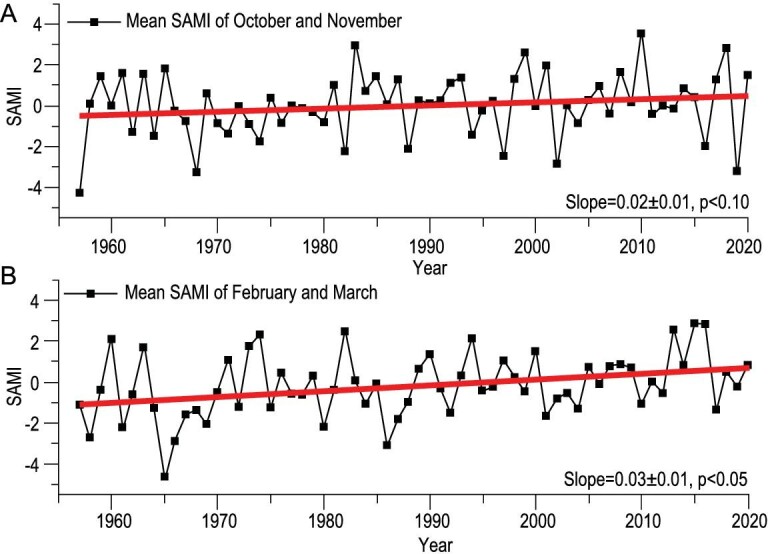
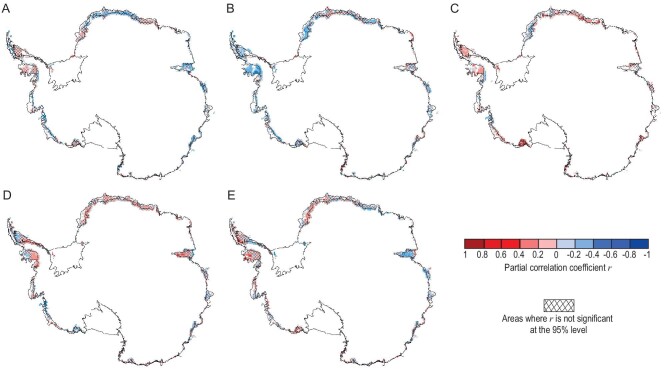
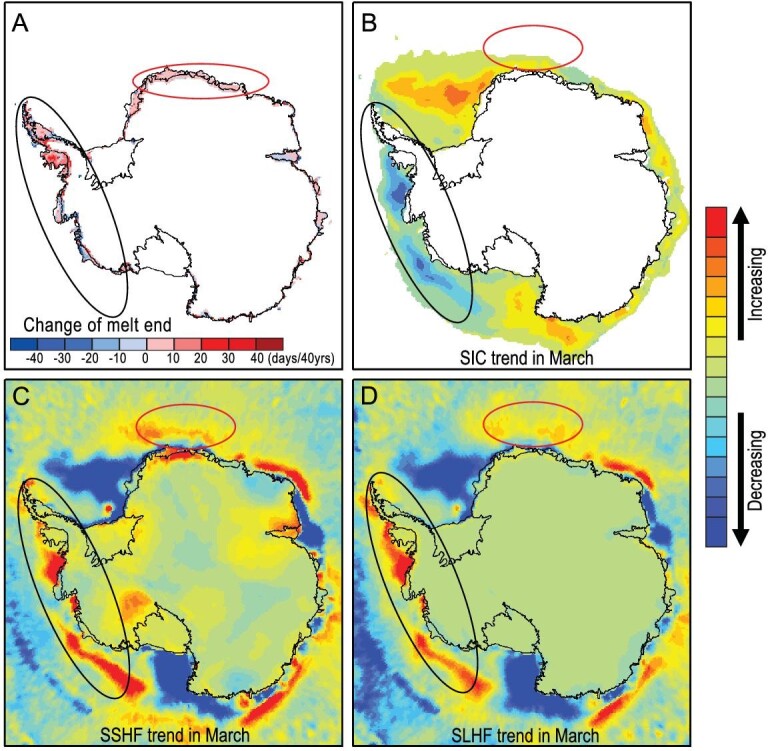
Antarctica's response to climate change varies greatly both spatially and temporally. Surface melting impacts mass balance and also lowers surface albedo. We use a 43-year record (from 1978 to 2020) of Antarctic snow melt seasons from space-borne microwave radiometers with a machine-learning algorithm to show that both the onset and the end of the melt season are being delayed. Granger-causality analysis shows that melt end is delayed due to increased heat flux from the ocean to the atmosphere at minimum sea-ice extent from warming oceans. Melt onset is Granger-caused primarily by the turbulent heat flux from ocean to atmosphere that is in turn driven by sea-ice variability. Delayed snowmelt season leads to a net decrease in the absorption of solar irradiance, as a delayed summer means that higher albedo occurs after the period of maximum solar radiation, which changes Antarctica's radiation balance more than sea-ice cover.
南极洲对气候变化的响应在空间和时间上差异极大。表面融化影响质量平衡,还会降低表面反照率。我们利用43年(1978年至2020年)来自星载微波辐射计的南极融雪季节记录,并结合机器学习算法表明,融雪季节的开始和结束都在推迟。格兰杰因果关系分析表明,在海冰范围处于最小值时,由于海洋向大气的热通量增加(海洋变暖所致),融雪结束被推迟。融雪开始主要由海洋向大气的湍流感热通量格兰杰引起,而后者又由海冰变化驱动。融雪季节推迟导致太阳辐照度吸收净减少,因为夏季推迟意味着在太阳辐射最强期之后出现更高的反照率,这对南极洲辐射平衡的改变大于海冰覆盖的改变。