Department of Psychology and Centre for Cognitive Neuroscience, University of Salzburg, Salzburg, Austria.
Department of Psychology, Johannes Kepler University, Linz, Austria.
Int J Eat Disord. 2023 Nov;56(11):2096-2106. doi: 10.1002/eat.24028. Epub 2023 Aug 10.
Food-cue-reactivity entails neural and experiential responses to the sight and smell of attractive foods. Negative emotions can modulate such cue-reactivity and this might be central to the balance between restrictive versus bulimic symptomatology in Anorexia Nervosa (AN) and Bulimia Nervosa (BN).
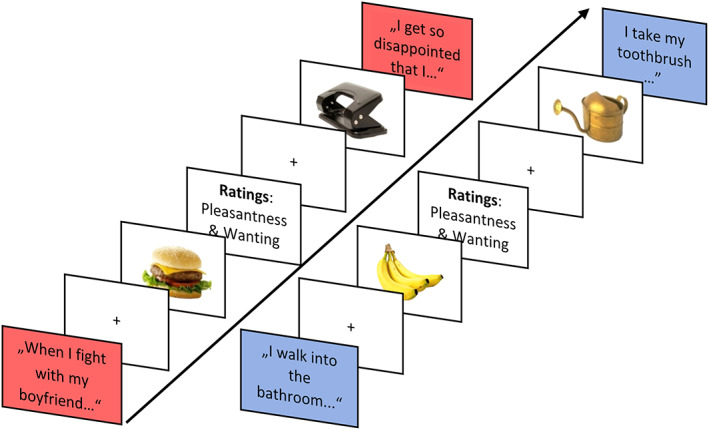
Pleasantness ratings and electrocortical responses to food images were measured in patients with AN (n = 35), BN (n = 32) and matched healthy controls (HC, n = 35) in a neutral state and after idiosyncratic negative emotion induction while electroencephalography (EEG) was recorded. The EEG data were analyzed using a mass testing approach.
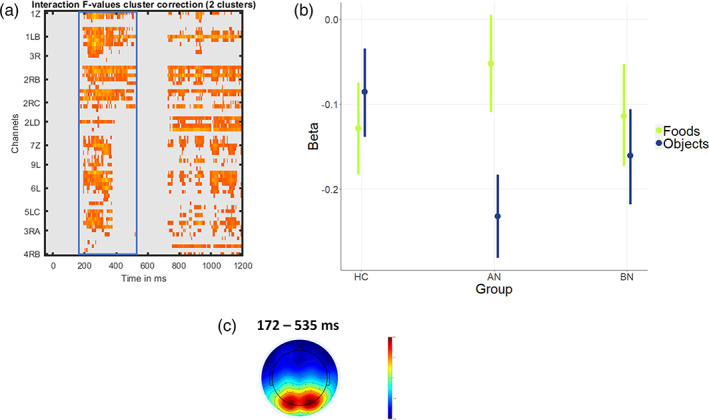
Individuals with AN showed reduced pleasantness for foods compared to objects alongside elevated widespread occipito-central food-object discrimination between 170 and 535 ms, indicative of strong neural cue-reactivity. Food-object discrimination was further increased in the negative emotional condition between 690 and 1200 ms over centroparietal regions. Neither of these effects was seen in individuals with BN.
Emotion modulated food-cue-reactivity in AN might reflect a decreased appetitive response in negative mood. Such specific (emotion-)regulatory strategies require more theoretical work and clinical attention. The absence of any marked effects in BN suggests that emotional cue-reactivity might be less prominent in this group or quite specific to certain emotional contexts or food types.
Negative affectivity is a risk factor for the development of eating disorders and individuals with eating disorders experience problems with emotion regulation. To better understand the effects of negative emotions, the present study investigated how they affected neural correlates of food perception in anorexia nervosa and bulimia nervosa.
食物线索反应是指对有吸引力的食物的视觉和嗅觉产生的神经和体验反应。负性情绪可以调节这种线索反应,这可能是神经性厌食症(AN)和贪食症(BN)中限制症状与暴食症状之间平衡的核心。
在中性状态和个体负性情绪诱导后,使用食物图片测量 AN(n=35)、BN(n=32)和匹配的健康对照组(HC,n=35)的愉悦度评分和脑电反应,同时记录脑电图(EEG)。使用大规模测试方法分析 EEG 数据。
与物体相比,AN 个体对食物的愉悦度降低,170-535ms 期间广泛的枕-中央食物-物体区分增加,表明存在强烈的神经线索反应。在负性情绪条件下,690-1200ms 期间,中-顶叶区域的食物-物体区分进一步增加。这些效应在 BN 个体中均未见。
AN 中情绪调节的食物线索反应可能反映了负性情绪下食欲反应的降低。这种特定的(情绪)调节策略需要更多的理论工作和临床关注。BN 中没有任何明显的影响表明,情绪线索反应在该组中可能不那么突出,或者对某些情绪环境或食物类型较为特定。
负性情感是进食障碍发展的一个风险因素,而进食障碍患者在情绪调节方面存在问题。为了更好地理解负性情绪的影响,本研究调查了负性情绪如何影响神经性厌食症和贪食症的食物感知神经相关。