Institute for Human Neuroscience, Boys Town National Research Hospital, Boys Town, NE, USA; Center for Pediatric Brain Health, Boys Town National Research Hospital, Boys Town, NE, USA.
Institute for Human Neuroscience, Boys Town National Research Hospital, Boys Town, NE, USA.
Dev Cogn Neurosci. 2023 Oct;63:101288. doi: 10.1016/j.dcn.2023.101288. Epub 2023 Aug 6.
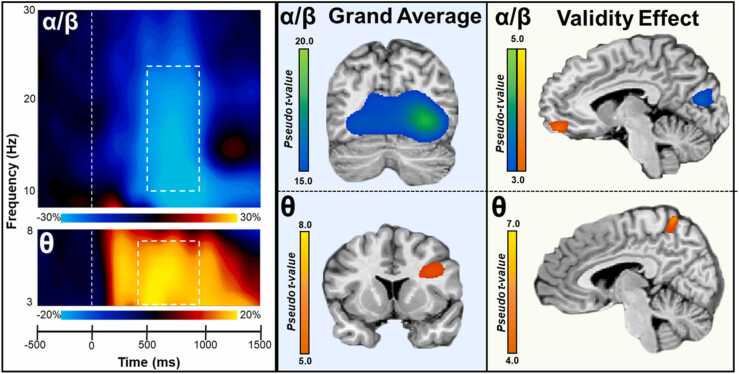
The neural and cognitive processes underlying the flexible allocation of attention undergo a protracted developmental course with changes occurring throughout adolescence. Despite documented age-related improvements in attentional reorienting throughout childhood and adolescence, the neural correlates underlying such changes in reorienting remain unclear. Herein, we used magnetoencephalography (MEG) to examine neural dynamics during a Posner attention-reorienting task in 80 healthy youth (6-14 years old). The MEG data were examined in the time-frequency domain and significant oscillatory responses were imaged in anatomical space. During the reorienting of attention, youth recruited a distributed network of regions in the fronto-parietal network, along with higher-order visual regions within the theta (3-7 Hz) and alpha-beta (10-24 Hz) spectral windows. Beyond the expected developmental improvements in behavioral performance, we found stronger theta oscillatory activity as a function of age across a network of prefrontal brain regions irrespective of condition, as well as more limited age- and validity-related effects for alpha-beta responses. Distinct brain-behavior associations between theta oscillations and attention-related symptomology were also uncovered across a network of brain regions. Taken together, these data are the first to demonstrate developmental effects in the spectrally-specific neural oscillations serving the flexible allocation of attention.
注意灵活分配的神经和认知过程在青春期经历了一个漫长的发展过程,在此过程中会发生变化。尽管有文献记载,儿童期和青春期的注意力重新定向会随着年龄的增长而改善,但重新定向过程中这种变化的神经相关性仍不清楚。在此,我们使用脑磁图(MEG)检查了 80 名健康青少年(6-14 岁)在 Posner 注意力重新定向任务中的神经动力学。MEG 数据在时频域中进行了检查,并在解剖空间中对显著的振荡反应进行了成像。在注意力的重新定向过程中,年轻人在额顶网络中募集了一个分布式的区域网络,以及在 theta(3-7 Hz)和 alpha-beta(10-24 Hz)频谱窗口内的更高阶视觉区域。除了行为表现的预期发展改善之外,我们还发现,无论条件如何,在一个前额叶脑区网络中,theta 振荡活动随年龄的增长而增强,而 alpha-beta 反应的年龄和有效性相关性影响则更为有限。在大脑区域网络中,theta 振荡与注意力相关症状之间也发现了独特的大脑-行为关联。总的来说,这些数据首次证明了在注意力灵活分配中具有特定频谱的神经振荡的发展效应。