Janssen Research & Development, LLC, Titusville, NJ, 08560, USA.
Janssen Global Services, LLC, Titusville, NJ, 08560, USA.
BMC Psychiatry. 2023 Aug 11;23(1):587. doi: 10.1186/s12888-023-05017-y.
Esketamine (ESK) nasal spray, taken with oral antidepressant therapy, is approved for the treatment of depressive symptoms in adults with major depressive disorder (MDD) with acute suicidal ideation or behavior. In pooled analyses of two pivotal phase 3 studies, ASPIRE I and II, remission rates were consistently higher among patients with MDD with active suicidality who were treated with ESK + standard of care (SOC) versus placebo (PBO) + SOC at all time points in the double-blind and most time points in the follow-up phases. The current analysis of the ASPIRE data sets assessed the effect of ESK + SOC versus PBO + SOC on additional remission-related endpoints: time to achieving remission and consistent remission, proportion of patients in remission and consistent remission, and days in remission.
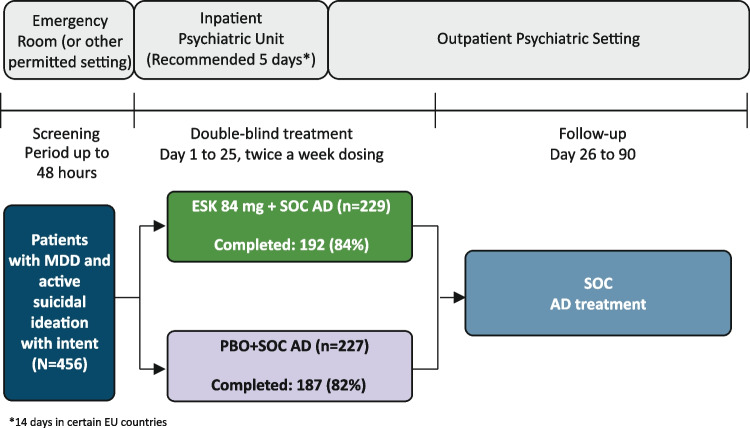
Post hoc analysis of pooled data from ASPIRE I and II (N = 451). Remission and consistent remission were defined as Montgomery-Åsberg Depression Rating Scale (MADRS) total score ≤ 12 at any given visit or two consecutive visits, respectively. Combined endpoints utilizing Clinical Global Impression-Severity of Suicidality-revised version [CGI-SS-r] ≤ 1 (i.e., not suicidal/questionably suicidal) along with the remission and consistent remission definitions (i.e., MADRS total score ≤ 12) were also examined.
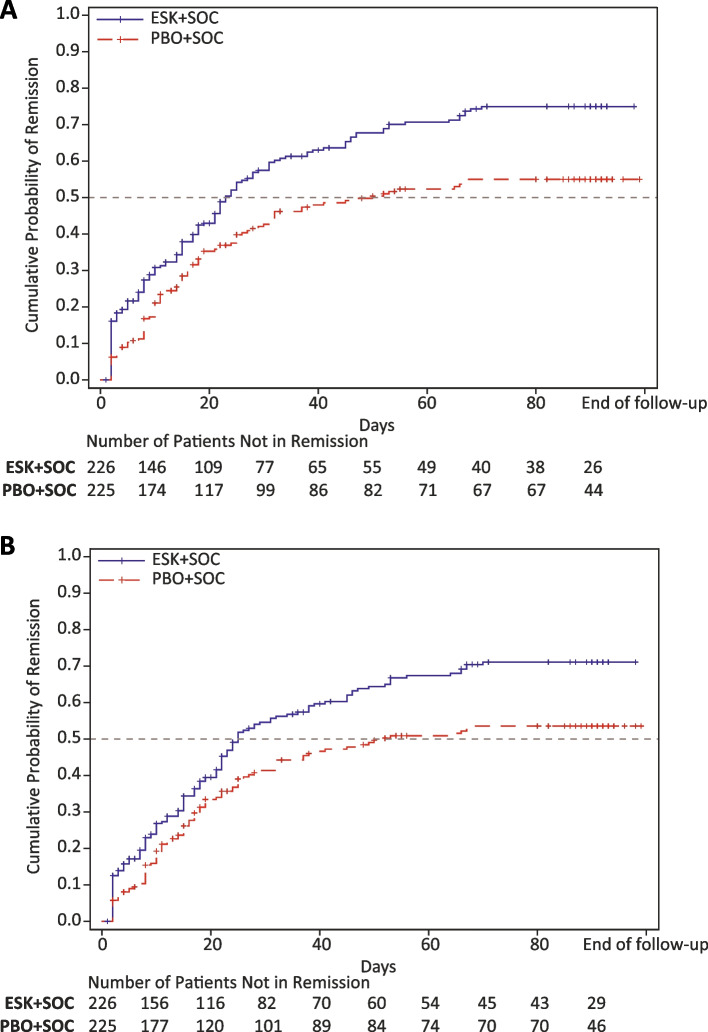
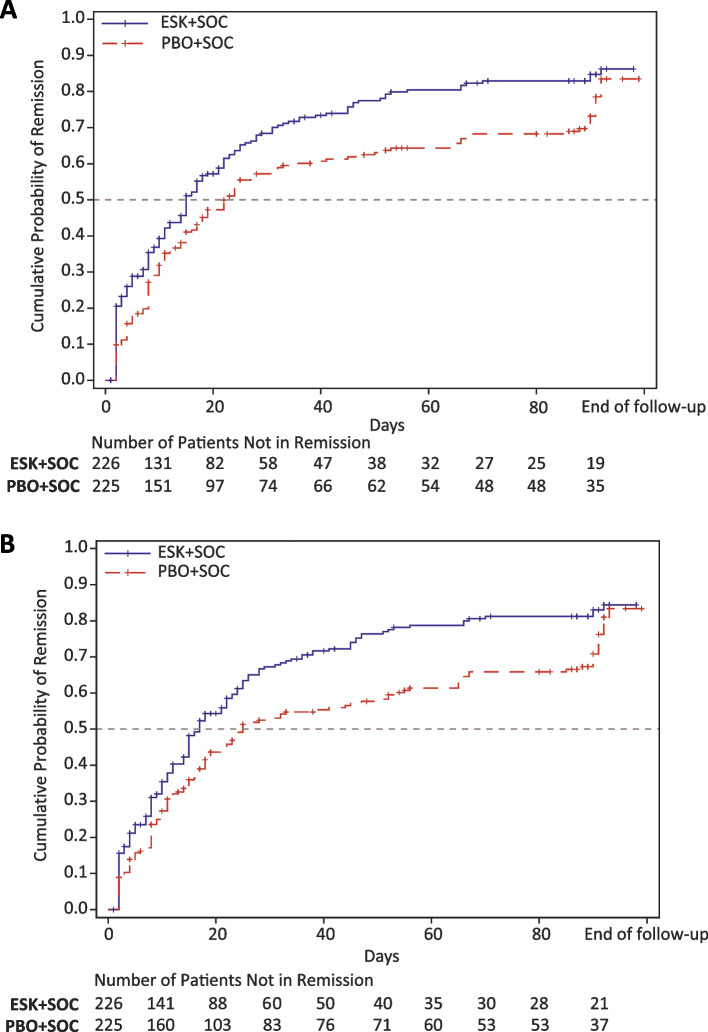
The median times to remission and consistent remission of MDD were significantly shorter in ESK + SOC versus PBO + SOC (15 versus 23 [p = 0.005] and 23 versus 50 days [p = 0.007], respectively) and a greater proportion of patients in ESK + SOC achieved remission and consistent remission by Day 25 (65.2% versus 55.5% and 54.2% versus 39.8%, respectively). Similar results were obtained using the combined endpoint for both remission definitions. The median percent of days in remission during the double-blind treatment phase was significantly greater in ESK + SOC (27.1% or 5 days) versus PBO + SOC (8.3% or 2 days; p = 0.006), and the significant difference was maintained during follow-up.
Treatment with ESK + SOC versus PBO + SOC resulted in significantly shorter time to remission, greater proportion of patients in remission, and greater percent of days in remission using increasingly rigorous definitions of remission. These findings underscore the clinical benefits of ESK for adults with MDD with suicidality.
ClinicalTrials.gov registry NCT03039192 (registered February 1, 2017) and NCT03097133 (registered March 31, 2017).
依他佐辛(ESK)鼻喷雾剂与口服抗抑郁药联合使用,获批用于治疗伴有急性自杀意念或行为的成人重性抑郁障碍(MDD)的抑郁症状。在两项关键性 3 期研究(ASPIRE I 和 II)的汇总分析中,在双盲期和随访期的大多数时间点,与安慰剂(PBO)+标准治疗(SOC)相比,有自杀意念活动的 MDD 患者接受 ESK+SOC 治疗后,缓解率始终更高。当前对 ASPIRE 数据集的分析评估了 ESK+SOC 与 PBO+SOC 对其他缓解相关终点的影响:达到缓解的时间和持续缓解时间、缓解患者和持续缓解患者的比例,以及缓解天数。
ASPIRE I 和 II 汇总数据的事后分析(N=451)。缓解和持续缓解定义为在任何特定就诊时或连续两次就诊时蒙哥马利-阿斯伯格抑郁评定量表(MADRS)总分≤12。还同时检查了采用临床总体印象-自杀严重程度修订版(CGI-SS-r)≤1(即无自杀/可疑自杀)和缓解及持续缓解定义(即 MADRS 总分≤12)的联合终点。
ESK+SOC 与 PBO+SOC 相比,MDD 患者达到缓解和持续缓解的中位时间明显更短(分别为 15 天 vs. 23 天 [p=0.005]和 23 天 vs. 50 天 [p=0.007]),且在第 25 天达到缓解和持续缓解的患者比例也更高(分别为 65.2% vs. 55.5%和 54.2% vs. 39.8%)。对于这两种缓解定义的联合终点,也获得了相似的结果。在双盲治疗阶段,ESK+SOC 中缓解的中位天数比例明显更高(27.1%或 5 天),而 PBO+SOC 为 8.3%或 2 天(p=0.006),且这一差异在随访期间保持不变。
与 PBO+SOC 相比,ESK+SOC 治疗可显著缩短缓解时间,使更多患者达到缓解,并且使用越来越严格的缓解定义,使缓解的天数比例更高。这些发现强调了依他佐辛对有自杀意念的 MDD 成人患者的临床获益。
ClinicalTrials.gov 注册号 NCT03039192(2017 年 2 月 1 日注册)和 NCT03097133(2017 年 3 月 31 日注册)。