Department of Medicine Solna, Karolinska Institutet, Stockholm, Sweden.
Department of Clinical Physiology, Karolinska Institutet, Stockholm, Sweden.
Cardiovasc Diabetol. 2023 Aug 11;22(1):208. doi: 10.1186/s12933-023-01950-0.
Empagliflozin reduces the risk of cardiovascular disease (CVD) in patients with type 2 diabetes (T2DM) and high cardiovascular risk via mechanisms which have not been fully explained. The mechanisms of such benefit have not been fully understood, and whether empagliflozin can be safely administered as first-line treatment in patients with CVD at the initial stages of glycaemic perturbations remains to be established. We investigated the effects of empagliflozin on insulin resistance, insulin sensitivity and β-cell function indexes in patients with a recent acute coronary event and newly detected dysglycaemia, i.e., impaired glucose tolerance (IGT) or T2DM.
Forty-two patients (mean age 67.5 years, 19% females) with a recent myocardial infarction (n = 36) or unstable angina (n = 6) and newly detected dysglycaemia were randomized to either empagliflozin 25 mg daily (n = 20) or placebo (n = 22). Patients were investigated with stress-perfusion cardiac magnetic resonance imaging before randomization, 7 months after the start of study drug and 3 months following its cessation. Indexes of insulin resistance, sensitivity and β-cell function were calculated based on glucose and insulin values from 2-hour oral glucose tolerance tests (OGTT) and fasting C-peptide. The differences in glucose, insulin, C-peptide, mannose levels and indexes between the two groups were computed by repeated measures ANOVA including an interaction term between the treatment allocation and the time of visit.
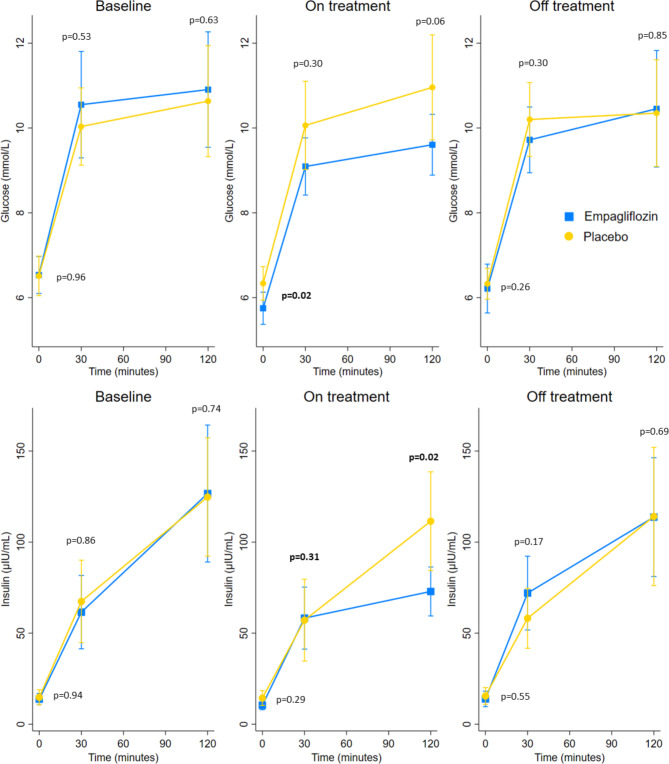
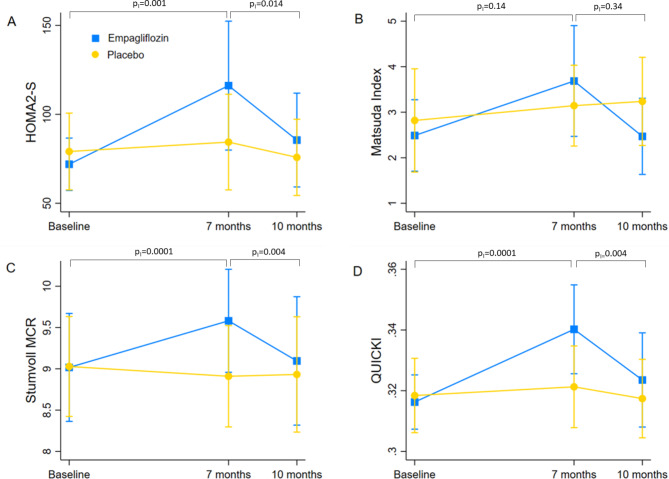
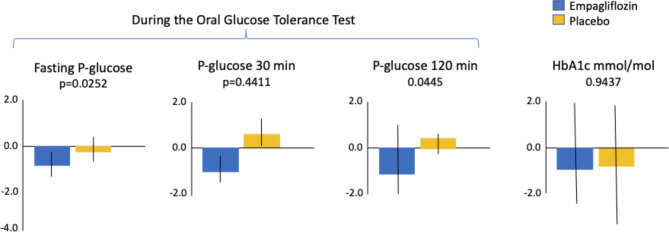
After 7 months, empagliflozin significantly decreased glucose and insulin values during the OGTT, whereas C-peptide, mannose and HbA1c did not differ. Empagliflozin significantly improved insulin sensitivity indexes but did not impact insulin resistance and β-cell function. After cessation of the drug, all indexes returned to initial levels. Insulin sensitivity indexes were inversely correlated with left ventricular mass at baseline.
Empagliflozin improved insulin sensitivity indexes in patients with a recent coronary event and drug naïve dysglycaemia. These findings support the safe use of empagliflozin as first-line glucose-lowering treatment in patients at very high cardiovascular risk with newly diagnosed dysglycaemia.
EudraCT number 2015-004571-73.
恩格列净可通过尚未完全阐明的机制降低 2 型糖尿病(T2DM)合并高心血管风险患者的心血管疾病(CVD)风险。但该药的获益机制尚未完全明确,对于刚发生血糖紊乱(即糖耐量受损[IGT]或 T2DM)、且处于心血管疾病早期的患者,恩格列净能否安全地作为一线治疗药物,仍有待明确。本研究旨在探讨恩格列净对近期发生急性冠状动脉事件且新诊断为血糖异常(即糖耐量受损[IGT]或 2 型糖尿病)患者的胰岛素抵抗、胰岛素敏感性和胰岛β细胞功能指标的影响。
42 例(平均年龄 67.5 岁,19%为女性)近期发生心肌梗死(n=36)或不稳定型心绞痛(n=6)且新诊断为血糖异常的患者被随机分为恩格列净 25mg/d 组(n=20)或安慰剂组(n=22)。所有患者在随机分组前、研究药物起始后 7 个月及停药后 3 个月接受应激灌注心脏磁共振成像检查。通过 2 小时口服葡萄糖耐量试验(OGTT)和空腹 C 肽计算胰岛素抵抗、敏感性和胰岛β细胞功能指标。采用重复测量方差分析比较两组间的葡萄糖、胰岛素、C 肽、甘露糖水平及指标的差异,其中包括治疗分配与就诊时间的交互项。
7 个月后,恩格列净显著降低了 OGTT 期间的血糖和胰岛素值,而 C 肽、甘露糖和糖化血红蛋白(HbA1c)无差异。恩格列净显著改善了胰岛素敏感性指标,但未影响胰岛素抵抗和胰岛β细胞功能。停药后,所有指标均恢复至初始水平。胰岛素敏感性指标与基线时的左心室质量呈负相关。
恩格列净改善了近期发生冠状动脉事件且无药物治疗史的血糖异常患者的胰岛素敏感性指标。这些发现支持将恩格列净作为高心血管风险且新诊断为血糖异常患者的一线降糖治疗药物安全使用。
EudraCT 编号 2015-004571-73。