Alabduljabbar Khaled, Alkhalifah Mohammed, Aldheshe Abdulaziz, Shihah Abdulelah Bin, Abu-Zaid Ahmed, DeVol Edward B, Albedah Norah, Aldakhil Haifa, Alzayed Balqees, Mahmoud Ahmed, Alkhenizan Abdullah
Department of Family Medicine & Polyclinics, King Faisal Specialist Hospital and Research Centre, Riyadh 11211, Saudi Arabia.
College of Medicine, Alfaisal University, Riyadh 11533, Saudi Arabia.
J Clin Med. 2023 Aug 4;12(15):5115. doi: 10.3390/jcm12155115.
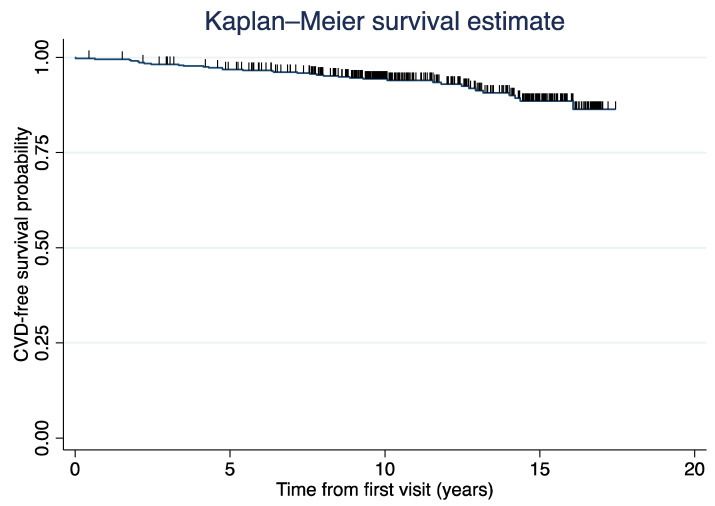
Saudi Arabia has an alarmingly high incidence of cardiovascular disease (CVD) and its associated risk factors. To effectively assess CVD risk, it is essential to develop tailored models for diverse regions and ethnicities using local population variables. No CVD risk prediction model has been locally developed. This study aims to develop the first 10-year CVD risk prediction model for Saudi adults aged 18 to 75 years. The electronic health records of Saudi male and female patients aged 18 to 75 years, who were seen in primary care settings between 2002 and 2019, were reviewed retrospectively via the Integrated Clinical Information System (ICIS) database (from January 2002 to February 2019). The Cox regression model was used to identify the risk factors and develop the CVD risk prediction model. Overall, 451 patients were included in this study, with a mean follow-up of 12.05 years. Thirty-five (7.7%) patients developed a CVD event. The following risk factors were included: fasting blood sugar (FBS) and high-density lipoprotein cholesterol (HDL-c), heart failure, antihyperlipidemic therapy, antithrombotic therapy, and antihypertension therapy. The Bayesian information criterion (BIC) score was 314.4. This is the first prediction model developed in Saudi Arabia and the second in any Arab country after the Omani study. We assume that our CVD predication model will have the potential to be used widely after the validation study.
沙特阿拉伯心血管疾病(CVD)及其相关风险因素的发病率高得惊人。为了有效评估心血管疾病风险,利用当地人群变量为不同地区和种族开发量身定制的模型至关重要。目前尚未在当地开发出心血管疾病风险预测模型。本研究旨在为18至75岁的沙特成年人开发首个10年心血管疾病风险预测模型。通过综合临床信息系统(ICIS)数据库(从2002年1月至2019年2月)对2002年至2019年期间在初级保健机构就诊的18至75岁沙特男性和女性患者的电子健康记录进行回顾性审查。采用Cox回归模型识别风险因素并开发心血管疾病风险预测模型。本研究共纳入451例患者,平均随访12.05年。35例(7.7%)患者发生心血管疾病事件。纳入的风险因素包括:空腹血糖(FBS)、高密度脂蛋白胆固醇(HDL-c)、心力衰竭、抗血脂治疗、抗血栓治疗和抗高血压治疗。贝叶斯信息准则(BIC)评分为314.4。这是沙特阿拉伯开发的首个预测模型,也是继阿曼研究之后阿拉伯国家的第二个此类模型。我们认为,经过验证研究后,我们的心血管疾病预测模型有潜力得到广泛应用。