Maternal and Fetal Medicine Unit, Department of Obstetrics and Gynecology, Bnai-Zion University Medical Center, Haifa 3498838, Israel.
Department of Statistics, Tel Hai Academic College, Tel Hai 122103, Israel.
Int J Mol Sci. 2023 Jul 27;24(15):12051. doi: 10.3390/ijms241512051.
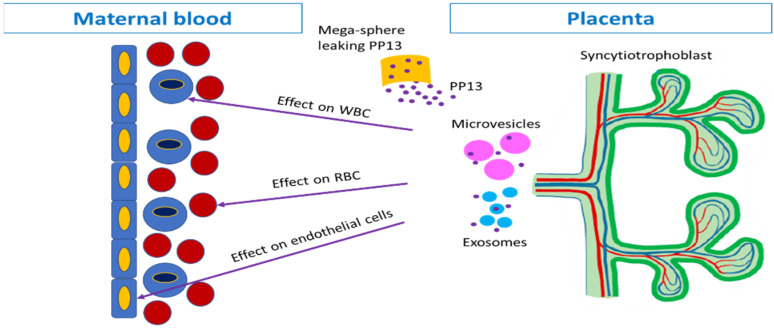
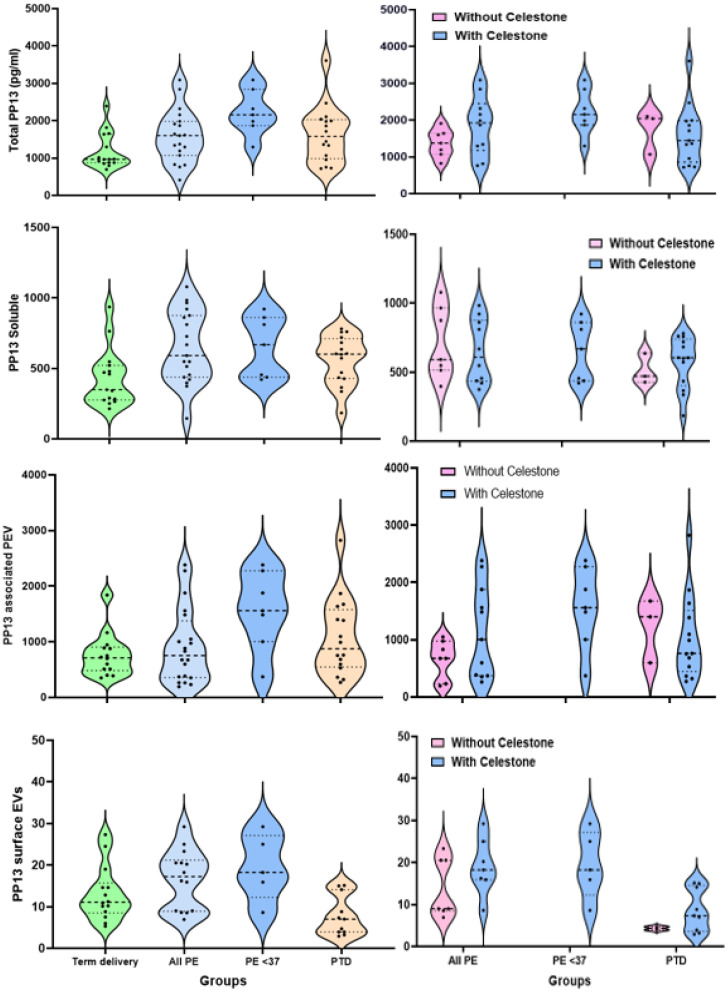
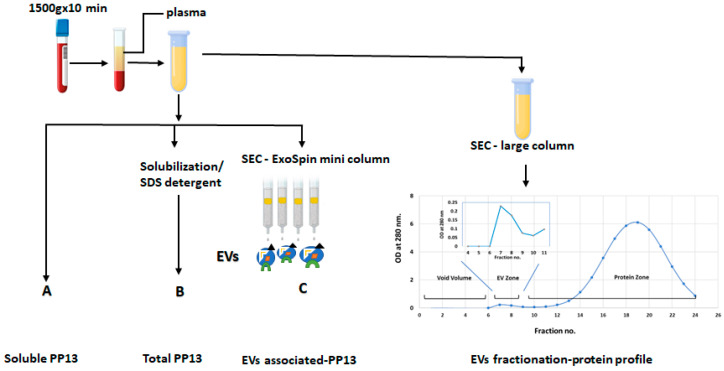
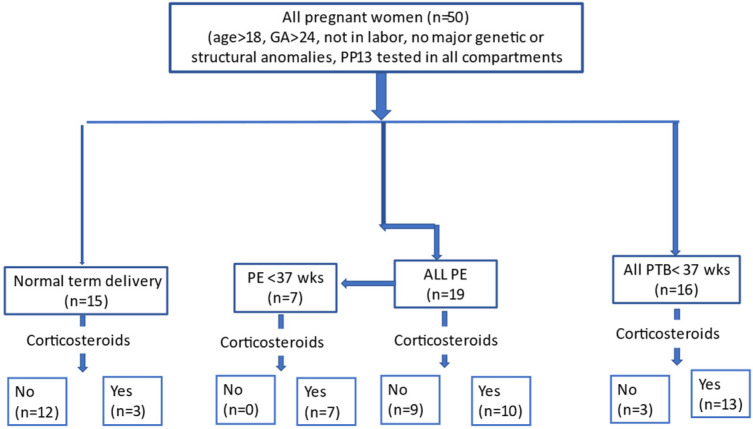
Placental protein 13 (PP13) is a regulatory protein involved in remodeling the vascular system of the pregnancy and extending the immune tolerance of the mother to the growing fetus. PP13 is localized on the surface of the syncytiotrophoblast. An ex vivo placental model shows that the PP13 is released via placental-associated extracellular vesicles (PEVs) to the maternal uterine vein. This exploratory study aimed to determine PEV-associated PP13 in the maternal circulation as compared to the known soluble fraction since each has a specific communication pathway. Patients admitted to Bnai Zion Medical Center for delivery were recruited, and included 19 preeclampsia (PE) patients (7 preterm PE gestational age < 37 weeks' gestation), 16 preterm delivery (PTD, delivery at GA < 37 weeks' gestation), and 15 matched term delivery controls. Treatment by corticosteroids (Celestone), which is often given to patients with suspected preterm PE and PTD, was recorded. The PEV proteome was purified from the patients' plasma by size exclusion chromatography (SEC) to separate the soluble and PEV-associated PP13. The total level of PP13 (soluble and PEV-associated) was determined using mild detergent that depleted the PEV proteome. PP13 fractions were determined by ELISA with PP13 specific antibodies. ELISA with alkaline phosphatase (PLAP)- and cluster differentiation 63 (CD63)-specific antibodies served to verify the placental origin of the PEVs. SPSS was used for statistical analysis. The patients' medical, pregnancy, and delivery records in all groups were similar except, as expected, that a larger number of PE and PTD patients had smaller babies who were delivered earlier, and the PE patients had hypertension and proteinuria. The SEC analysis detected the presence of PP13 in the cargo of the PEVs and on their surface, in addition to the known soluble fraction. The median soluble PP13 was not significantly different across the PE, PTD, and term delivery control groups. However, after depleting the PEV of their proteome, the total PP13 (soluble and PEV-associated) was augmented in the cases of preterm PE, reaching 2153 pg/mL [IQR 1866-2838] but not in cases of PTD reaching 1576 pg/mL [1011-2014] or term delivery groups reaching 964 pg/mL [875-1636]), < 0.01. On the surface of the circulating PEV from PTD patients, there was a decrease in PP13. Corticosteroid treatment was accompanied by a massive depletion of PP13 from the PEV, especially in preterm PE patients. This exploratory study is, thus, the first to determine PEV-associated PP13 in maternal circulation, providing a quantitative determination of the soluble and the PEV-associated fractions, and it shows that the latter is the larger. We found an increase in the amount of PP13 carried via the PEV-associated pathway in PE and PTD patients compared to term delivery cases, which was further augmented when the patients were treated with corticosteroids, especially in preterm PE. The signal conveyed by this novel communication pathway warrants further research to investigate these two differential pathways for the liberation of PP13.
胎盘蛋白 13(PP13)是一种参与重塑妊娠血管系统并延长母体对胎儿免疫耐受的调节蛋白。PP13 位于合体滋养层的表面。体外胎盘模型显示,PP13 通过胎盘相关细胞外囊泡(PEV)释放到母体子宫静脉中。本探索性研究旨在确定母体循环中的 PEV 相关 PP13 与已知可溶性部分的区别,因为它们各自具有特定的通讯途径。招募了因分娩而入住 Bnai Zion 医学中心的患者,并纳入了 19 例先兆子痫(PE)患者(7 例早产 PE 孕龄<37 周)、16 例早产分娩(PTD,分娩时 GA<37 周)和 15 例匹配的足月分娩对照组。记录了疑似早产 PE 和 PTD 患者常接受的皮质类固醇(Celestone)治疗情况。通过大小排阻色谱法(SEC)从患者血浆中纯化 PEV 蛋白质组,以分离可溶性和 PEV 相关的 PP13。使用温和的去污剂测定总 PP13(可溶性和 PEV 相关)水平,该去污剂耗尽了 PEV 蛋白质组。通过具有 PP13 特异性抗体的 ELISA 测定 PP13 分数。碱性磷酸酶(PLAP)和簇分化 63(CD63)特异性抗体的 ELISA 用于验证 PEV 的胎盘来源。使用 SPSS 进行统计分析。除了预期的 PE 和 PTD 患者的婴儿更小、更早分娩以及 PE 患者的高血压和蛋白尿外,所有组的患者的医疗、妊娠和分娩记录相似。SEC 分析检测到 PP13 存在于 PEV 的货物中和其表面,以及已知的可溶性部分。PE、PTD 和足月分娩对照组之间可溶性 PP13 的中位数没有显著差异。然而,在用去污剂耗尽 PEV 的蛋白质组后,总 PP13(可溶性和 PEV 相关)在早产 PE 病例中增加,达到 2153 pg/mL [IQR 1866-2838],但在 PTD 病例中未增加,达到 1576 pg/mL [1011-2014]或足月分娩组达到 964 pg/mL [875-1636]),<0.01。在 PTD 患者的循环 PEV 表面,PP13 减少。皮质类固醇治疗伴随着 PP13 从 PEV 大量耗竭,尤其是在早产 PE 患者中。因此,这项探索性研究首次确定了母体循环中的 PEV 相关 PP13,提供了对可溶性和 PEV 相关分数的定量测定,并表明后者更大。我们发现 PE 和 PTD 患者通过 PEV 相关途径携带的 PP13 数量增加,与足月分娩病例相比,接受皮质类固醇治疗的患者,尤其是早产 PE 患者,这一数量进一步增加。这种新型通讯途径所传递的信号值得进一步研究,以调查这两种释放 PP13 的差异途径。