Sińska Beata I, Kucharska Alicja, Panczyk Mariusz, Matejko Bartłomiej, Traczyk Iwona, Harton Anna, Jaworski Mariusz
Department of Human Nutrition, Faculty of Health Sciences, Medical University of Warsaw, 27 Erazma Ciołka Street, 01-445 Warsaw, Poland.
Department of Education and Research in Health, Faculty of Health Sciences, Medical University of Warsaw, 61 Żwirki i Wigury Street, 02-091 Warsaw, Poland.
Healthcare (Basel). 2023 Aug 2;11(15):2185. doi: 10.3390/healthcare11152185.
A large percentage of people with type 1 diabetes experience stigma, which may directly affect diabetes management. Moreover, it may adversely influence the acceptance of the disease and, thus, the treatment process, including compliance with medical and dietary recommendations. Therefore, it is important to seek adequate forms of counteracting the phenomenon of stigmatization. Thus, the aim of the study was to determine the factors influencing the level of perceived stigma by T1D patients, with particular emphasis on sociodemographic factors (including sex, place of residence, and education) and clinical factors related to the course of the disease.
An observational cross-sectional online questionnaire was conducted in a group of 339 people with T1D. The link to the questionnaire was shared via social media. The DSAS-1 questionnaire translated into Polish was used as the research tool.
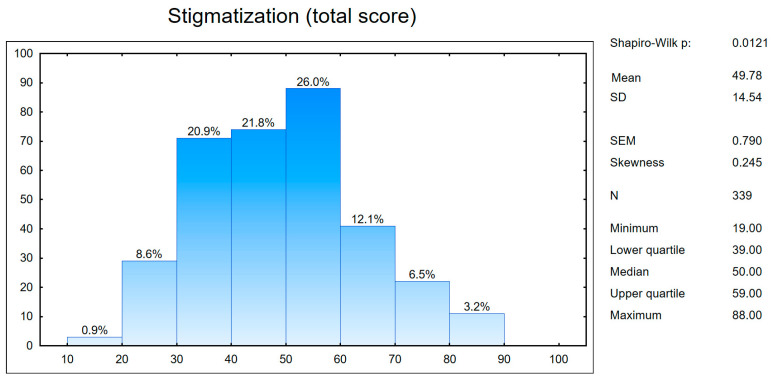
A moderate level of stigmatization was found (49.78 ± 14.54 points). It was significantly lower in people living in small towns compared to rural residents (ß = -0.121, = 0.038), lower in people in relationships compared to those who are single (ß = -0.175, = 0.001), in people diagnosed with T1D at an older age (ß = -0.107, = 0.048), and in those who rated their financial situation as very good vs. bad (ß = -0.314, < 0.001). It was also found that the level of stigma significantly decreased with age (ß = -0.181, = 0.001). In addition, a significantly higher stigma perception was uncovered in the group of people with HbA1C > 7% than in the group ≤ 7% (ß = 0.118, = 0.030).
Due to the occurrence of stigma among people with T1D, which can directly affect the management of diabetes, effective and comprehensive efforts should be made to provide support to people with diabetes. It is also necessary to raise awareness among the general public and disseminate knowledge about diabetes, which can reduce stigmatization as a result. Anti-stigma messages should be included in the prevention programs about the potential side effects and risks associated with mistreating people with T1D.
很大一部分1型糖尿病患者遭受耻辱感,这可能直接影响糖尿病的管理。此外,它可能对疾病的接受度产生不利影响,进而影响治疗过程,包括对医疗和饮食建议的依从性。因此,寻找应对耻辱化现象的适当形式很重要。因此,本研究的目的是确定影响1型糖尿病患者感知耻辱水平的因素,特别强调社会人口学因素(包括性别、居住地点和教育程度)以及与疾病进程相关的临床因素。
对339名1型糖尿病患者进行了一项观察性横断面在线问卷调查。问卷链接通过社交媒体分享。翻译成波兰语的DSAS-1问卷用作研究工具。
发现耻辱感处于中等水平(49.78±14.54分)。与农村居民相比,生活在小镇的人的耻辱感明显更低(β=-0.121,P=0.038);与单身者相比,处于恋爱关系中的人的耻辱感更低(β=-0.175,P=0.001);诊断为1型糖尿病时年龄较大的人的耻辱感更低(β=-0.107,P=0.048);认为自己经济状况非常好与差的人的耻辱感相比,前者更低(β=-0.314,P<0.001)。还发现耻辱感水平随年龄显著降低(β=-0.181,P=0.001)。此外,糖化血红蛋白>7%的人群的耻辱感认知明显高于糖化血红蛋白≤7%的人群(β=0.118,P=0.030)。
由于1型糖尿病患者中存在耻辱感,这可能直接影响糖尿病的管理,因此应做出有效和全面的努力为糖尿病患者提供支持。提高公众意识并传播有关糖尿病的知识也很有必要,这可以减少耻辱感。关于虐待1型糖尿病患者的潜在副作用和风险的预防计划中应纳入反耻辱信息。