Pregi Emese, Romsics Imre, Várdai Róbert, Pukánszky Béla
Laboratory of Plastics and Rubber Technology, Department of Physical Chemistry and Materials Science, Faculty of Chemical Technology and Biotechnology, Budapest University of Technology and Economics, Műegyetem rkp. 3, H-1111 Budapest, Hungary.
Institute of Materials and Environmental Chemistry, Research Centre for Natural Sciences, Magyar Tudósok Körútja 2, H-1117 Budapest, Hungary.
Polymers (Basel). 2023 Jul 29;15(15):3237. doi: 10.3390/polym15153237.
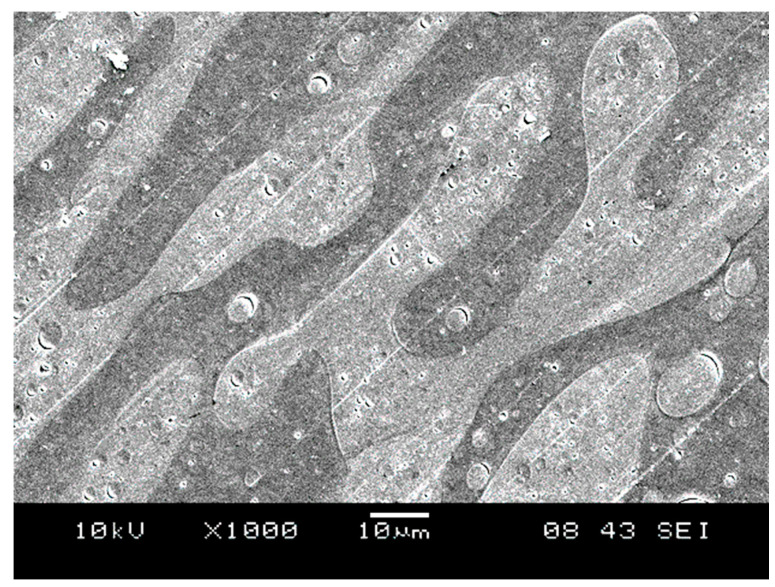
Poly(butylene adipate-co-terephthalate) (PBAT) was added to poly(lactic acid) (PLA)/lignin blends to decrease the considerable stiffness and brittleness of the blends. Two- and three-component blends were prepared in a wide composition range through homogenization in an internal mixer followed by compression molding. Interactions among the components were estimated by comparing the solubility parameters of the materials used and through thermal analysis. Mechanical properties were characterized by tensile testing. The structure of the blends was studied using scanning electron (SEM) and digital optical (DOM) microscopy. The results showed that the interactions between PBAT and lignin are somewhat stronger than those between PLA and the other two components. The maleic anhydride grafted PLA added as a coupling agent proved completely ineffective; it does not modify the interactions. The structural analysis confirmed the immiscibility of the components; the structure of the blends was heterogeneous at each composition. A dispersed structure formed when the concentration of one of the components was small, while, depending on lignin content, an interpenetrating network-like structure developed and phase inversion took place in the range of 30-60 vol% PBAT content. Lignin was located mainly in the PBAT phase. Properties were determined by the relative amount of PBAT and PLA; the addition of lignin deteriorated properties, mainly the deformability of the blends. Other means, such as reactive processing, must be used to improve compatibility and blend properties. The results contribute considerably to a better understanding of structure-property correlations in lignin-based hybrid blends.
将聚(己二酸丁二醇酯 - 对苯二甲酸丁二醇酯)(PBAT)添加到聚乳酸(PLA)/木质素共混物中,以降低共混物相当大的硬度和脆性。通过在密炼机中均质化然后压缩成型,在较宽的组成范围内制备了二元和三元共混物。通过比较所用材料的溶解度参数并通过热分析来估计各组分之间的相互作用。通过拉伸试验表征机械性能。使用扫描电子显微镜(SEM)和数字光学显微镜(DOM)研究共混物的结构。结果表明,PBAT与木质素之间的相互作用比PLA与其他两种组分之间的相互作用稍强。作为偶联剂添加的马来酸酐接枝PLA被证明完全无效;它不会改变相互作用。结构分析证实了各组分的不相容性;共混物的结构在每种组成下都是不均匀的。当其中一种组分的浓度较低时形成分散结构,而根据木质素含量,在PBAT含量为30 - 60体积%的范围内会形成互穿网络状结构并发生相转变。木质素主要位于PBAT相中。性能由PBAT和PLA的相对含量决定;木质素的添加会使性能变差,主要是共混物的可变形性。必须使用其他方法,如反应加工,来改善相容性和共混物性能。这些结果对更好地理解木质素基杂化共混物中的结构 - 性能关系有很大贡献。