Meng Chunyan, Li Taolin, Wang Jing
Department of Public Curriculum, Zigong Vocational and Technical College, Sichuan, China.
Key Laboratory of Applied Psychology, Chongqing Normal University, Chongqing, China.
Front Neurosci. 2023 Jul 28;17:1218595. doi: 10.3389/fnins.2023.1218595. eCollection 2023.
Similar attention patterns have been found in individuals with autism spectrum disorder (ASD) and autistic traits (ATs). The Intense World Theory and previous studies suggest that individuals with ASD may demonstrate a vigilance-avoidance attention pattern toward emotional faces. However, the attention patterns in individuals with ATs remain unclear. Therefore, this study employs eye-tracking technology to examine the characteristics and temporal course of attention bias toward emotional faces in individuals with ATs.
The Autism-spectrum Quotient (AQ) was used to evaluate the level of ATs among 2,502 college students. A total of 50 participants were selected from the 2,502 college students: 25 high-AQ group participants were randomly selected from the 10% of individuals with the highest AQ scores. Similarly, 25 low-AQ group participants were randomly selected from the 10% of participants with the lowest AQ scores. All selected participants completed an eye-tracking study while performing a dot-probe task with emotional faces (positive-neutral, negative-neutral, and negative-positive). By analyzing data from different time periods, the attention bias and time course of individuals with ATs toward emotional faces were investigated.
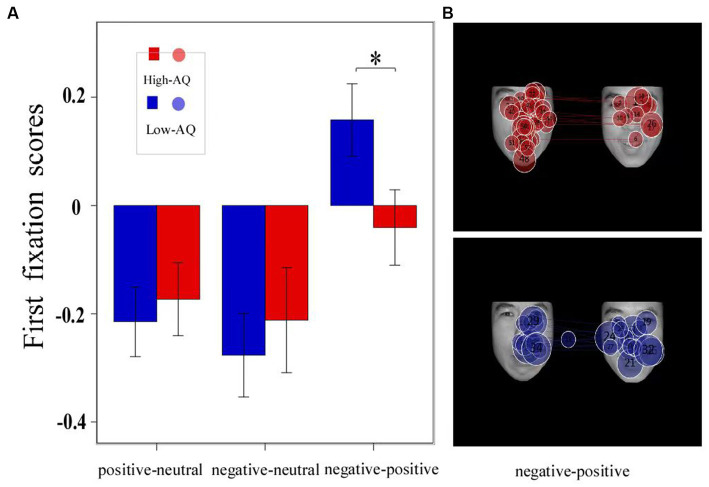
The results show that compared to the low-AQ group, the high-AQ group detected negative faces faster in the early stages of emotional face processing. As the presentation time of emotional faces increased (at the 2-3 s mark), the fixation scores for negative-neutral faces of the high-AQ group were less than 0.5, which was significantly lower than those of the low-AQ group. Meanwhile, the high-AQ group showed brief attentional avoidance toward positive emotion at 3-4 s in the positive-neutral trials, indicating that the high-AQ group exhibited attention avoidance to both negative and positive faces during the middle and later stages of emotional processing.
This study suggests that individuals with ATs display a vigilance-avoidance pattern toward emotional faces. It contributes to a deeper understanding of the mechanisms of attention in persons with ATs and further supports the Intense World Theory.
在患有自闭症谱系障碍(ASD)和具有自闭症特征(ATs)的个体中发现了相似的注意力模式。强烈世界理论及先前的研究表明,患有ASD的个体可能对情绪化面孔表现出警惕 - 回避的注意力模式。然而,具有ATs的个体的注意力模式仍不清楚。因此,本研究采用眼动追踪技术来研究具有ATs的个体对情绪化面孔的注意力偏差的特征和时间进程。
使用自闭症谱系商数(AQ)评估2502名大学生的ATs水平。从这2502名大学生中总共选取了50名参与者:25名高AQ组参与者从AQ得分最高的10%个体中随机选取。同样,25名低AQ组参与者从AQ得分最低的10%参与者中随机选取。所有选定的参与者在执行带有情绪化面孔(正性 - 中性、负性 - 中性和负性 - 正性)的点探测任务时完成了一项眼动追踪研究。通过分析不同时间段的数据,研究了具有ATs的个体对情绪化面孔的注意力偏差和时间进程。
结果表明,与低AQ组相比,高AQ组在情绪化面孔处理的早期阶段更快地检测到负面面孔。随着情绪化面孔呈现时间的增加(在2 - 3秒标记处),高AQ组负性 - 中性面孔的注视得分小于0.5,显著低于低AQ组。同时,在正性 - 中性试验中,高AQ组在3 - 4秒时对正性情绪表现出短暂的注意力回避,表明高AQ组在情绪处理的中期和后期阶段对负面和正面面孔都表现出注意力回避。
本研究表明,具有ATs的个体对情绪化面孔表现出警惕 - 回避模式。这有助于更深入地理解具有ATs的个体的注意力机制,并进一步支持强烈世界理论。