Ehrsam Jonas P, Chen Jin, Haberecker Martina, Arni Stephan, Inci Ilhan
Department of Thoracic Surgery, University Hospital Zurich, Zurich, Switzerland.
Centre for Surgery Zurich, Thoracic surgery, Klinik Hirslanden, Zurich, Switzerland.
Transplant Direct. 2023 Aug 9;9(9):e1516. doi: 10.1097/TXD.0000000000001516. eCollection 2023 Sep.
Acute rejection is still a major limitation for a successful outcome in lung transplantation. Since (NAD) has been shown to have various immunomodulatory properties on the innate and adaptive immune system, we evaluate here a potential protective effect of NAD against acute lung rejection.
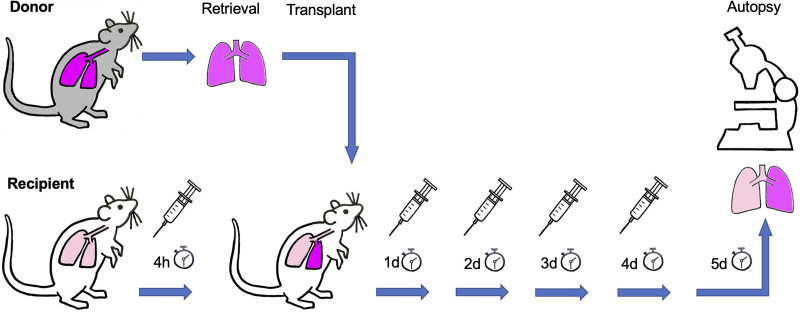
Rat single-lung transplantation was performed in 2 groups (n = 8 per group), using Brown-Norway donors and major histocompatibility complex-mismatched Lewis recipients. Recipients of the NAD group received 1000 mg/kg NAD intraperitoneally before transplantation and daily thereafter until euthanasia, whereas the control group received saline solution. At autopsy on day 5, blood samples were analyzed and the lung allograft was assessed by bronchioalveolar lavage, histology, and immunochemistry.
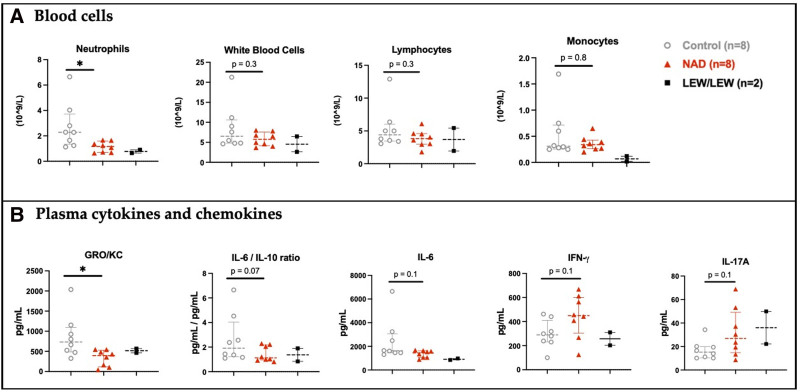
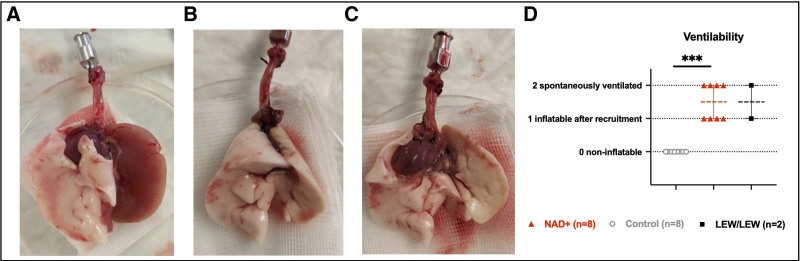
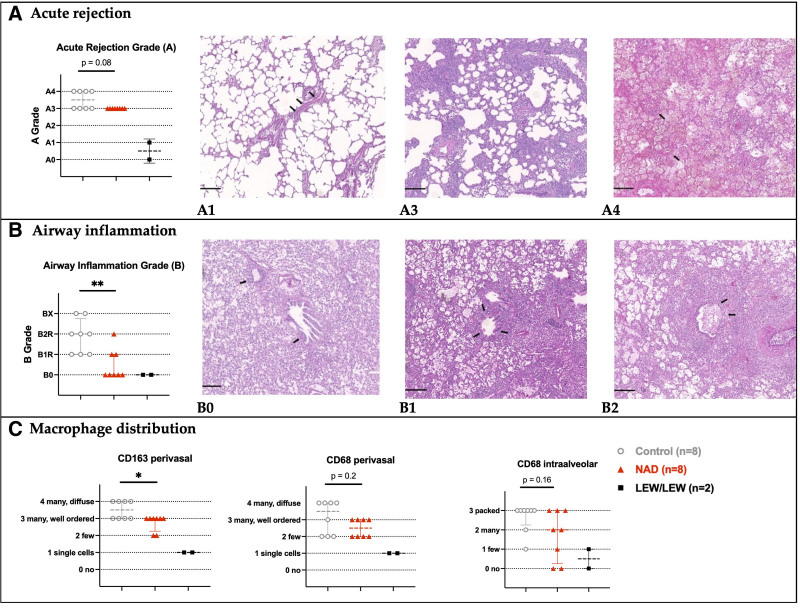
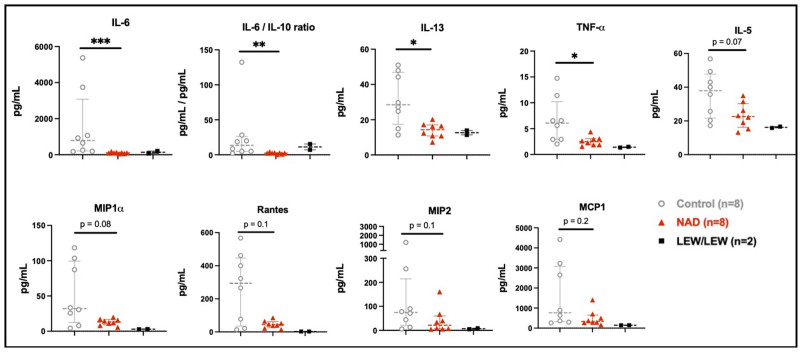
The NAD group maintained an intact compliant lung tissue, a strong trend of lower acute cellular rejection (A3 versus A3-A4) and significantly less lymphocytic bronchiolitis (B0-B2R versus B1R-Bx). In addition, a trend of fewer alveolar CD68 macrophages and significantly fewer interstitial CD163 macrophages was observed. Bronchoalveolar lavage in the NAD group showed significantly fewer proinflammatory cytokines interleukin (IL)-6, IL-13, TNFα, and a protective IL-6/IL-10-ratio. In blood samples, we observed significantly fewer neutrophils, and proinflammatory GRO/KC in the NAD group.
NAD might be a promising substance in prevention of acute allograft rejection in lung transplantation.
急性排斥反应仍然是肺移植成功的主要限制因素。由于烟酰胺腺嘌呤二核苷酸(NAD)已被证明对先天性和适应性免疫系统具有多种免疫调节特性,我们在此评估NAD对急性肺排斥反应的潜在保护作用。
将大鼠单肺移植分为2组(每组n = 8),供体为布朗-挪威大鼠,受体为主要组织相容性复合体不匹配的刘易斯大鼠。NAD组受体在移植前腹腔注射1000 mg/kg NAD,此后每天注射直至安乐死,而对照组注射生理盐水。在第5天尸检时,分析血样,并通过支气管肺泡灌洗、组织学和免疫化学评估肺移植组织。
NAD组维持了完整的顺应性肺组织,急性细胞排斥反应(A3与A3-A4相比)有降低的强烈趋势,淋巴细胞性细支气管炎显著减少(B0-B2R与B1R-Bx相比)。此外,观察到肺泡CD68巨噬细胞数量有减少趋势,间质CD163巨噬细胞数量显著减少。NAD组支气管肺泡灌洗显示促炎细胞因子白细胞介素(IL)-6、IL-13、肿瘤坏死因子α显著减少,且IL-6/IL-10比值具有保护作用。在血样中,我们观察到NAD组中性粒细胞以及促炎因子生长调节致癌基因蛋白/角质形成细胞趋化因子显著减少。
NAD可能是预防肺移植急性移植物排斥反应的一种有前景的物质。