Luque-Campos Noymar, Riquelme Ricardo, Molina Luis, Canedo-Marroquín Gisela, Vega-Letter Ana María, Luz-Crawford Patricia, Bustamante-Barrientos Felipe A
Laboratorio de Inmunología Celular y Molecular, Facultad de Medicina, Universidad de los Andes, Santiago, Chile.
Centro de Investigación e Innovación Biomédica, Universidad de los Andes, Santiago, Chile.
Front Physiol. 2023 Jul 28;14:1217815. doi: 10.3389/fphys.2023.1217815. eCollection 2023.
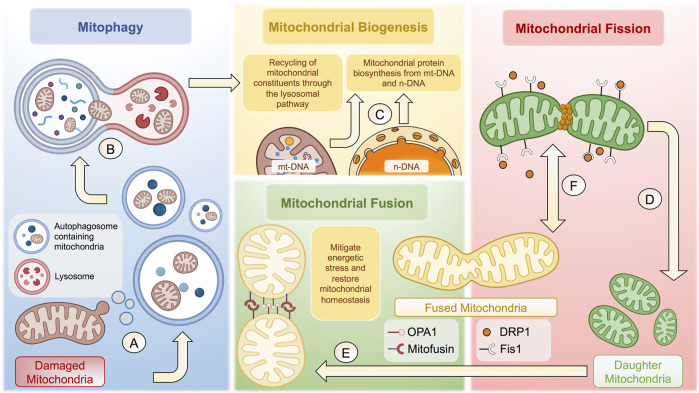
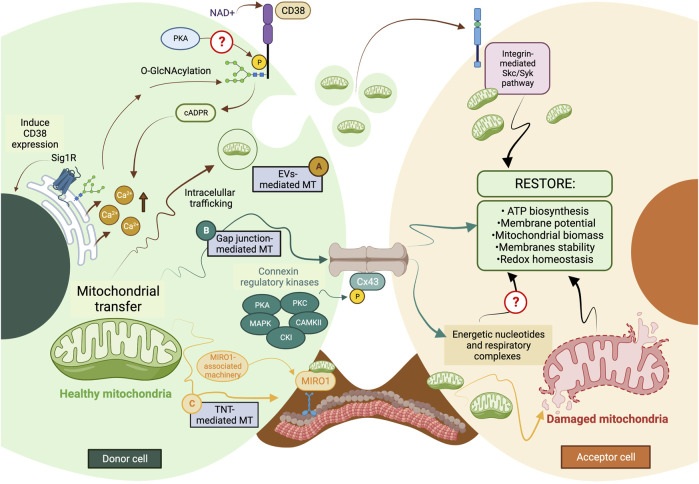
Mitochondrial dysfunction is a central event in the pathogenesis of several degenerative brain disorders. It entails fission and fusion dynamics disruption, progressive decline in mitochondrial clearance, and uncontrolled oxidative stress. Many therapeutic strategies have been formulated to reverse these alterations, including replacing damaged mitochondria with healthy ones. Spontaneous mitochondrial transfer is a naturally occurring process with different biological functions. It comprises mitochondrial donation from one cell to another, carried out through different pathways, such as the formation and stabilization of tunneling nanotubules and Gap junctions and the release of extracellular vesicles with mitochondrial cargoes. Even though many aspects of regulating these mechanisms still need to be discovered, some key enzymatic regulators have been identified. This review summarizes the current knowledge on mitochondrial dysfunction in different neurodegenerative disorders. Besides, we analyzed the usage of mitochondrial transfer as an endogenous revitalization tool, emphasizing the enzyme regulators that govern this mechanism. Going deeper into this matter would be helpful to take advantage of the therapeutic potential of mitochondrial transfer.
线粒体功能障碍是几种退行性脑疾病发病机制中的核心事件。它会导致裂变和融合动力学紊乱、线粒体清除能力逐渐下降以及不受控制的氧化应激。人们已经制定了许多治疗策略来逆转这些改变,包括用健康的线粒体替代受损的线粒体。自发线粒体转移是一个具有不同生物学功能的自然发生过程。它包括从一个细胞向另一个细胞的线粒体捐赠,通过不同途径进行,如隧道纳米管和缝隙连接的形成与稳定以及携带线粒体货物的细胞外囊泡的释放。尽管调节这些机制的许多方面仍有待发现,但一些关键的酶调节剂已被确定。本综述总结了目前关于不同神经退行性疾病中线粒体功能障碍的知识。此外,我们分析了线粒体转移作为一种内源性复苏工具的应用,强调了控制这一机制的酶调节剂。深入研究这个问题将有助于利用线粒体转移的治疗潜力。