Frisch Emilie, Clavier Lisa, Belhamdi Abdessamad, Vrana Nihal Engin, Lavalle Philippe, Frisch Benoît, Heurtault Béatrice, Gribova Varvara
Université de Strasbourg, CNRS UMR 7199, 3Bio Team, Laboratoire de Conception et Application de Molécules Bioactives, Faculté de Pharmacie, Strasbourg, France.
Institut National de la Santé et de la Recherche Médicale, Inserm UMR_S 1121 Biomaterials and Bioengineering, Centre de Recherche en Biomédecine de Strasbourg, Strasbourg, France.
Front Bioeng Biotechnol. 2023 Jul 27;11:1193204. doi: 10.3389/fbioe.2023.1193204. eCollection 2023.
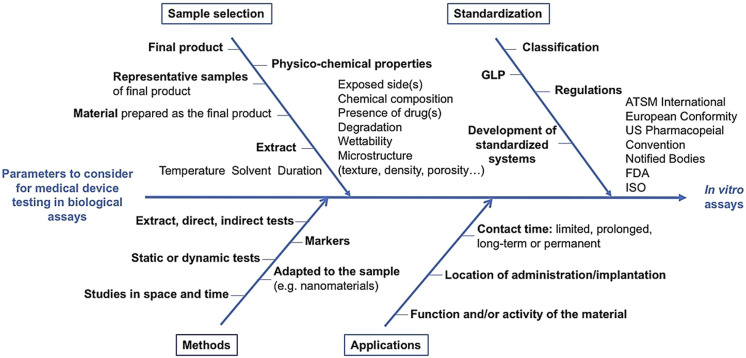
Nowadays, implants and prostheses are widely used to repair damaged tissues or to treat different diseases, but their use is associated with the risk of infection, inflammation and finally rejection. To address these issues, new antimicrobial and anti-inflammatory materials are being developed. Aforementioned materials require their thorough preclinical testing before clinical applications can be envisaged. Although many researchers are currently working on new tissues for drug screening and tissue replacement, models for evaluation of new biomaterials are just emerging and are extremely rare. In this context, there is an increased need for advanced models, which would best recapitulate the environment, limiting animal experimentation and adapted to the multitude of these materials. Here, we overview currently available preclinical methods and models for biological evaluation of new biomaterials. We describe several biological tests used in biocompatibility assessment, which is a primordial step in new material's development, and discuss existing challenges in this field. In the second part, the emphasis is made on the development of new 3D models and approaches for preclinical evaluation of biomaterials. The third part focuses on the main parameters to consider to achieve the optimal conditions for evaluating biocompatibility; we also overview differences in regulations across different geographical regions and regulatory systems. Finally, we discuss future directions for the development of innovative biomaterial-related assays: models, dynamic testing models, complex multicellular and multiple organ systems, as well as patient-specific personalized testing approaches.
如今,植入物和假体被广泛用于修复受损组织或治疗各种疾病,但其使用与感染、炎症以及最终的排斥风险相关。为了解决这些问题,新型抗菌和抗炎材料正在研发中。上述材料在设想临床应用之前需要进行全面的临床前测试。尽管目前许多研究人员正在致力于开发用于药物筛选和组织替代的新组织,但用于评估新型生物材料的模型刚刚出现且极为罕见。在此背景下,对先进模型的需求日益增加,这些模型应能最好地模拟体内环境,减少动物实验,并适用于众多此类材料。在此,我们概述了目前可用于新型生物材料生物学评估的临床前方法和模型。我们描述了生物相容性评估中使用的几种生物学测试,这是新材料开发的首要步骤,并讨论了该领域现存的挑战。在第二部分,重点介绍了用于生物材料临床前评估的新型三维模型和方法的开发。第三部分着重阐述了为实现生物相容性评估的最佳条件而需考虑的主要参数;我们还概述了不同地理区域和监管体系在法规方面的差异。最后,我们讨论了创新生物材料相关检测方法的未来发展方向:模型、动态测试模型、复杂的多细胞和多器官系统,以及针对患者的个性化测试方法。