Shen Wenqi, Cai Lingli, Wang Bin, Wang Yuying, Wang Ningjian, Lu Yingli
Institute and Department of Endocrinology and Metabolism, Shanghai Ninth People's Hospital, Shanghai Jiao Tong University School of Medicine, Shanghai, People's Republic of China.
Diabetes Metab Syndr Obes. 2023 Aug 8;16:2377-2387. doi: 10.2147/DMSO.S423272. eCollection 2023.
This study aimed to determine the associations of relative fat mass (RFM), a novel adiposity indicator, with the prevalence of non-alcoholic fatty liver disease (NAFLD) and cardiovascular disease (CVD) and compared the disease discriminative ability of RFM with other common adiposity indicators in the general Chinese population.
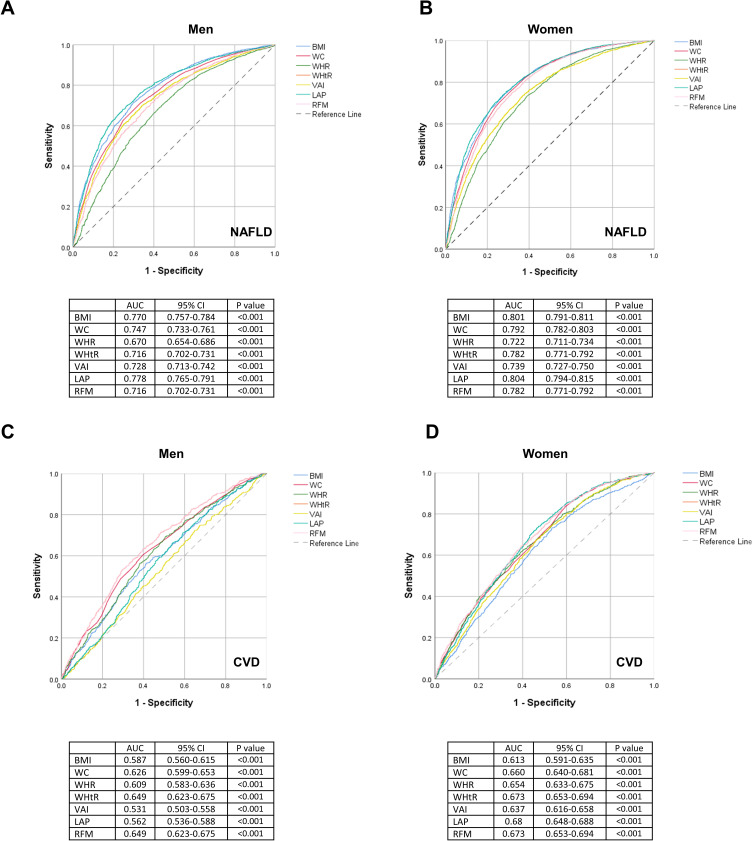
This cross-sectional study consisted of 11,532 adult participants from the SPECT-China study (2014-2016). We included RFM and six other adiposity indicators, including body mass index (BMI), waist circumference (WC), waist-to-hip ratio (WHR), waist-to-height ratio (WHtR), visceral adiposity index (VAI), and lipid accumulation product (LAP). Binary logistic regression analysis was used to assess the relationship between adiposity indicators and the prevalence of NAFLD and CVD. The receiver operating characteristic (ROC) curve was used to evaluate the ability to screen NAFLD and CVD.
After adjusting for confounding variables, RFM showed a strong association with the prevalence of NAFLD and CVD. In men, each 1-SD (standard deviation) increase in RFM was associated with more than 3-fold increased risk of NAFLD (OR: 4.33, 95% CI: 3.79-4.93) and 66% increased risk of CVD (OR: 1.66, 95% CI: 1.36-2.02); in women, per 1-SD increase in RFM was associated with about 4-fold increased risk of NAFLD (OR: 5.16, 95% CI: 4.62-5.77) and 26% increased risk of CVD (OR: 1.26, 95% CI: 1.08-1.47). ROC analysis showed that RFM and WHtR were the strongest predictors for CVD.
RFM was significantly associated with prevalent NAFLD and CVD in Chinese adults and might be considered a simple tool for disease prediction. Further large longitudinal studies are needed to verify our findings.
本研究旨在确定一种新型肥胖指标——相对脂肪量(RFM)与非酒精性脂肪性肝病(NAFLD)和心血管疾病(CVD)患病率之间的关联,并比较RFM与其他常见肥胖指标在中国普通人群中对疾病的判别能力。
这项横断面研究纳入了来自SPECT-中国研究(2014 - 2016年)的11532名成年参与者。我们纳入了RFM以及其他六种肥胖指标,包括体重指数(BMI)、腰围(WC)、腰臀比(WHR)、腰高比(WHtR)、内脏脂肪指数(VAI)和脂质蓄积产物(LAP)。采用二元逻辑回归分析来评估肥胖指标与NAFLD和CVD患病率之间的关系。受试者工作特征(ROC)曲线用于评估筛查NAFLD和CVD的能力。
在调整混杂变量后,RFM与NAFLD和CVD的患病率显示出强烈关联。在男性中,RFM每增加1个标准差(SD),NAFLD风险增加超过3倍(比值比:4.33,95%置信区间:3.79 - 4.93),CVD风险增加66%(比值比:1.66,95%置信区间:1.36 - 2.02);在女性中,RFM每增加1个标准差,NAFLD风险增加约4倍(比值比:5.16,95%置信区间:4.62 - 5.77),CVD风险增加26%(比值比:1.26,95%置信区间:1.08 - 1.47)。ROC分析表明,RFM和WHtR是CVD最强的预测指标。
RFM与中国成年人中普遍存在的NAFLD和CVD显著相关,可能被视为一种疾病预测的简单工具。需要进一步的大型纵向研究来验证我们的发现。