Hervàs-Arnandis Susi, Palomar-de Lucas Brenda, Bilanin Cristina, Mingueza-Verdejo Paloma, Viciano Mónica, Oliver-Meseguer Judit, Leyva-Pérez Antonio
Instituto de Tecnología Química (UPV-CSIC), Universidad Politècnica de València-Consejo Superior de Investigaciones Científicas Avda. de los Naranjos s/n 46022 Valencia Spain
AIMPLAS, València Parc Tecnològic C/Gustave Eiffel, 4 46980 Paterna Valencia Spain.
RSC Adv. 2023 Aug 10;13(34):23859-23869. doi: 10.1039/d3ra05024f. eCollection 2023 Aug 4.
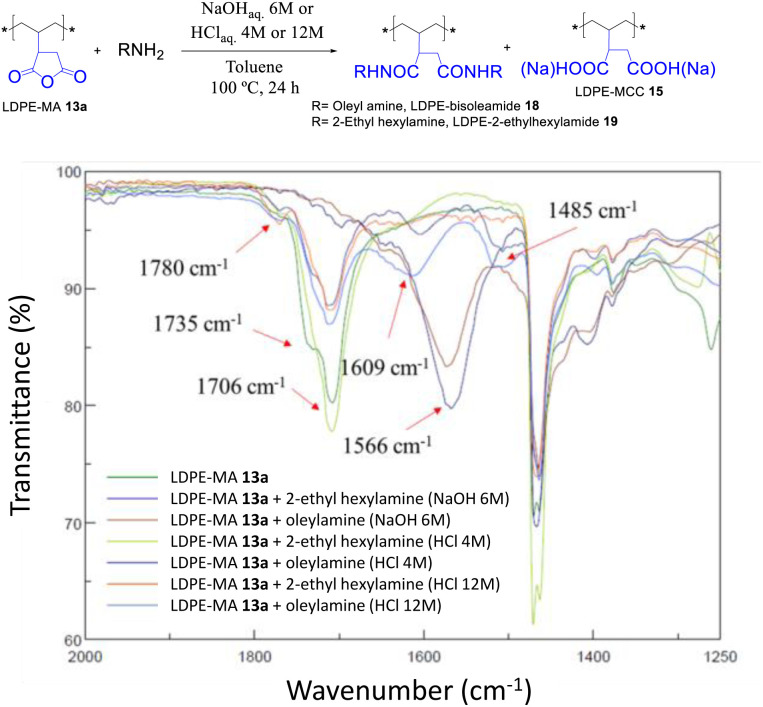
Low-density (LD) and high-density polyethylene (HDPE), recycled or not, incorporates up to 7 wt% of ester groups after reacting either with ethyl diazoacetate (EDA) under catalytic and solvent free-reaction conditions, or with maleic anhydride (MA) and acrylates (AC) under catalytic radical conditions. The resulting upcycled polyethylene esters are hydrolytically stable at extreme pH (0-14) and can be further transformed into carboxylic acids, carboxylates, other esters and amides.
低密度(LD)和高密度聚乙烯(HDPE),无论是否回收利用,在无催化剂和无溶剂反应条件下与重氮乙酸乙酯(EDA)反应,或在催化自由基条件下与马来酸酐(MA)和丙烯酸酯(AC)反应后,都能引入高达7 wt%的酯基。所得的升级循环聚乙烯酯在极端pH值(0 - 14)下具有水解稳定性,并且可以进一步转化为羧酸、羧酸盐、其他酯类和酰胺。