Menjívar Cecilia, Diossa-Jiménez Leydy
Department of Sociology, UCLA, Los Angeles, California, USA.
Lat Am Res Rev. 2023 Sep;58(3):501-518. doi: 10.1017/lar.2022.72. Epub 2022 Dec 6.
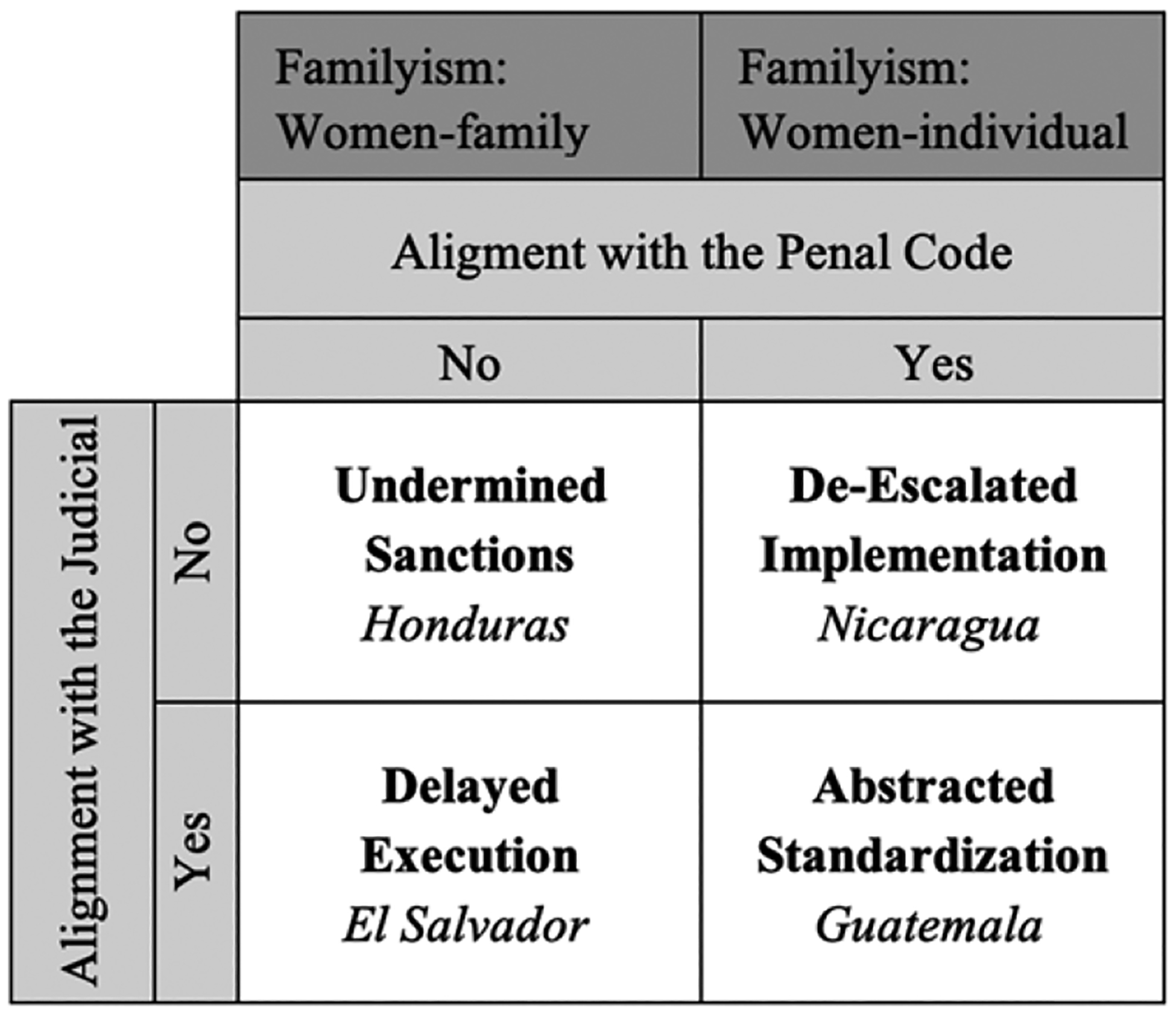
The scholarship seeking to explain the ineffectiveness of violence against women (VAW) laws has focused on the lack of resources or will to implement these laws. Less attention has been given to how these laws are crafted and positioned in the legal hierarchy, which may undermine them from the start. This article focuses on four cases from Central America, a region where fifty-five laws to protect women from violence were passed between 1960 and 2018, yet VAW continues. It finds that the legal positioning and language of these laws prioritize family unity while undermining women's rights to protection; thus, these laws fail by design. The article identifies four legal placements that delay (El Salvador), undermine (Honduras), diminish (Nicaragua), or render abstract (Guatemala) the effectiveness of VAW laws in the context of penal and judicial codes. This work has direct policy implications and broader relevance beyond the cases examined here.
旨在解释针对妇女暴力行为(VAW)法律为何无效的学术研究,一直聚焦于缺乏实施这些法律的资源或意愿。对于这些法律在法律体系中的制定方式和定位关注较少,而这可能从一开始就削弱了它们的效力。本文聚焦于中美洲的四个案例,在该地区,1960年至2018年间通过了55项保护妇女免受暴力侵害的法律,但针对妇女的暴力行为仍在继续。研究发现,这些法律的法律定位和措辞将家庭团聚置于优先地位,同时却损害了妇女获得保护的权利;因此,这些法律从设计上就是失败的。本文确定了四种法律定位,它们在刑法典和司法法典的背景下,会延迟(萨尔瓦多)、削弱(洪都拉斯)、降低(尼加拉瓜)或使针对妇女暴力行为法律的效力变得抽象(危地马拉)。这项研究具有直接的政策意义,并且在此处研究的案例之外具有更广泛的相关性。