Rick Anne-Marie, Copp Elizabeth, Buckley Abigail, Yanowitz Toby, Martin Judith, Shaikh Nader, Switzer Galen, Hooven Thomas, Beigi Richard
University of Pittsburgh.
Three Rivers Rowing Association.
Res Sq. 2023 Aug 1:rs.3.rs-2838294. doi: 10.21203/rs.3.rs-2838294/v1.
To determine test characteristics of categorical risk stratification for early onset sepsis (EOS) using maternal criteria for suspected intraamniotic infection (IAI) and/or newborn exam and compare them to the EOS calculator.
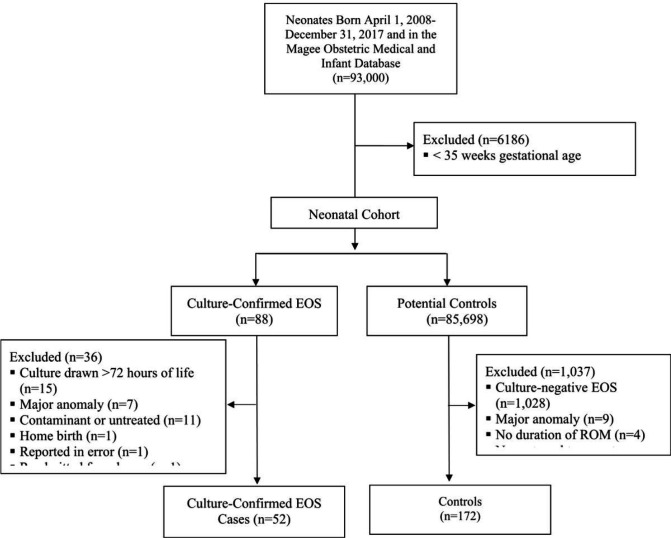
Retrospective 1:3 case-control study of late preterm/term infants with bacterial culture growth obtained <72 hours of life. For categorical approach, infants of mothers with suspected IAI or equivocal/ill appearing were presumed high-risk for EOS and blood culture obtained. For calculator, estimated probability of EOS and care recommendations were recorded from online calculator. Test characteristics were compared with McNemar's test; recommendation for blood culture was considered a "positive" test.
52 cases and 172 controls were included. Compared to the calculator, the categorical approach had higher sensitivity 90%(95%CI:79-96%) vs 67% (95%CI:54-79%) but lower specificity 85%(95%CI:78-89%) vs. 92%(95%CI:87-96%). 10% of cases were not identified by either.
A categorical approach using suspected IAI/newborn exam offers good EOS discrimination and is comparable to the calculator.
使用疑似羊膜腔内感染(IAI)的母体标准和/或新生儿检查来确定早发型败血症(EOS)分类风险分层的检测特征,并将其与EOS计算器进行比较。
对出生后<72小时获得细菌培养结果的晚期早产/足月儿进行回顾性1:3病例对照研究。对于分类方法,疑似IAI或表现不明确/患病母亲的婴儿被假定为EOS高危,并进行血培养。对于计算器,从在线计算器记录EOS的估计概率和护理建议。使用McNemar检验比较检测特征;血培养建议被视为“阳性”检测。
纳入52例病例和172例对照。与计算器相比,分类方法具有更高的敏感性,分别为90%(95%CI:79-96%)和67%(95%CI:54-79%),但特异性较低,分别为85%(95%CI:78-89%)和92%(95%CI:87-96%)。10%的病例两种方法均未识别出。
使用疑似IAI/新生儿检查的分类方法对EOS具有良好的鉴别能力,与计算器相当。