Division of Endocrinology, Metabolism, and Lipids, Department of Medicine, Emory University School of Medicine, Atlanta, Georgia, USA.
Division of Endocrinology, Gerontology and Metabolism, Department of Medicine, Stanford University, Stanford, California, USA.
Diabetes Technol Ther. 2023 Oct;25(10):677-688. doi: 10.1089/dia.2023.0304. Epub 2023 Aug 28.
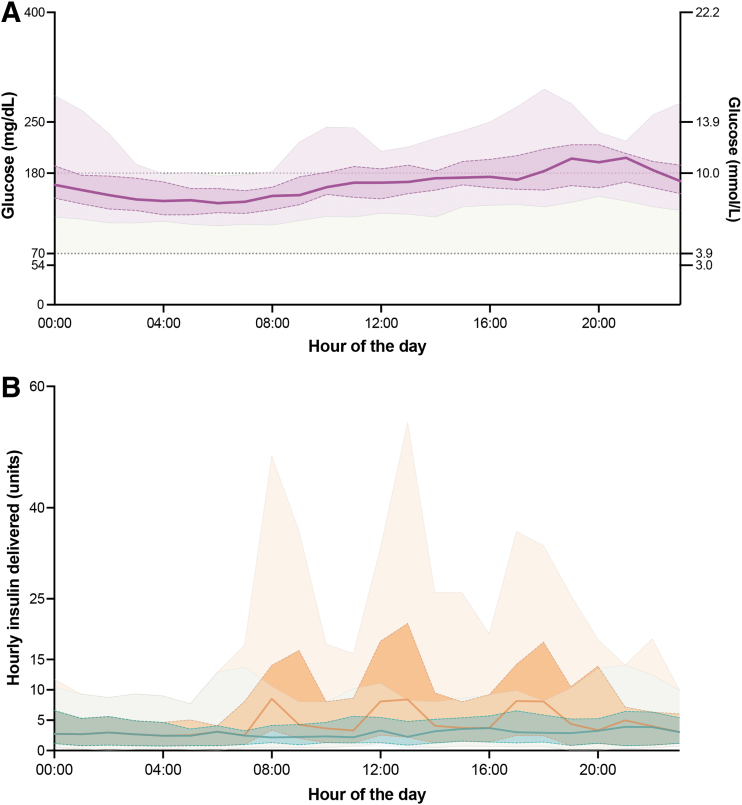
Multiple daily injection insulin therapy frequently fails to meet hospital glycemic goals and is prone to hypoglycemia. Automated insulin delivery (AID) with remote glucose monitoring offers a solution to these shortcomings. In a single-arm multicenter pilot trial, we tested the feasibility, safety, and effectiveness of the Omnipod 5 AID System with real-time continuous glucose monitoring (CGM) for up to 10 days in hospitalized patients with insulin-requiring diabetes on nonintensive care unit medical-surgical units. Primary endpoints included the proportion of time in automated mode and percent time-in-range (TIR 70-180 mg/dL) among participants with >48 h of CGM data. Safety endpoints included incidence of severe hypoglycemia and diabetes-related ketoacidosis (DKA). Additional glycemic endpoints, CGM accuracy, and patient satisfaction were also explored. Twenty-two participants were enrolled; 18 used the system for a total of 96 days (mean 5.3 ± 3.1 days per patient), and 16 had sufficient CGM data required for analysis. Median percent time in automated mode was 95% (interquartile range 92%-98%) for the 18 system users, and the 16 participants with >48 h of CGM data achieved an overall TIR of 68% ± 16%, with 0.17% ± 0.3% time <70 mg/dL and 0.06% ± 0.2% time <54 mg/dL. Sensor mean glucose was 167 ± 21 mg/dL. There were no DKA or severe hypoglycemic events. All participants reported satisfaction with the system at study end. The use of AID with a disposable tubeless patch-pump along with remote real-time CGM is feasible in the hospital setting. These results warrant further investigation in randomized trials.
多次每日注射胰岛素治疗常常无法达到医院的血糖目标,且容易发生低血糖。带有远程血糖监测的自动胰岛素输送(AID)为这些缺点提供了一种解决方案。在一项单臂多中心试点试验中,我们在非重症监护病房的医疗外科病房中,对需要胰岛素的糖尿病住院患者进行了为期 10 天的、使用实时连续血糖监测(CGM)的 Omnipod 5 AID 系统的可行性、安全性和有效性测试,参与者的 CGM 数据至少有 48 小时。主要终点包括自动化模式的时间比例和 CGM 数据大于 48 小时的参与者的时间在目标范围内的比例(TIR 70-180mg/dL)。安全性终点包括严重低血糖和糖尿病相关酮症酸中毒(DKA)的发生率。还探讨了其他血糖终点、CGM 准确性和患者满意度。 共有 22 名参与者入组;18 名参与者总共使用该系统 96 天(每名患者平均 5.3±3.1 天),16 名参与者有足够的 CGM 数据分析。18 名系统使用者的中位自动化模式时间比例为 95%(四分位距 92%-98%),16 名 CGM 数据大于 48 小时的参与者的总体 TIR 为 68%±16%,<70mg/dL 的时间为 0.17%±0.3%,<54mg/dL 的时间为 0.06%±0.2%。传感器平均血糖为 167±21mg/dL。无 DKA 或严重低血糖事件。所有参与者在研究结束时均报告对系统满意。 在医院环境中,使用一次性无管贴泵和远程实时 CGM 的 AID 是可行的。这些结果值得在随机试验中进一步研究。