College of Public Health, Medical and Veterinary Sciences, James Cook University, Townsville, VIC, Australia.
Melbourne School of Population and Global Health, University of Melbourne, Melbourne, VIC, Australia.
Int J Health Policy Manag. 2023;12:6876. doi: 10.34172/ijhpm.2023.6876. Epub 2023 Mar 5.
Corporations in unhealthy commodity industries (UCIs) have growing influence on the health of national populations through practices that lead to increased consumption of unhealthy products. The use of government-led public health surveillance is best practice to better understand any emerging public health threat. However, there is minimal systematic evidence, generated and monitored by national governments, regarding the scope of UCI corporate practices and their impacts. This study aims to synthesise current frameworks that exist to identify and monitor UCI influence on health to highlight the range of practices deployed by corporations and inform future surveillance efforts in key UCIs.
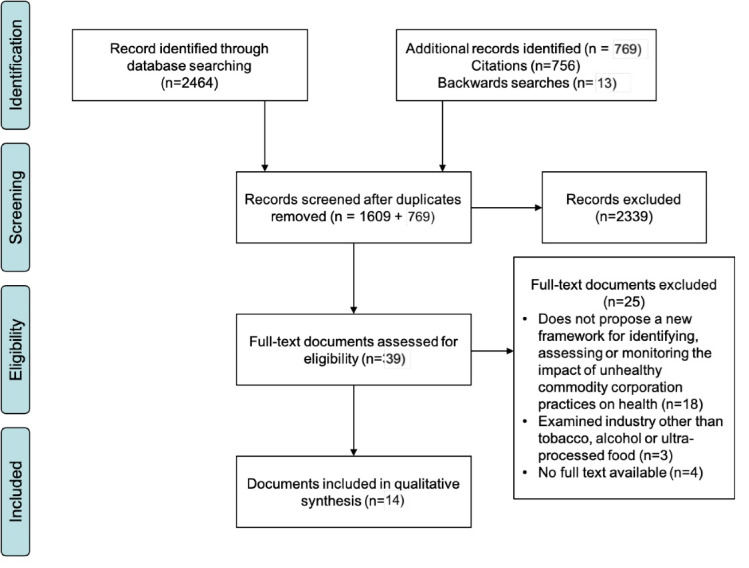
Seven biomedical, business and scientific databases were searched to identify literature focused on corporate practices that impact human health and frameworks for monitoring or assessment of the way UCIs impact health. Content analysis occurred in three phases, involving (1) the identification of framework documents in the literature and extraction of all corporate practices from the frameworks; (2) initial inductive grouping and synthesis followed by deductive synthesis using Lima and Galea's 'vehicles of power' as a heuristic; and (3) scoping for potential indicators linked to each corporate practice and development of an integrated framework.
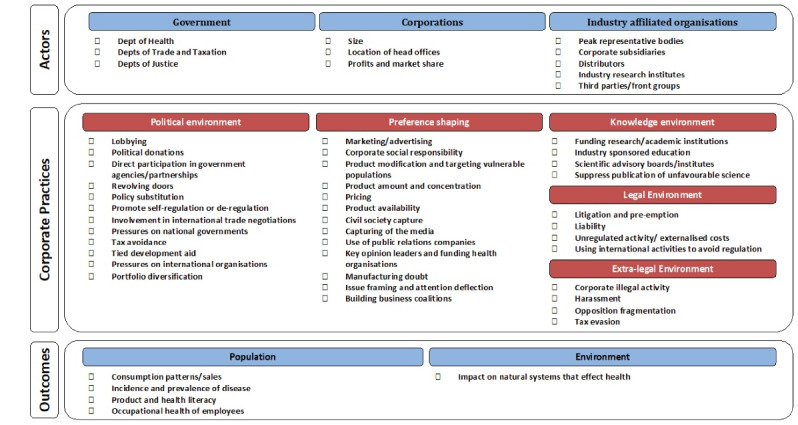
Fourteen frameworks were identified with 37 individual corporate practices which were coded into five different themes according the Lima and Galea 'Corporate Practices and Health' framework. We proposed a summary framework to inform the public health surveillance of UCIs which outlines key actors, corporate practices and outcomes that should be considered. The proposed framework draws from the health policy triangle framework and synthesises key features of existing frameworks.
Systematic monitoring of the practices of UCIs is likely to enable governments to mitigate the negative health impacts of corporate practices. The proposed synthesised framework highlights the range of practices deployed by corporations for public health surveillance at a national government level. We argue there is significant precedent and great need for monitoring of these practices and the operationalisation of a UCI monitoring system should be the object of future research.
不健康商品行业(UCI)的企业通过导致不健康产品消费增加的做法,对国家人口健康产生越来越大的影响。利用政府主导的公共卫生监测是更好地了解任何新出现的公共卫生威胁的最佳实践。然而,各国政府生成和监测的关于 UCI 企业实践范围及其影响的系统证据很少。本研究旨在综合现有的识别和监测 UCI 对健康影响的框架,以突出企业采用的各种做法,并为关键 UCI 中的未来监测工作提供信息。
在七个生物医学、商业和科学数据库中搜索,以确定重点关注影响人类健康的企业实践和监测或评估 UCI 对健康影响方式的框架的文献。内容分析分三个阶段进行,包括:(1)在文献中识别框架文件并从框架中提取所有企业实践;(2)使用 Lima 和 Galea 的“权力载体”作为启发式方法进行初始归纳分组和综合,然后进行演绎综合;(3)对与每个企业实践相关的潜在指标进行范围界定,并制定一个综合框架。
确定了 14 个框架,其中包含 37 项个别企业实践,这些实践根据 Lima 和 Galea 的“企业实践与健康”框架被编码为五个不同主题。我们提出了一个总结框架,为 UCI 的公共卫生监测提供信息,其中概述了应考虑的主要行为者、企业实践和结果。该框架借鉴了健康政策三角框架,并综合了现有框架的关键特征。
对 UCI 实践的系统监测可能使政府能够减轻企业实践对健康的负面影响。拟议的综合框架突出了企业在国家政府层面为公共卫生监测部署的各种做法。我们认为,对这些做法进行监测具有重要的先例和巨大的需求,监测 UCI 的运作系统应该是未来研究的对象。