Department of Social and Behavioral Sciences, Yale School of Public Health, New Haven, Connecticut, United States of America.
Harvey Cushing/John Hay Whitney Medical Library, Yale University, New Haven, Connecticut, United States of America.
PLoS One. 2024 Apr 26;19(4):e0300699. doi: 10.1371/journal.pone.0300699. eCollection 2024.
Business practices have influenced human health for centuries, yet an overarching concept to study these activities across nations, time periods, and industries (called 'the commercial determinants of health' (CDH)) has emerged only recently. The purpose of this review was to assess the descriptive characteristics of CDH research and to identify remaining research gaps.
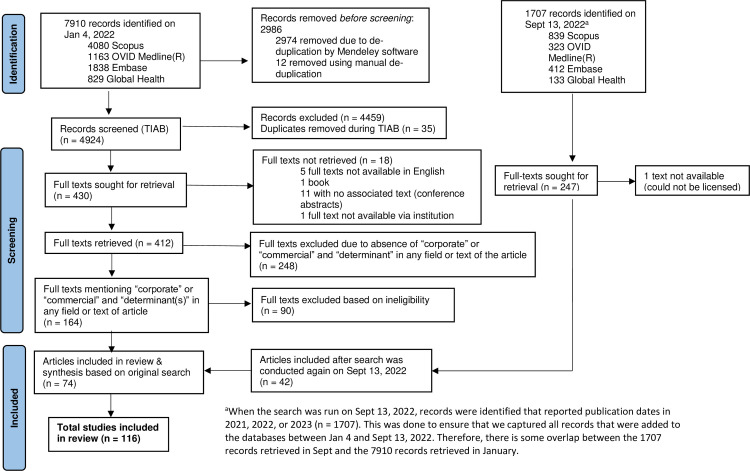
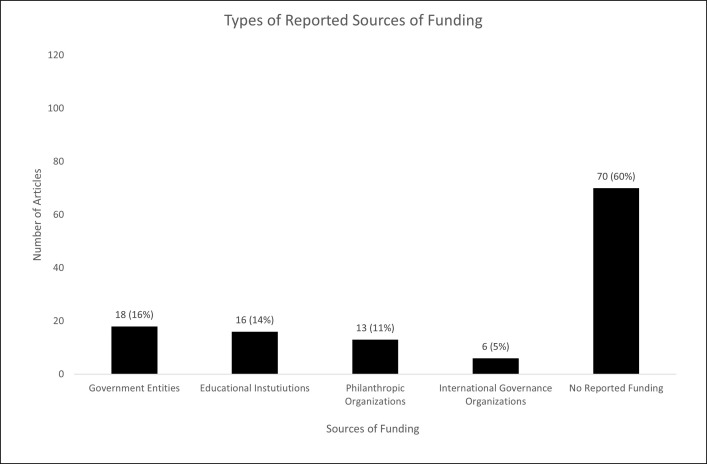
We systematically searched four databases (Scopus, OVID Medline, Ovid Embase, and Ovid Global Health) on Sept 13, 2022 for literature using CDH terms that described corporate activities that have the potential to influence population health and/or health equity (n = 116). We evaluated the following characteristics of the literature: methods employed, industries studied, regions investigated, funders, reported conflicts of interest, and publication in open-access formats.
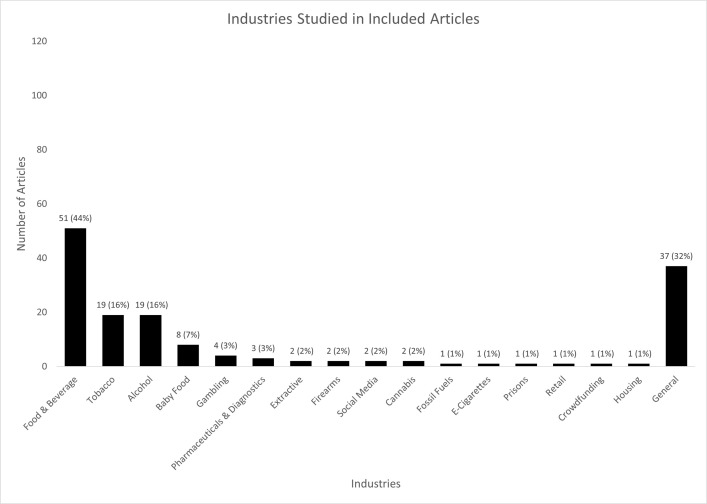
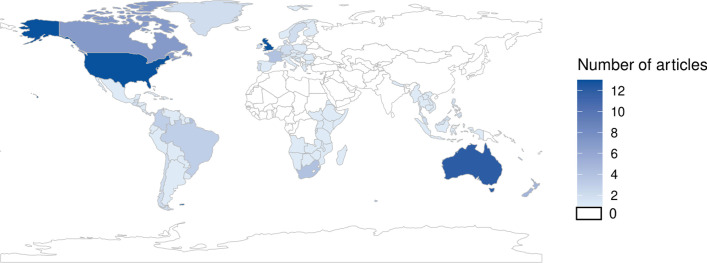
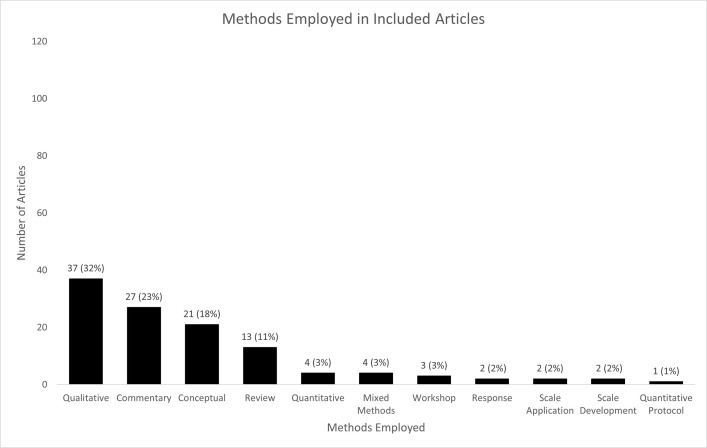
The characteristics of the articles included that many were conceptual (50/116 articles; 43%) or used qualitative methods (37; 32%). Only eight articles (7%) used quantitative or mixed methods. The articles most often discussed corporate activities in relation to the food and beverage (51/116; 44%), tobacco (20; 17%), and alcohol industries (19; 16%), with limited research on activities occurring in other industries. Most articles (42/58 articles reporting a regional focus; 72%) focused on corporate activities occurring in high-income regions of the world.
Our findings indicate that literature that has used CDH terms and described corporate practices that influence human health has primarily focused on three major industries in higher-income regions of the world. Qualitative methods were the most common empirical method for investigating these activities. CDH-focused investigations of corporate practices conducted by less-studied industries (e.g., social media) and in lower-income regions are recommended. Longitudinal quantitative studies assessing the associations between corporate practices and a range of health outcomes is also a necessary next step for this field.
商业实践影响人类健康已有数个世纪之久,但直到最近才出现一个涵盖国家、时期和行业的总体概念来研究这些活动(称为“商业对健康的决定因素”(CDH))。本研究旨在评估 CDH 研究的描述性特征,并确定尚存的研究空白。
我们于 2022 年 9 月 13 日系统地在四个数据库(Scopus、OVID Medline、Ovid Embase 和 Ovid Global Health)中检索了使用 CDH 术语描述有可能影响人群健康和/或健康公平的公司活动的文献(n=116)。我们评估了文献的以下特征:所采用的方法、研究的行业、调查的地区、资助者、报告的利益冲突以及以开放获取格式发表的情况。
所纳入文章的特征为:许多文章是概念性的(50/116 篇;43%)或采用定性方法(37 篇;32%)。只有 8 篇文章(7%)采用定量或混合方法。这些文章最常讨论与食品和饮料(51/116;44%)、烟草(20 篇;17%)和酒精行业(19 篇;16%)相关的公司活动,而对其他行业的活动则研究有限。大多数文章(42/58 篇报告有区域重点的文章;72%)重点关注发生在世界高收入地区的公司活动。
我们的研究结果表明,使用 CDH 术语并描述影响人类健康的公司实践的文献主要集中在世界高收入地区的三个主要行业。定性方法是调查这些活动最常用的经验方法。建议对较少研究的行业(例如社交媒体)和低收入地区开展 CDH 为重点的公司实践研究。该领域下一步也是必要的是开展评估公司实践与一系列健康结果之间关联的纵向定量研究。