Health Informatics Institute, Morsani College of Medicine, University of South Florida, Tampa, FL.
Department of Clinical Sciences, Lund University Clinical Research Center, Skåne University Hospital, Malmö, Sweden.
Diabetes Care. 2023 Oct 1;46(10):1839-1847. doi: 10.2337/dc23-0417.
To study the interaction among HLA genotype, early probiotic exposure, and timing of complementary foods in relation to risk of islet autoimmunity (IA).
The Environmental Determinants of Diabetes in the Young (TEDDY) study prospectively follows 8,676 children with increased genetic risk of type 1 diabetes. We used a Cox proportional hazards regression model adjusting for potential confounders to study early feeding and the risk of IA in a sample of 7,770 children.
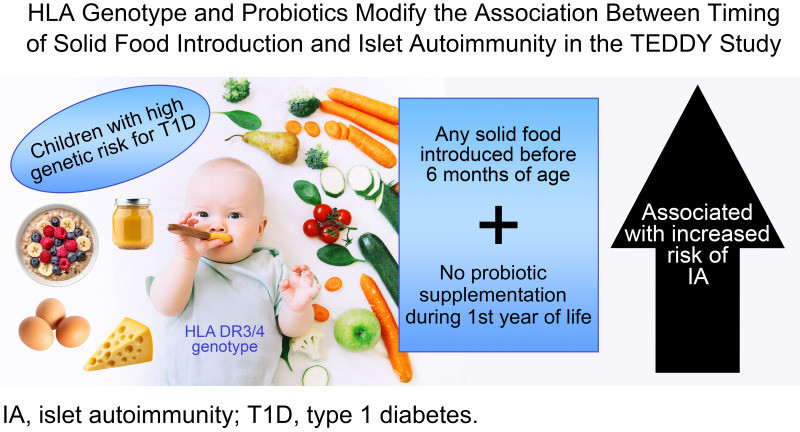
Any solid food introduced early (<6 months) was associated with increased risk of IA if the child had the HLA DR3/4 genotype and no probiotic exposure during the 1st year of life. Rice introduced at 4-5.9 months compared with later in the U.S. was associated with an increased risk of IA.
Timing of solid food introduction, including rice, may be associated with IA in children with the HLA DR3/4 genotype not exposed to probiotics. The microbiome composition under these exposure combinations requires further study.
研究 HLA 基因型、早期益生菌暴露和补充食物时机之间的相互作用与胰岛自身免疫 (IA) 风险的关系。
儿童 1 型糖尿病环境决定因素研究 (TEDDY) 前瞻性地随访了 8676 名遗传易患 1 型糖尿病的儿童。我们使用 Cox 比例风险回归模型,在一个包含 7770 名儿童的样本中调整了潜在混杂因素,以研究早期喂养与 IA 风险之间的关系。
如果儿童具有 HLA DR3/4 基因型且在生命的第 1 年没有益生菌暴露,那么任何早期(<6 个月)引入的固体食物都会增加 IA 的风险。与美国后期相比,4-5.9 个月引入的大米与 IA 风险增加相关。
在未暴露于益生菌的 HLA DR3/4 基因型儿童中,固体食物(包括大米)的引入时机可能与 IA 有关。在这些暴露组合下的微生物组组成需要进一步研究。