Heart, Lung, Blood and Vascular Medicine Institute, University of Pittsburgh, Pittsburgh, Pennsylvania, USA; email:
Department of Medicine, University of Maryland School of Medicine, Baltimore, Maryland, USA; email:
Annu Rev Med. 2024 Jan 29;75:337-351. doi: 10.1146/annurev-med-052422-020045. Epub 2023 Aug 15.
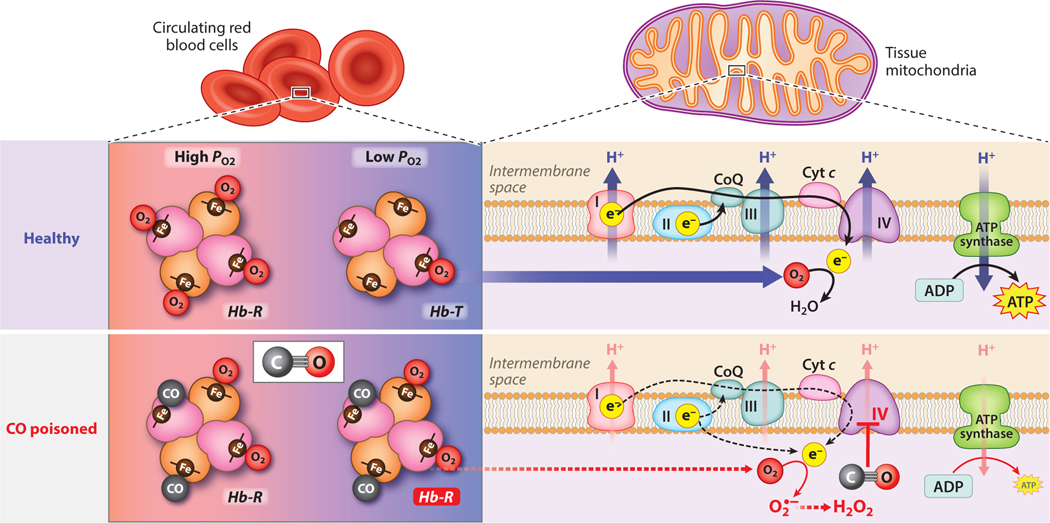
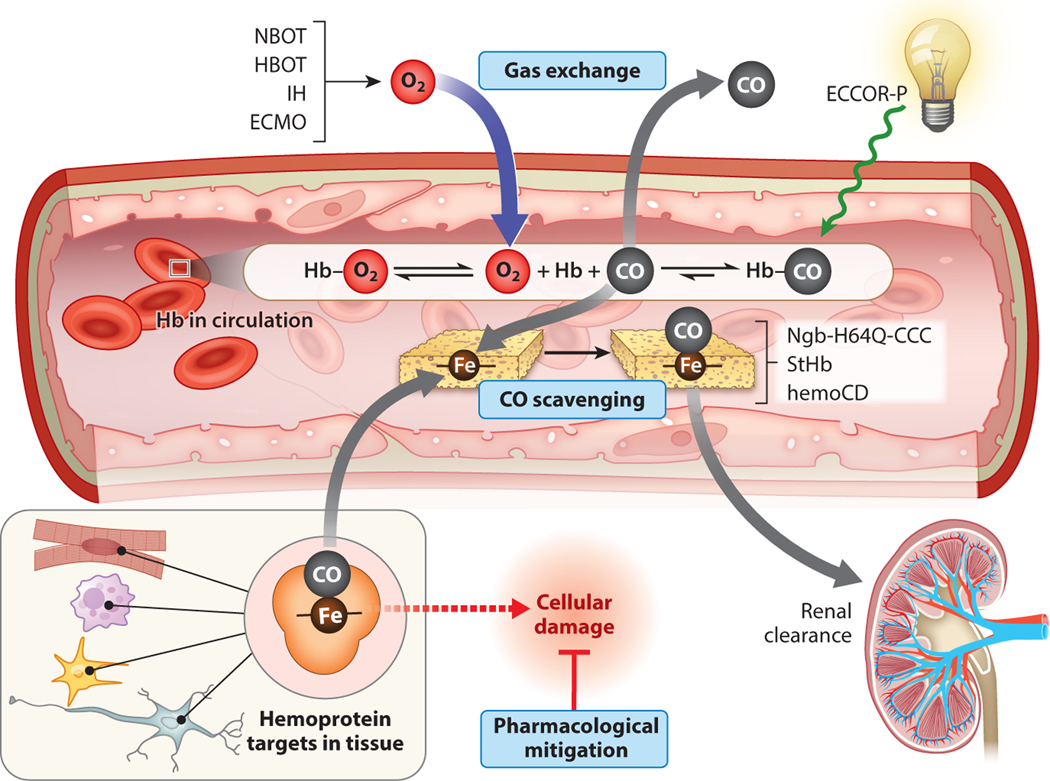
Carbon monoxide (CO) poisoning leads to 50,000-100,000 emergency room visits and 1,500-2,000 deaths each year in the United States alone. Even with treatment, survivors often suffer from long-term cardiac and neurocognitive deficits, highlighting a clear unmet medical need for novel therapeutic strategies that reduce morbidity and mortality associated with CO poisoning. This review examines the prevalence and impact of CO poisoning and pathophysiology in humans and highlights recent advances in therapeutic strategies that accelerate CO clearance and mitigate toxicity. We focus on recent developments of high-affinity molecules that take advantage of the uniquely strong interaction between CO and heme to selectively bind and sequester CO in preclinical models. These scavengers, which employ heme-binding scaffolds ranging from organic small molecules to hemoproteins derived from humans and potentially even microorganisms, show promise as field-deployable antidotes that may rapidly accelerate CO clearance and improve outcomes for survivors of acute CO poisoning.
在美国,每年仅因一氧化碳(CO)中毒就会导致 5 万至 10 万人到急诊室就诊,1500 至 2000 人死亡。即使经过治疗,幸存者仍常常患有长期的心脏和神经认知缺陷,这突显了一种明显未满足的医疗需求,即需要新的治疗策略来降低与 CO 中毒相关的发病率和死亡率。本文综述了 CO 中毒的流行程度和对人类的影响及其病理生理学,并重点介绍了加速 CO 清除和减轻毒性的治疗策略的最新进展。我们专注于利用 CO 与血红素之间独特的强相互作用的高亲和力分子的最新发展,这些分子选择性地结合并在临床前模型中隔离 CO。这些清除剂利用血红素结合支架,范围从有机小分子到源自人类甚至微生物的血红素蛋白,有望成为可现场部署的解毒剂,可快速加速 CO 清除并改善急性 CO 中毒幸存者的预后。