Pearce Gemma, Holliday Nikki, Sandhu Harbinder, Eftekhari Helen, Bruce Julie, Timms Emma, Ablett Laura, Kavi Lesley, Simmonds Jane, Evans Rebecca, Magee Paul, Powell Richard, Keogh Shane, McGregor Gordon
Coventry University, Coventry, UK.
University of Warwick, Coventry, UK.
Pilot Feasibility Stud. 2023 Aug 15;9(1):143. doi: 10.1186/s40814-023-01365-4.
There is a dearth of research to support the treatment of people with postural tachycardia syndrome (PoTS). Despite expert consensus suggesting exercise is recommended for this patient group, there are no randomised control trials examining this rigorously. The aim was to co-create a feasibility trial protocol and a rehabilitation intervention for people living with PoTS.
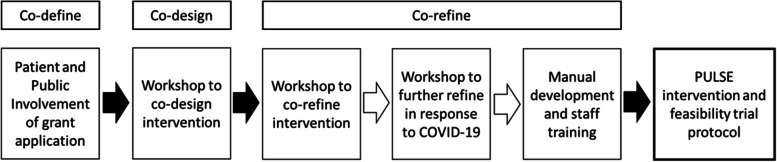
The intervention and feasibility trial design were co-created as part of the PostUraL tachycardia Syndrome Exercise (PULSE) study. We used the 'three co's framework' of co-define, co-design and co-refine. Recruitment included key national charities and National Health Service Trusts treating people living with PoTS in the UK. Eighteen patient and public involvement members attended the co-define session, and 16 co-creators with a mix of expertise attended the subsequent co-design and co-refine sessions. Seven intervention practitioners were trained in the rehabilitation intervention, providing feedback for further co-refinement.
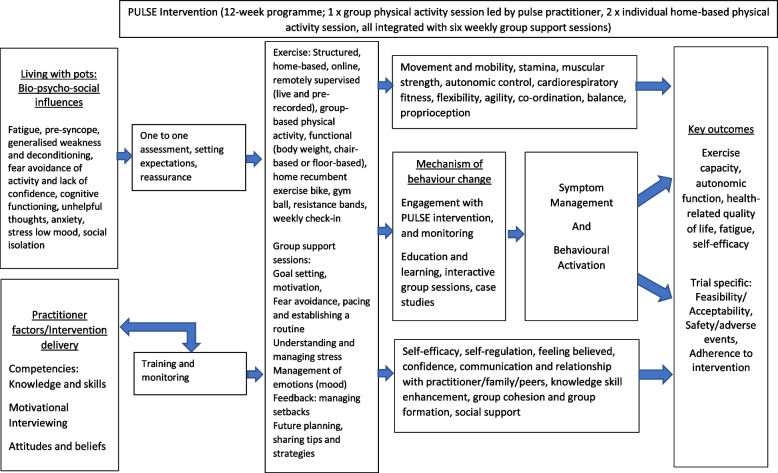
The final co-created intervention comprises online physical activity, and lifestyle and behaviour change support sessions. It is based on functional movement activities using a patient-centred approach tailored to individual needs. Physical activity intensity is guided by individuals' perception of effort rather than by objective measures. Recumbent bikes are provided for home use. Patients deemed randomisation to be acceptable because research in this area was considered important.
An innovative approach was used to co-create the PULSE intervention and feasibility trial protocol to meet the evidence-based and logistical needs of people living with PoTS, clinicians, service deliverers, third-sector organisations, academics and funders. This can be used as a successful example and template for future research internationally. People living with PoTS were recognised as experts and involved in every aspect of conceptualisation, design and refinement. This complex rehabilitation intervention is currently being tested in a randomised feasibility trial comparing the PULSE intervention with best-practice usual care for people living with PoTS.
ISRCTN45323485 was registered on April 7, 2020.
缺乏支持体位性心动过速综合征(PoTS)患者治疗的研究。尽管专家共识建议该患者群体进行运动,但尚无严格检验这一建议的随机对照试验。目的是共同制定一项可行性试验方案以及针对PoTS患者的康复干预措施。
作为体位性心动过速综合征运动(PULSE)研究的一部分,共同制定了干预措施和可行性试验设计。我们采用了“三个共同”框架,即共同定义、共同设计和共同完善。招募工作包括英国主要的全国性慈善机构以及治疗PoTS患者的国民保健服务信托机构。18名患者及公众参与成员参加了共同定义会议,16名具有不同专业知识的共同创造者参加了随后的共同设计和共同完善会议。7名干预措施实施者接受了康复干预培训,并提供反馈以进一步共同完善。
最终共同制定的干预措施包括在线体育活动以及生活方式和行为改变支持课程。它基于功能性运动活动,采用以患者为中心、根据个体需求量身定制的方法。体育活动强度由个体的努力感知而非客观指标来指导。提供卧式自行车供家庭使用。患者认为随机分组是可以接受的,因为该领域的研究被认为很重要。
采用了一种创新方法来共同制定PULSE干预措施和可行性试验方案,以满足PoTS患者、临床医生、服务提供者、第三部门组织、学者和资助者的循证及后勤需求。这可作为国际上未来研究的成功范例和模板。PoTS患者被视为专家,并参与了概念化、设计和完善的各个方面。目前正在进行一项随机可行性试验,比较PULSE干预措施与针对PoTS患者的最佳实践常规护理。
ISRCTN45323485于2020年4月7日注册。