Division of Hematology and Oncology, Memorial Sloan Kettering Cancer Center/Weill Cornell Medical College, New York City, NY, USA.
Department of Internal Medicine, University of Iowa, Iowa City, IA, USA.
Nat Med. 2023 Sep;29(9):2259-2267. doi: 10.1038/s41591-023-02528-9. Epub 2023 Aug 15.
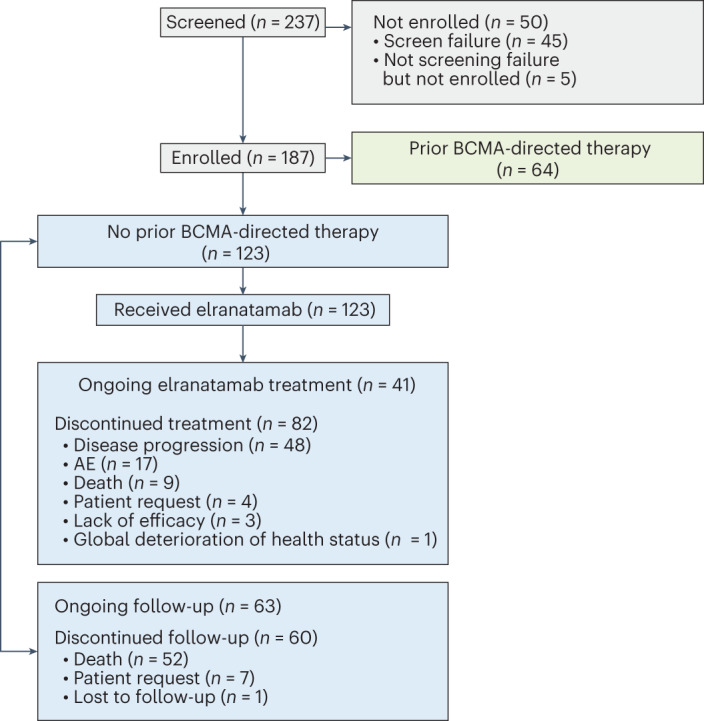
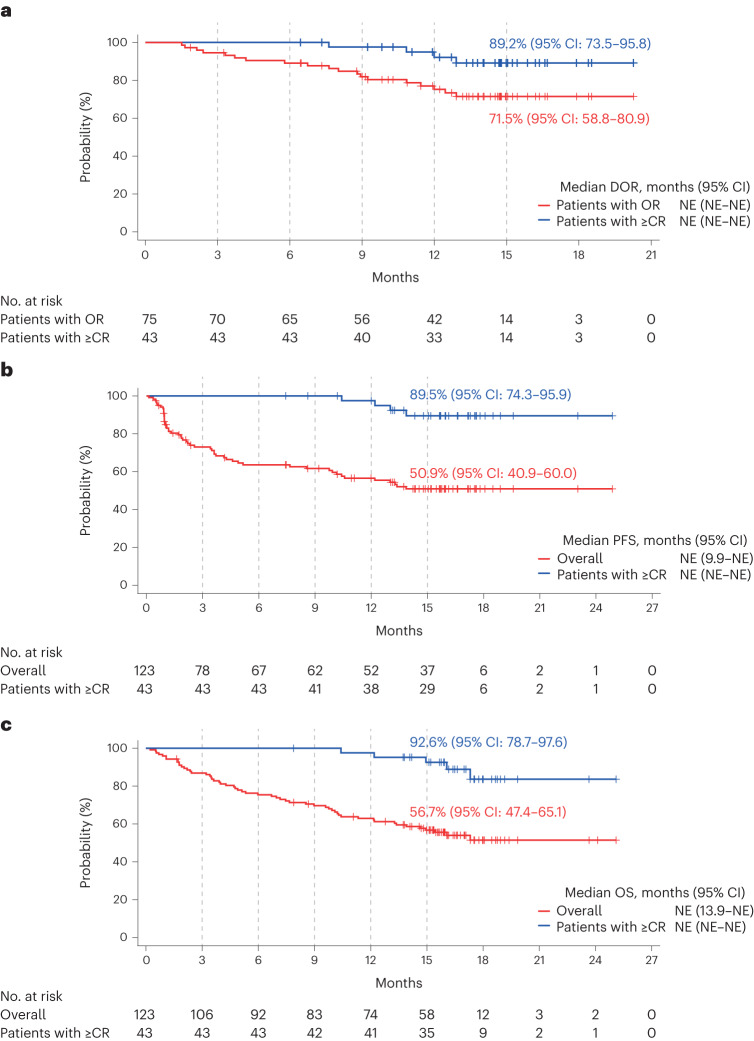
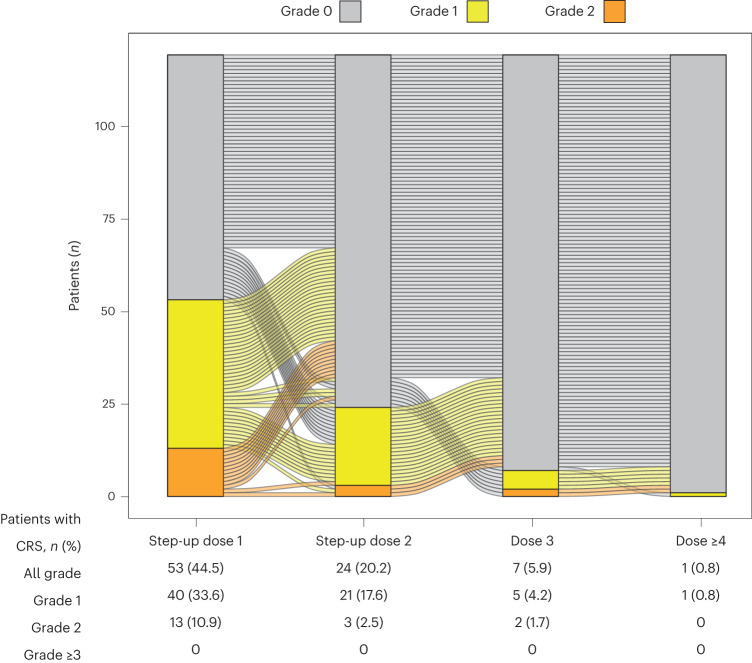
Elranatamab is a humanized B-cell maturation antigen (BCMA)-CD3 bispecific antibody. In the ongoing phase 2 MagnetisMM-3 trial, patients with relapsed or refractory multiple myeloma received subcutaneous elranatamab once weekly after two step-up priming doses. After six cycles, persistent responders switched to biweekly dosing. Results from cohort A, which enrolled patients without prior BCMA-directed therapy (n = 123) are reported. The primary endpoint of confirmed objective response rate (ORR) by blinded independent central review was met with an ORR of 61.0% (75/123); 35.0% ≥complete response. Fifty responders switched to biweekly dosing, and 40 (80.0%) improved or maintained their response for ≥6 months. With a median follow-up of 14.7 months, median duration of response, progression-free survival and overall survival (secondary endpoints) have not been reached. Fifteen-month rates were 71.5%, 50.9% and 56.7%, respectively. Common adverse events (any grade; grade 3-4) included infections (69.9%, 39.8%), cytokine release syndrome (57.7%, 0%), anemia (48.8%, 37.4%), and neutropenia (48.8%, 48.8%). With biweekly dosing, grade 3-4 adverse events decreased from 58.6% to 46.6%. Elranatamab induced deep and durable responses with a manageable safety profile. Switching to biweekly dosing may improve long-term safety without compromising efficacy. ClinicalTrials.gov identifier: NCT04649359 .
依鲁替尼单抗是一种人源化 B 细胞成熟抗原(BCMA)-CD3 双特异性抗体。在正在进行的 2 期 MagnetisMM-3 试验中,复发或难治性多发性骨髓瘤患者在接受两次递增式预充剂量后,每周接受一次皮下注射依鲁替尼单抗。在 6 个周期后,持续缓解的患者转为每两周一次给药。报告了队列 A 的结果,该队列招募了未经 BCMA 定向治疗的患者(n=123)。由盲法独立中心审查确认的客观缓解率(ORR)主要终点达到,ORR 为 61.0%(123/123);35.0%为完全缓解。50 名缓解者转为每两周一次给药,40 名(80.0%)缓解或维持≥6 个月。中位随访 14.7 个月时,中位缓解持续时间、无进展生存期和总生存期(次要终点)尚未达到。15 个月的比率分别为 71.5%、50.9%和 56.7%。常见的不良反应(任何等级;3-4 级)包括感染(69.9%,39.8%)、细胞因子释放综合征(57.7%,0%)、贫血(48.8%,37.4%)和中性粒细胞减少症(48.8%,48.8%)。转为每两周一次给药后,3-4 级不良事件从 58.6%降至 46.6%。依鲁替尼单抗诱导了深度和持久的缓解,且安全性可控。转为每两周一次给药可能会提高长期安全性,而不影响疗效。临床试验注册号:NCT04649359。