Kiran Sham, Nagarajappa Vani H, Sathyanarayana Santhosh O, Hegde Avni, Raghupathy Palany
Department of Pediatric and Adolescent Endocrinology, Indira Gandhi Institute of Child Health, Bangalore, Karnataka, India.
Department of Pediatric and Adolescent Endocrinology, Karnataka Institute of Endocrinology and Research, Bangalore, Karnataka, India.
Indian J Endocrinol Metab. 2023 May-Jun;27(3):208-212. doi: 10.4103/ijem.ijem_376_22. Epub 2023 Jun 26.
Regular self-monitoring of blood glucose (SMBG) remains the mainstay method for diabetes monitoring. The major limitation of SMBG is poor compliance and it only provides a snapshot of glucose values at that point of time. Continuous glucose monitors (CGMs) are non-invasive devices which measure subcutaneous interstitial glucose for every five minutes and provide glucose variability throughout the day.
To assess the effectiveness of intermittent continuous blood glucose monitoring in comparison with SMBG on the percentage reduction in HbA1c level in children with type 1 diabetes mellitus (DM).
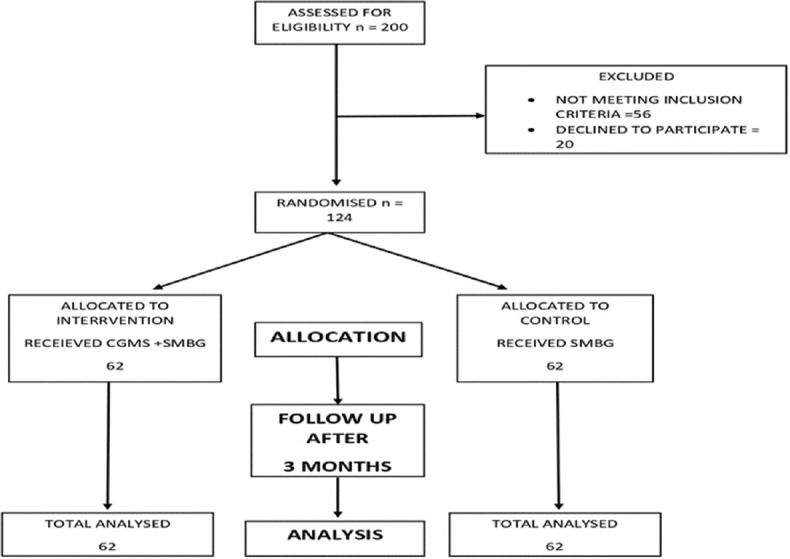
Children diagnosed with type 1 DM of age group 3-18 years were enlisted into the study. Participants were randomised to the study arm (CGMs+SMBG) or the control arm (SMBG alone). Subjects in the study group were given CGM along with regular SMBG for 14 days. The control group was asked to perform SMBG. HbA1c levels were measured in both groups after three months of intervention.
There were 62 children in each group. After three months, in the intervention group HbA1c level dropped from 11.23% ± 1.53% (Mean ± SD) to 10.14% ± 1.99%, in control group HbA1c level dropped from 11.62% ± 1.62% to 11.32% ± 1.57%. The fall in HbA1c level in intervention group is significant (p value -0.01).
In a resource-limited setting, intermittent use of CGMs atleast once every two to three months will help in understanding the factors influencing glucose variation throughout the day and, with appropriate therapeutic modifications, will aid in achieving optimal glycaemic control.
定期自我血糖监测(SMBG)仍然是糖尿病监测的主要方法。SMBG的主要局限性在于依从性差,并且它仅提供该时间点的血糖值快照。连续血糖监测仪(CGM)是无创设备,每五分钟测量一次皮下组织间液葡萄糖,并提供全天血糖变异性。
评估间歇性连续血糖监测与SMBG相比,对1型糖尿病(DM)儿童糖化血红蛋白(HbA1c)水平降低百分比的有效性。
招募年龄在3至18岁的1型DM患儿参加研究。参与者被随机分配到研究组(CGM+SMBG)或对照组(仅SMBG)。研究组的受试者在进行常规SMBG的同时使用CGM 14天。对照组被要求进行SMBG。干预三个月后,测量两组的HbA1c水平。
每组有62名儿童。三个月后,干预组的HbA1c水平从11.23%±1.53%(平均值±标准差)降至10.14%±1.99%,对照组的HbA1c水平从11.62%±1.62%降至11.32%±1.57%。干预组HbA1c水平的下降具有显著性(p值-0.01)。
在资源有限的情况下,每两到三个月至少间歇性使用一次CGM将有助于了解影响全天血糖变化的因素,并且通过适当的治疗调整,将有助于实现最佳血糖控制。