Zhao Rong, Wang Pan, Liu Lin, Zhang Fanyu, Hu Peng, Wen Jiaping, Li Hongyi, Biswal Bharat B
MOE Key Laboratory for Neuroinformation, Center for Information in Medicine, School of Life Science and Technology, The Clinical Hospital of Chengdu Brain Science Institute, University of Electronic Science and Technology of China, Chengdu, China.
The Fourth People's Hospital of Chengdu, Chengdu, China.
Front Neurosci. 2023 Jul 31;17:1236221. doi: 10.3389/fnins.2023.1236221. eCollection 2023.
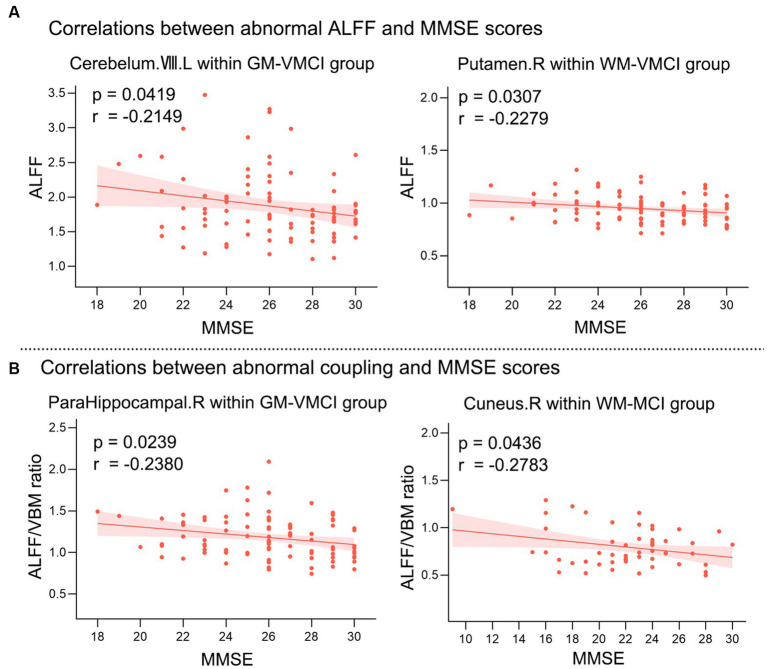
Alzheimer's disease (AD), one of the leading diseases of the nervous system, is accompanied by symptoms such as loss of memory, thinking and language skills. Both mild cognitive impairment (MCI) and very mild cognitive impairment (VMCI) are the transitional pathological stages between normal aging and AD. While the changes in whole-brain structural and functional information have been extensively investigated in AD, The impaired structure-function coupling remains unknown. The current study employed the OASIS-3 dataset, which includes 53 MCI, 90 VMCI, and 100 Age-, gender-, and education-matched normal controls (NC). Several structural and functional parameters, such as the amplitude of low-frequency fluctuations (ALFF), voxel-based morphometry (VBM), and The ALFF/VBM ratio, were used To estimate The whole-brain neuroimaging changes In MCI, VMCI, and NC. As disease symptoms became more severe, these regions, distributed in the frontal-inf-orb, putamen, and paracentral lobule in the white matter (WM), exhibited progressively increasing ALFF (ALFF < ALFF < ALFF), which was similar to the tendency for The cerebellum and putamen in the gray matter (GM). Additionally, as symptoms worsened in AD, the cuneus/frontal lobe in the WM and the parahippocampal gyrus/hippocampus in the GM showed progressively decreasing structure-function coupling. As the typical focal areas in AD, The parahippocampal gyrus and hippocampus showed significant positive correlations with the severity of cognitive impairment, suggesting the important applications of the ALFF/VBM ratio in brain disorders. On the other hand, these findings from WM functional signals provided a novel perspective for understanding the pathophysiological mechanisms involved In cognitive decline in AD.
阿尔茨海默病(AD)是主要的神经系统疾病之一,伴有记忆丧失、思维和语言技能等症状。轻度认知障碍(MCI)和极轻度认知障碍(VMCI)都是正常衰老与AD之间的过渡性病理阶段。虽然AD患者全脑结构和功能信息的变化已得到广泛研究,但结构 - 功能耦合受损情况仍不清楚。本研究采用了OASIS - 3数据集,其中包括53例MCI患者、90例VMCI患者以及100名年龄、性别和教育程度匹配的正常对照(NC)。使用了几个结构和功能参数,如低频波动幅度(ALFF)、基于体素的形态学测量(VBM)以及ALFF/VBM比值,来估计MCI、VMCI和NC组的全脑神经影像学变化。随着疾病症状加重,这些分布在白质(WM)中的额下回、壳核和中央旁小叶的区域,其ALFF呈现逐渐增加的趋势(ALFF < ALFF < ALFF),这与灰质(GM)中小脑和壳核的趋势相似。此外,随着AD症状恶化,WM中的楔叶/额叶以及GM中的海马旁回/海马的结构 - 功能耦合逐渐降低。作为AD的典型病灶区域,海马旁回和海马与认知障碍严重程度呈显著正相关,这表明ALFF/VBM比值在脑部疾病中有重要应用。另一方面,来自WM功能信号的这些发现为理解AD认知衰退所涉及的病理生理机制提供了新的视角。