Balaji G, Yadav G, Patel S A, Ramesh A, Nema S, Ramalingam T
Department of Orthopaedics, Jawaharlal Institute of Postgraduate Medical Education and Research (JIPMER), Pondicherry, India.
Department of Orthopaedics, Sarvajanik College of Physiotherapy Rampura, Surat, India.
Malays Orthop J. 2023 Jul;17(2):7-12. doi: 10.5704/MOJ.2307.002.
Anatomical femoral tunnel placement is critical for anterior cruciate ligament reconstruction (ACLR). Tunnel placement may vary with different surgical techniques. The aim of this study was to compare the accuracy of femoral tunnel placement between the Anteromedial (AM) and Anterolateral (AL) visualisation portals on post-operative CT scans among a cohort of ACLR patients.
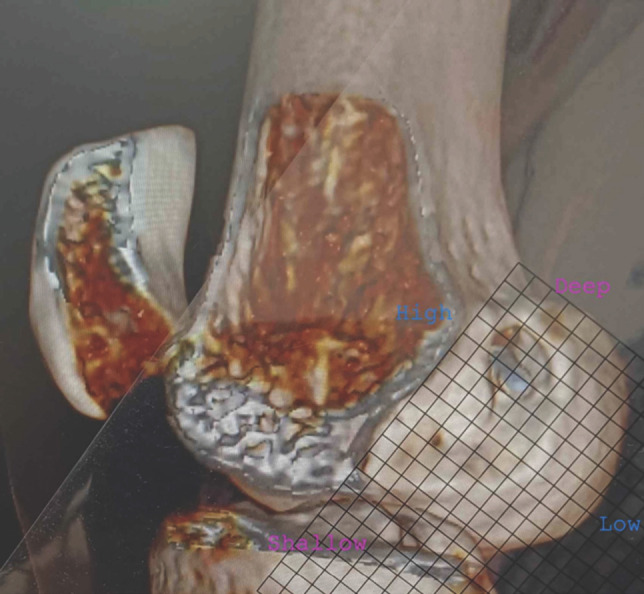
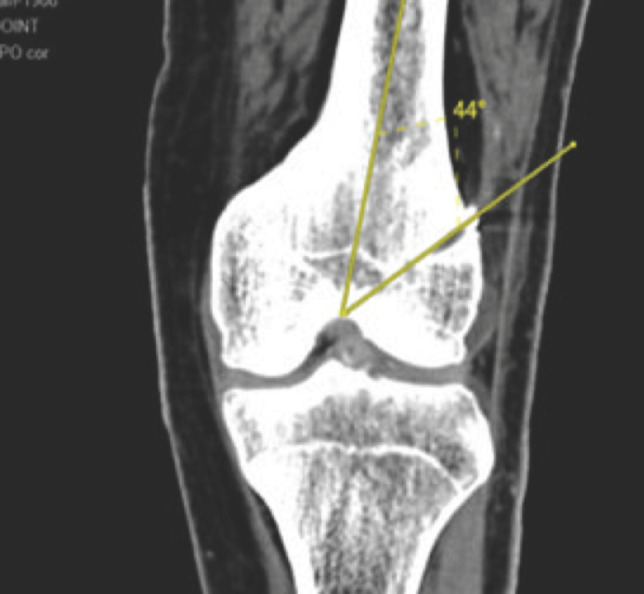
This cross-sectional study was conducted from January 2018 to March 2020 after obtaining ethics clearance. Patients who went for arthroscopic ACLR in our institute were divided into an AM (group 1) and an AL (group 2) based on the visualisation portal for creating the femoral tunnel and a 3D CT scan was done. The femoral tunnel position was calculated in deep to shallow and high to low direction using the Bernard Hertel grid. Femoral tunnel angle was measured in the 2D coronal image. Statistical analysis was done with the data collected.
Fifty patients with an average age of 26.36 (18-55) years ±7.216 SD were enrolled in the study. In this study, the AM technique was significantly more accurate (p<0.01) than the AL technique in terms of femoral tunnel angle. Furthermore, the deep to the shallow position was significantly (p= 0.018) closer to normative values, as determined by the chi-square test. The chances of error in tunnel angle in femoral condyle are 2.6 times greater in the AL technique (minimal clinical difference).
To conclude, in ACLR the anteromedial visualisation portal can facilitate accurate femoral tunnel placement compared to the anterolateral visualisation portal.
解剖学股骨隧道定位对于前交叉韧带重建术(ACLR)至关重要。隧道定位可能因不同的手术技术而有所不同。本研究的目的是比较一组前交叉韧带重建术患者术后CT扫描中,前内侧(AM)和前外侧(AL)可视化入路在股骨隧道定位的准确性。
本横断面研究于2018年1月至2020年3月在获得伦理批准后进行。在我们研究所接受关节镜下前交叉韧带重建术的患者,根据创建股骨隧道的可视化入路分为AM组(第1组)和AL组(第2组),并进行了三维CT扫描。使用伯纳德·赫特尔网格在深至浅和高至低方向计算股骨隧道位置。在二维冠状位图像上测量股骨隧道角度。对收集到的数据进行统计分析。
本研究纳入了50例平均年龄为26.36(18 - 55)岁±7.216标准差的患者。在本研究中,就股骨隧道角度而言,AM技术比AL技术显著更准确(p<0.01)。此外,经卡方检验确定,深至浅位置显著(p = 0.018)更接近标准值。AL技术中股骨髁隧道角度误差的几率是AM技术的2.6倍(最小临床差异)。
总之,在前交叉韧带重建术中,与前外侧可视化入路相比,前内侧可视化入路有助于更准确地定位股骨隧道。