Department of Thoracic Surgery, Ningbo No.2 Hospital, Ningbo, China.
Ningbo Institute of Life and Health Industry, University of Chinese Academy of Sciences, Ningbo, China.
Front Immunol. 2023 Jul 31;14:1177847. doi: 10.3389/fimmu.2023.1177847. eCollection 2023.
Lung adenocarcinoma (LUAD) as a frequent type of lung cancer has a 5-year overall survival rate of lower than 20% among patients with advanced lung cancer. This study aims to construct a risk model to guide immunotherapy in LUAD patients effectively.
LUAD Bulk RNA-seq data for the construction of a model, single-cell RNA sequencing (scRNA-seq) data (GSE203360) for cell cluster analysis, and microarray data (GSE31210) for validation were collected from The Cancer Genome Atlas (TCGA) and Gene Expression Omnibus (GEO) database. We used the Seurat R package to filter and process scRNA-seq data. Sample clustering was performed in the ConsensusClusterPlus R package. Differentially expressed genes (DEGs) between two groups were mined by the Limma R package. MCP-counter, CIBERSORT, ssGSEA, and ESTIMATE were employed to evaluate immune characteristics. Stepwise multivariate analysis, Univariate Cox analysis, and Lasso regression analysis were conducted to identify key prognostic genes and were used to construct the risk model. Key prognostic gene expressions were explored by RT-qPCR and Western blot assay.
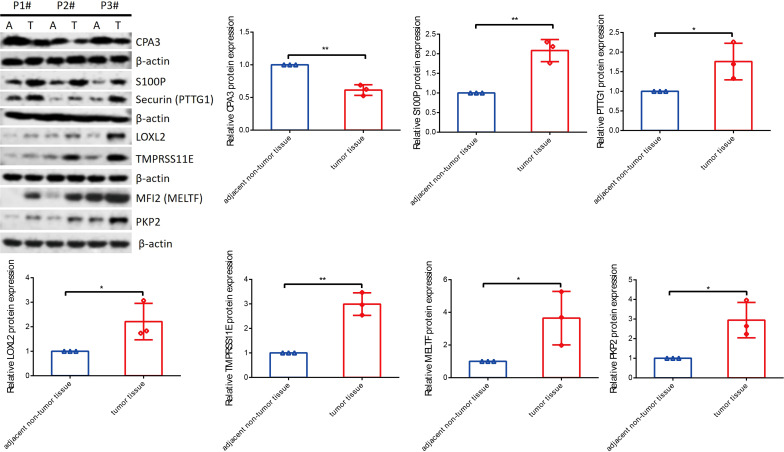
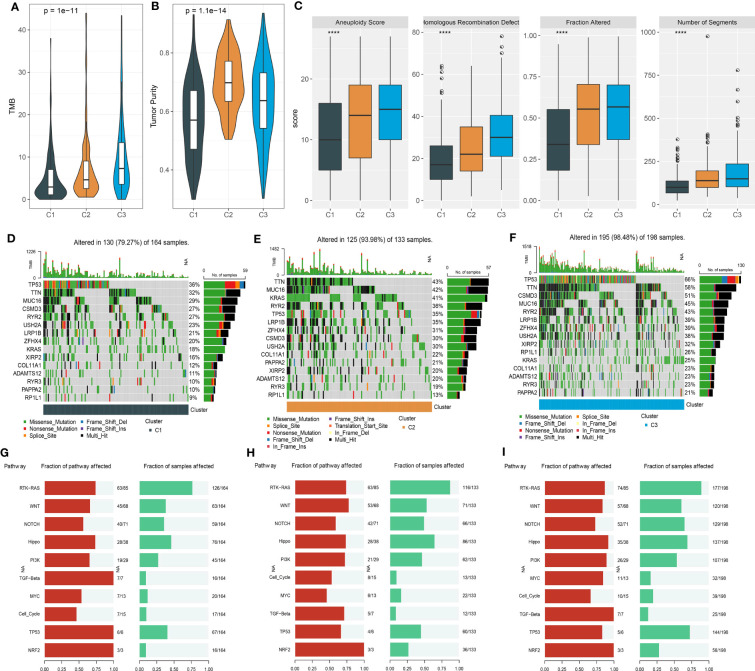
A total of 27 immune cell marker genes associated with prognosis were identified for subtyping LUAD samples into clusters C3, C2, and C1. C1 had the longest overall survival and highest immune infiltration among them, followed by C2 and C3. Oncogenic pathways such as VEGF, EFGR, and MAPK were more activated in C3 compared to the other two clusters. Based on the DEGs among clusters, we confirmed seven key prognostic genes including CPA3, S100P, PTTG1, LOXL2, MELTF, PKP2, and TMPRSS11E. Two risk groups defined by the seven-gene risk model presented distinct responses to immunotherapy and chemotherapy, immune infiltration, and prognosis. The mRNA and protein level of CPA3 was decreased, while the remaining six gene levels were increased in clinical tumor tissues.
Immune cell markers are effective in clustering LUAD samples into different subtypes, and they play important roles in regulating the immune microenvironment and cancer development. In addition, the seven-gene risk model may serve as a guide for assisting in personalized treatment in LUAD patients.
肺腺癌(LUAD)作为一种常见的肺癌类型,在晚期肺癌患者中的 5 年总生存率低于 20%。本研究旨在构建一个风险模型,以有效指导 LUAD 患者的免疫治疗。
从癌症基因组图谱(TCGA)和基因表达综合数据库(GEO)中收集 LUAD 批量 RNA-seq 数据用于模型构建、单细胞 RNA 测序(scRNA-seq)数据(GSE203360)用于细胞聚类分析和微阵列数据(GSE31210)用于验证。我们使用 Seurat R 软件包过滤和处理 scRNA-seq 数据。使用 ConsensusClusterPlus R 软件包进行样本聚类。使用 Limma R 软件包挖掘两组之间的差异表达基因(DEGs)。使用 MCP-counter、CIBERSORT、ssGSEA 和 ESTIMATE 评估免疫特征。进行逐步多变量分析、单变量 Cox 分析和 Lasso 回归分析以确定关键预后基因,并用于构建风险模型。通过 RT-qPCR 和 Western blot 检测验证关键预后基因的表达。
鉴定了 27 个与 LUAD 样本预后相关的免疫细胞标记基因,将 LUAD 样本分为 C3、C2 和 C1 亚群。其中 C1 的总生存时间最长,免疫浸润程度最高,其次是 C2 和 C3。与其他两个亚群相比,C3 中血管内皮生长因子(VEGF)、表皮生长因子受体(EFGR)和丝裂原活化蛋白激酶(MAPK)等致癌途径更为活跃。基于亚群之间的 DEGs,我们验证了包括 CPA3、S100P、PTTG1、LOXL2、MELTF、PKP2 和 TMPRSS11E 在内的 7 个关键预后基因。由七个基因风险模型定义的两个风险组对免疫治疗和化疗、免疫浸润和预后有不同的反应。在临床肿瘤组织中,CPA3 的 mRNA 和蛋白水平降低,而其余六个基因水平升高。
免疫细胞标记物可有效将 LUAD 样本聚类为不同亚型,在调节免疫微环境和癌症发展方面发挥重要作用。此外,七基因风险模型可能有助于指导 LUAD 患者的个体化治疗。