Boston University School of Public Health, Department of Biostatistics, Boston, Massachusetts, USA.
Department of Pathology and Laboratory Medicine, Larner College of Medicine, University of Vermont, Burlington, Vermont, USA.
Aging Cell. 2023 Oct;22(10):e13955. doi: 10.1111/acel.13955. Epub 2023 Aug 16.
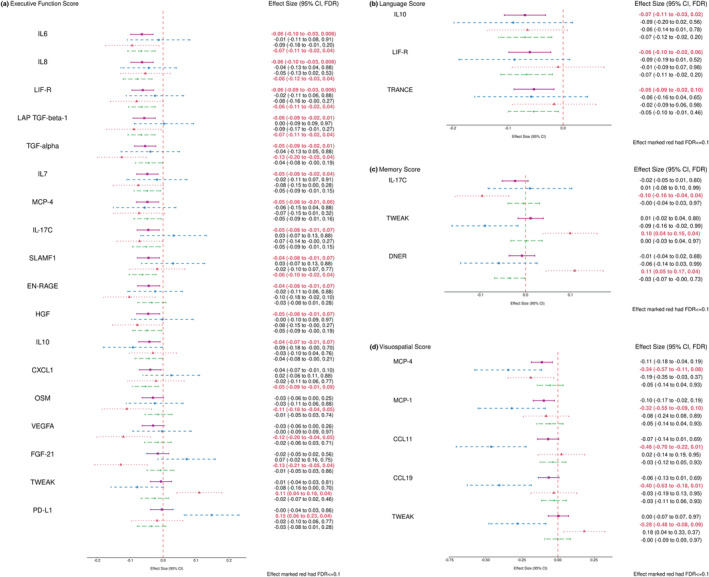
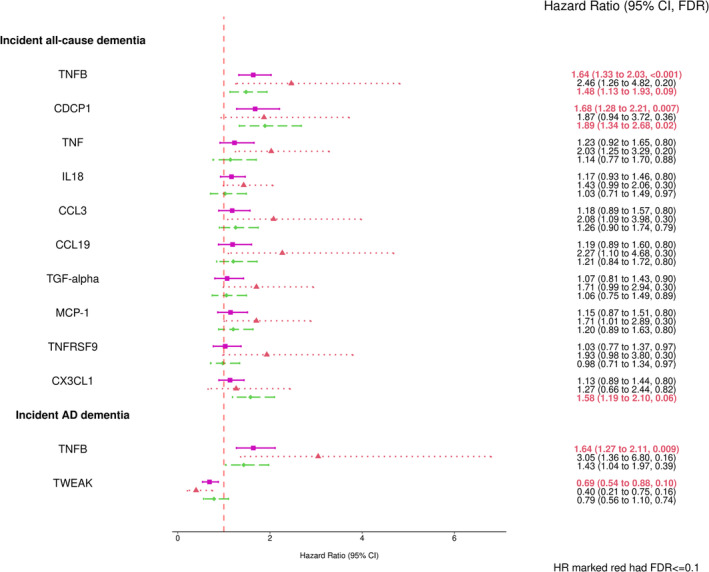
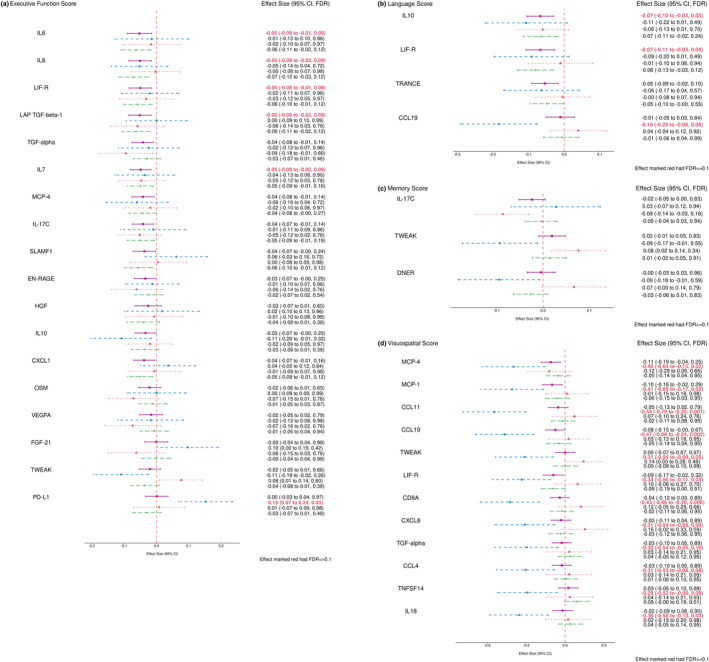
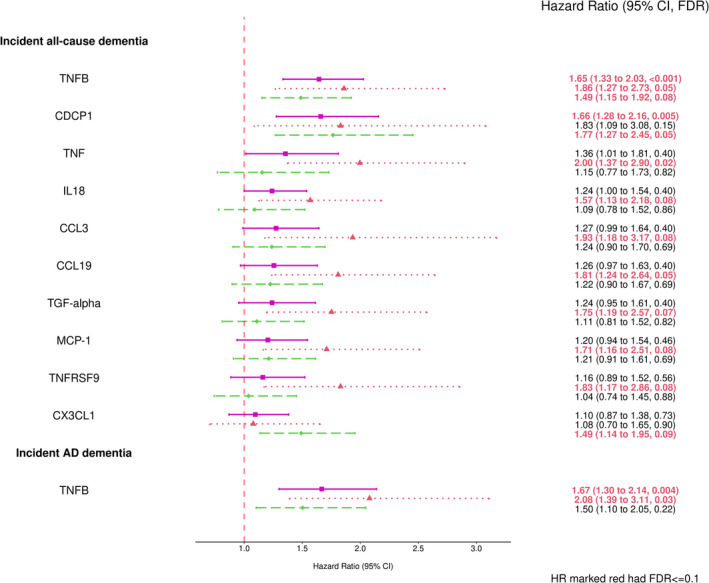
Inflammatory protein biomarkers induced by immune responses have been associated with cognitive decline and the pathogenesis of Alzheimer's disease (AD). Here, we investigate associations between a panel of inflammatory biomarkers and cognitive function and incident dementia outcomes in the well-characterized Framingham Heart Study Offspring cohort. Participants aged ≥40 years and dementia-free at Exam 7 who had a stored plasma sample were selected for profiling using the OLINK proteomics inflammation panel. Cross-sectional associations of the biomarkers with cognitive domain scores (N = 708, 53% female, 22% apolipoprotein E (APOE) ε4 carriers, 15% APOE ε2 carriers, mean age 61) and incident all-cause and AD dementia during up to 20 years of follow-up were tested. APOE genotype-stratified analyses were performed to explore effect modification. Higher levels of 12 and 3 proteins were associated with worse executive function and language domain factor scores, respectively. Several proteins were associated with more than one cognitive domain, including IL10, LIF-R, TWEAK, CCL19, IL-17C, MCP-4, and TGF-alpha. Stratified analyses suggested differential effects between APOE ε2 and ε4 carriers: most ε4 carrier associations were with executive function and memory domains, whereas most ε2 associations were with the visuospatial domain. Higher levels of TNFB and CDCP1 were associated with higher risks of incident all-cause and AD dementia. Our study found that TWEAK concentration was associated both with cognitive function and risks for AD dementia. The association of these inflammatory biomarkers with cognitive function and incident dementia may contribute to the discovery of therapeutic interventions for the prevention and treatment of cognitive decline.
免疫反应引起的炎症蛋白生物标志物与认知能力下降和阿尔茨海默病(AD)的发病机制有关。在这里,我们研究了一系列炎症生物标志物与认知功能的关系,并在特征明确的弗雷明汉心脏研究后代队列中研究了这些生物标志物与认知障碍和痴呆发病结果之间的关系。选择在第 7 次检查时年龄≥40 岁且无痴呆的参与者,并对其储存的血浆样本进行分析,以使用 OLINK 蛋白质组学炎症分析面板进行分析。在多达 20 年的随访期间,对生物标志物与认知域评分的横断面关联(N=708,53%为女性,22%为载脂蛋白 E(APOE)ε4 携带者,15%为 APOE ε2 携带者,平均年龄 61 岁)和全因和 AD 痴呆的发病进行了测试。进行了 APOE 基因型分层分析以探索效应修饰。12 种和 3 种蛋白质的水平升高分别与执行功能和语言域因子评分较差相关。有几种蛋白质与多个认知域相关,包括 IL10、LIF-R、TWEAK、CCL19、IL-17C、MCP-4 和 TGF-α。分层分析表明,APOE ε2 和 ε4 携带者之间的影响存在差异:大多数 ε4 携带者的关联与执行功能和记忆域有关,而大多数 ε2 携带者的关联与视觉空间域有关。较高的 TNFB 和 CDCP1 水平与全因和 AD 痴呆的发病风险增加有关。我们的研究发现,TWEAK 浓度与认知功能和 AD 痴呆的发病风险均相关。这些炎症生物标志物与认知功能和发病性痴呆的相关性可能有助于发现预防和治疗认知能力下降的治疗干预措施。