Aflac Cancer and Blood Disorders Center at Children's Healthcare of Atlanta, Atlanta, GA, USA.
Department of Pediatrics, Emory University School of Medicine, Atlanta, GA, USA.
J Assist Reprod Genet. 2023 Oct;40(10):2391-2400. doi: 10.1007/s10815-023-02908-7. Epub 2023 Aug 16.
Reproductive health is important, but often neglected in cancer survivorship care. This study explored contraceptive use and factors associated with fertility testing among young adult survivors of childhood cancer in Germany.
Young adult survivors of childhood cancer were identified through the German Childhood Cancer Registry and completed a mailed survey. Survivors were queried regarding contraceptive use, reproductive goals, uncertainty about fertility, and completion or interest in fertility testing. Multivariable stepwise logistic regression models were used to calculate Odds Ratios (OR) and 95% confidence intervals (CI) as a means of identifying factors associated with completion of and interest in fertility testing.
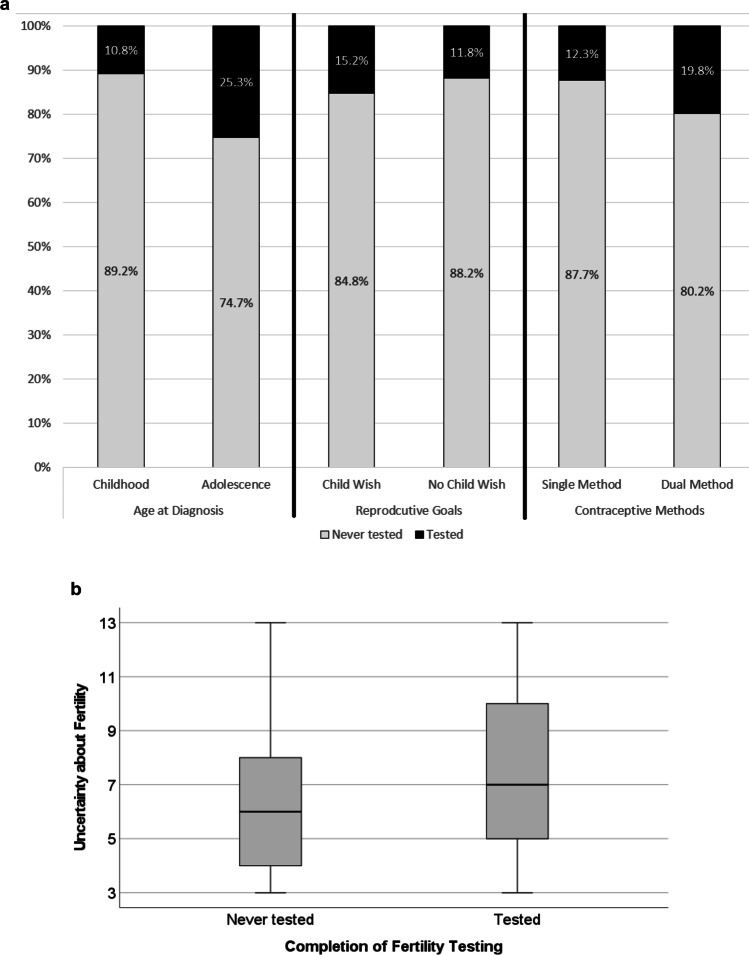
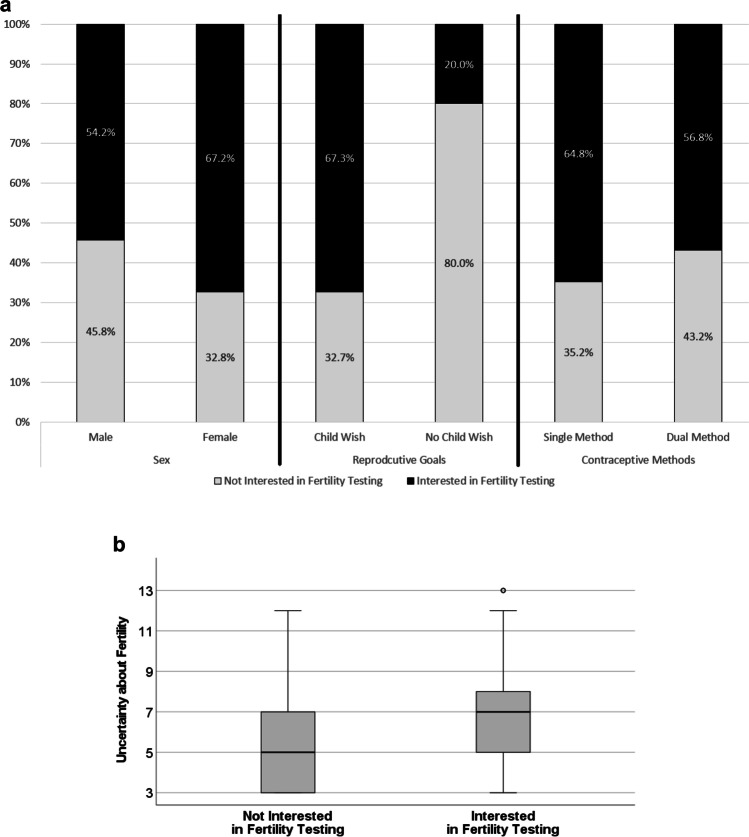
Survivors (N = 472; 57.8% female; aged 23.3 ± 1.5 years, and 14.9 ± 5.0 years from diagnosis), reported high rates of contraceptive use, including 61.2% using a single method, 30.6% dual methods, and 8.1% no/less effective methods. Few survivors had completed fertility testing (13.0%), although 58.8% were interested. Having been diagnosed during adolescence (OR = 2.66, 95%CI: 1.39-5.09), greater uncertainty about fertility (OR = 1.16, 95%CI: 1.03-1.31), and use of dual contraceptive methods (OR = 1.94, 95%CI: 1.02-3.69) were associated with having completed fertility testing. Factors associated with interest in fertility testing included goals of wanting to have children (OR = 7.76, 95%CI: 3.01-20.04) and greater uncertainty about fertility (OR = 1.19 95%CI: 1.06-1.33).
In this sample of young adults who survived childhood cancer, most reported contraceptive use. Few survivors had completed fertility testing, although more than half were interested. Interventions are needed to address potential barriers to fertility testing and help survivors manage fertility-related uncertainty.
生殖健康很重要,但在癌症生存者护理中往往被忽视。本研究探讨了德国儿童癌症幸存者中年轻成年人的避孕措施使用情况和与生育力检测相关的因素。
通过德国儿童癌症登记处确定年轻的儿童癌症幸存者,并完成邮寄调查。询问幸存者避孕措施使用情况、生育目标、对生育能力的不确定性以及完成或有兴趣进行生育力检测的情况。使用多变量逐步逻辑回归模型计算优势比(OR)和 95%置信区间(CI),以确定与完成和有兴趣进行生育力检测相关的因素。
幸存者(N=472;57.8%为女性;年龄 23.3±1.5 岁,诊断后 14.9±5.0 岁)报告了高避孕措施使用率,包括 61.2%使用单一方法,30.6%使用双重方法,8.1%使用无效/低效方法。尽管有 58.8%的人感兴趣,但很少有幸存者完成生育力检测(13.0%)。青春期诊断(OR=2.66,95%CI:1.39-5.09)、对生育能力的不确定性更大(OR=1.16,95%CI:1.03-1.31)和使用双重避孕方法(OR=1.94,95%CI:1.02-3.69)与完成生育力检测相关。与对生育力检测感兴趣相关的因素包括有生育孩子的目标(OR=7.76,95%CI:3.01-20.04)和对生育能力的不确定性更大(OR=1.19,95%CI:1.06-1.33)。
在本研究中,大多数接受调查的儿童癌症幸存者报告使用了避孕措施。尽管有超过一半的幸存者有兴趣,但很少有幸存者完成生育力检测。需要采取干预措施来解决生育力检测的潜在障碍,并帮助幸存者管理与生育能力相关的不确定性。