Soderlund Matthew, Boren Morgan, O'Reilly Andrew, San Juan Angielyn, Mahylis Jared M
Department of Orthopaedic Surgery, Midwestern University/Franciscan Health-Olympia Fields, Olympia Fields, IL, USA.
Department of Orthopedic Surgery, Northshore University Health System, Evanston, IL, USA.
JSES Rev Rep Tech. 2021 Oct 2;2(1):1-7. doi: 10.1016/j.xrrt.2021.08.012. eCollection 2022 Feb.
Surgical management of massive irreparable rotator cuff tears remains controversial. Arthroscopic debridement (AD) has shown promising results especially in the population older than 65 years; however, there is no consensus on the benefits of various AD procedures. The aim of this systematic review was to evaluate the functional midterm to long-term outcomes in patients treated with AD in combination with subacromial decompression, biceps tenotomy, tuberoplasty, or bursectomy, without repair of the rotator cuff tear.
A comprehensive search was performed in PubMed, Cumulative Index to Nursing and Allied Health Literature (CINAHL), and Cochrane databases for studies reporting clinical outcomes of AD of massive rotator cuff tears. Quality was determined using the Methodological Index for Nonrandomized Studies (MINORS) criteria by two independent reviewers. Pooled frequency-weighted means and standard deviations were calculated for patient-reported outcomes.
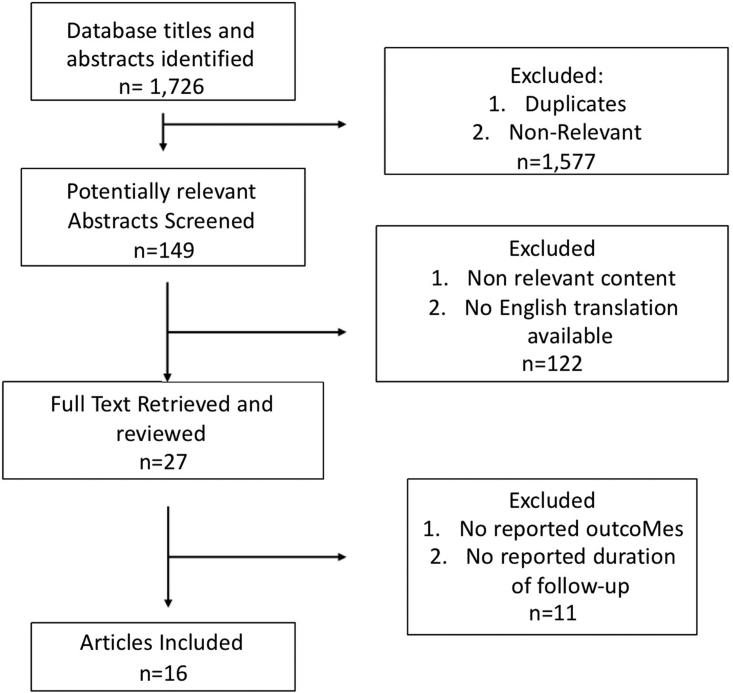
Sixteen articles containing 643 patients and 662 shoulders met the eligibility criteria. The mean age at the time of surgery was 65.9 ± 4.4 years with a mean follow-up period of 46.5 ± 27.3 months. There was notable clinically significant improvement across all patient-reported outcome scores postoperatively: Constant 70.4 ± 8.9 ( value = .06), University of California, Los Angeles ultrasonography 26.7 ± 5.2 ( value = .001), American Shoulder and Elbow Surgeons score 71.7 ± 2.1 ( value = .12), Disabilities of the Arm, Shoulder, and Hand score 35.3, and visual analog score 1.7 ± 0.9. Forty-nine patients (7%) required reoperation, which most commonly was a reverse total shoulder arthroplasty for the development of rotator cuff arthropathy.
Arthroscopic debridement with a combination of subacromial decompression, tuberoplasty, subacromial bursectomy, and biceps tenotomy, for treatment of massive irreparable rotator cuff tears, produces good functional outcomes and improvement in pain at mid to long term follow up for the low-demand population greater than 65 years of age looking for pain relief over substantial increase in function.
巨大不可修复性肩袖撕裂的手术治疗仍存在争议。关节镜下清创术(AD)已显示出有前景的结果,尤其是在65岁以上人群中;然而,对于各种AD手术的益处尚无共识。本系统评价的目的是评估在不修复肩袖撕裂的情况下,接受AD联合肩峰下减压、肱二头肌切断术、结节成形术或滑囊切除术治疗的患者的中期至长期功能结局。
在PubMed、护理及相关健康文献累积索引(CINAHL)和Cochrane数据库中进行全面检索,以查找报告巨大肩袖撕裂AD临床结局的研究。由两名独立 reviewers 使用非随机研究方法学索引(MINORS)标准确定质量。计算患者报告结局的合并频率加权均值和标准差。
16篇文章包含643例患者和662个肩部,符合纳入标准。手术时的平均年龄为65.9±4.4岁,平均随访期为46.5±27.3个月。术后所有患者报告结局评分均有显著的临床显著改善:Constant评分70.4±8.9(P值=.06),加利福尼亚大学洛杉矶分校超声评分26.7±5.2(P值=.001),美国肩肘外科医师评分71.7±2.1(P值=.12),上肢、肩部和手部功能障碍评分35.3,视觉模拟评分1.7±0.9。49例患者(7%)需要再次手术,最常见的是因肩袖关节病行反式全肩关节置换术。
对于65岁以上低需求人群,寻求缓解疼痛而非大幅提高功能,采用AD联合肩峰下减压、结节成形术、肩峰下滑囊切除术和肱二头肌切断术治疗巨大不可修复性肩袖撕裂,在中期至长期随访中可产生良好的功能结局并改善疼痛。