Disel Umut, Sivakumar Smruthy, Pham Tim, Fleischmann Zoe, Anu R I, Sokol Ethan S, Kurzrock Razelle
Acıbadem Adana Hospital, Department of Medical Oncology, Adana, Turkey.
Foundation Medicine, Inc., Cambridge, MA, USA.
Oncologist. 2024 Feb 2;29(2):e213-e223. doi: 10.1093/oncolo/oyad230.
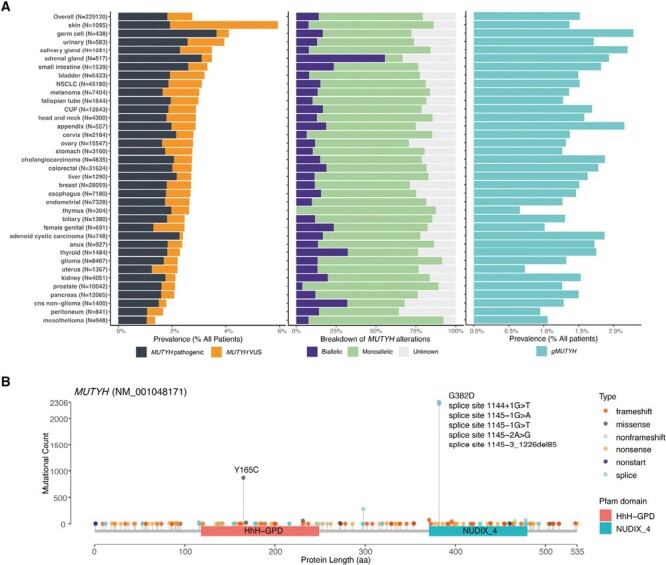
The aim of this study was to determine the pan-cancer landscape of MUTYH alterations and the relationship between MUTYH mutations and potentially actionable biomarkers such as specific genomic alterations, tumor mutational burden, and mutational signatures. We used a large pan-cancer comprehensive genomic dataset from patients profiled (tissue next generation sequencing) during routine clinical care. Overall, 2.8% of 229 120 solid tumors had MUTYH alterations, of which 55% were predicted germline. Thirty tumor types had a 2% or greater MUTYH mutation rate. MUTYH-altered versus -WT cancers had significantly higher tumor mutational burden and more frequent alterations in KRAS G12C, but not in KRAS in general; these observations were statistically significant, especially in colorectal cancers. Across cancers, PD-L1 expression levels (immunohistochemistry) were not associated with MUTYH alteration status. In silico computation demonstrated that MUTYH mutational signatures are associated with higher levels of hydrophobicity (which may reflect higher immunogenicity of neoantigens) relative to several other signature types such as microsatellite instability. Survival of patients with MUTYH-altered versus -WT tumors was similar. In conclusion, comprehensive genomic profiling suggests that several features of MUTYH-altered cancers may be pharmacologically targetable. Drugs such as sotorasib (targeting KRAS G12C) and immune checkpoint inhibitors, targeting the increased mutational load and higher neo-antigen hydrophobicity/immunogenicity merit investigation in MUTYH-mutated malignancies.
本研究的目的是确定MUTYH改变的泛癌格局以及MUTYH突变与潜在可操作生物标志物(如特定基因组改变、肿瘤突变负担和突变特征)之间的关系。我们使用了来自常规临床护理期间进行分析的患者(组织下一代测序)的大型泛癌综合基因组数据集。总体而言,229120例实体瘤中有2.8%存在MUTYH改变,其中55%被预测为种系突变。30种肿瘤类型的MUTYH突变率达到或超过2%。与野生型癌症相比,MUTYH改变的癌症具有显著更高的肿瘤突变负担,且KRAS G12C的改变更为频繁,但KRAS总体改变并不频繁;这些观察结果具有统计学意义,在结直肠癌中尤为明显。在所有癌症中,PD-L1表达水平(免疫组织化学)与MUTYH改变状态无关。计算机模拟计算表明,相对于其他几种特征类型(如微卫星不稳定性),MUTYH突变特征与更高水平的疏水性相关(这可能反映新抗原的更高免疫原性)。MUTYH改变的肿瘤患者与野生型肿瘤患者的生存率相似。总之,综合基因组分析表明,MUTYH改变的癌症的几个特征可能是可药物靶向的。索托拉西布(靶向KRAS G12C)和免疫检查点抑制剂等药物,针对增加的突变负荷和更高的新抗原疏水性/免疫原性,值得在MUTYH突变的恶性肿瘤中进行研究。