Chen Jiayan, Qin Guanghao, Li Liangzhe, Qi Yifan, Xia Yang, Zhang Qing, Wu Yi, You Yue, Yang Lanting, Guo Naici, Moutari Salissou, Moore Jonathan E, Bu Shaochong, Xu Ling, He Wei, Yu Sile, Pazo Emmanuel Eric, He Xingru
Department of Ophthalmology, He Eye Specialist Hospital, Shenyang, 110034, China.
Tianjin Medical University, Tianjin, China.
Ophthalmol Ther. 2023 Dec;12(6):2959-2971. doi: 10.1007/s40123-023-00784-z. Epub 2023 Aug 17.
The primary objective of this study is to assess whether the combination of intense pulsed light (IPL) with 3% diquafosol (DQS) ophthalmic solution is more effective than intense pulsed light in alleviating signs and symptoms of dry eye disease (DED).
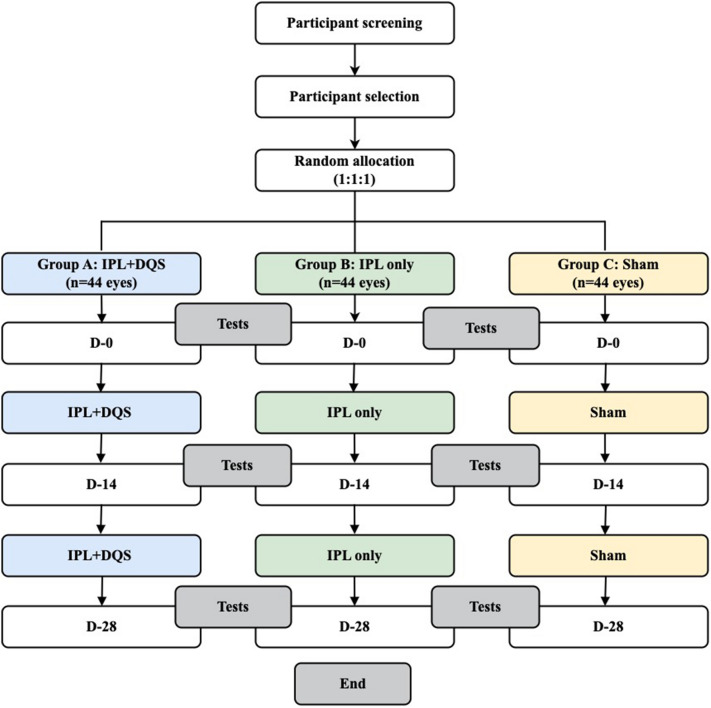
This randomized study included 66 participants with evaporative dry eye (EDE) who received IPL + DQS therapy (n = 44 eyes), IPL therapy (n = 44 eyes), or sham therapy (n = 44 eyes). All participants were examined at baseline (D0), day 14 (D14), and day 28 (D28) for non-invasive break-up time (NITBUT), tear-film lipid layer (TFLL), corneal conjunctival staining (CS), meibomian gland quality (MGQ), meibomian gland expression (MGEx), and ocular surface disease index (OSDI).
At day 28, comparison among the IPL + DQS therapy, IPL therapy, and sham therapy found significant differences in the mean NITBUT (12.03 ± 1.27 versus 10.47 ± 3.48 versus 4.57 ± 0.46; p < 0.001), TFLL (2.09 ± 0.29 versus 2.27 ± 0.45 versus 2.89 ± 0.65; p < 0.001), CS (1.43 ± 0.82 versus 1.93 ± 1.32 versus 3.52 ± 1.00; p < 0.001), MGQ (1.55 ± 0.66 versus 1.91 ± 0.77 versus 2.66 ± 0.53; p < 0.001), MGEx (1.27 ± 0.45 versus 1.75 ± 0.44 versus 2.41 ± 0.50; p < 0.001), and OSDI score (19.36 ± 7.01 versus 24.77 ± 4.68 versus 42.61 ± 7.49; p < 0.001); significant improvements in NITBUT, TFLL, CS, MGQ, MGEx, and OSDI were found in the IPL + DQS therapy and IPL therapy, while the sham therapy had no significant improvements.
Combining 3% diquafosol ophthalmic solution with intense pulsed light was superior to IPL therapy alone in relieving the signs and symptoms of patients with severe evaporative DED.
Clinical Trials Identifier: NCT05694026.
本研究的主要目的是评估强脉冲光(IPL)与3%地夸磷索(DQS)滴眼液联合使用在缓解干眼疾病(DED)体征和症状方面是否比单纯强脉冲光更有效。
这项随机研究纳入了66名患有蒸发型干眼(EDE)的参与者,他们接受了IPL + DQS治疗(n = 44只眼)、IPL治疗(n = 44只眼)或假治疗(n = 44只眼)。所有参与者在基线(D0)、第14天(D14)和第28天(D28)接受检查,评估指标包括无创泪膜破裂时间(NITBUT)、泪膜脂质层(TFLL)、角膜结膜染色(CS)、睑板腺质量(MGQ)、睑板腺分泌(MGEx)和眼表疾病指数(OSDI)。
在第28天,IPL + DQS治疗组、IPL治疗组和假治疗组之间的比较发现,平均NITBUT(12.03±1.27对10.47±3.48对4.57±0.46;p < 0.001)、TFLL(2.09±0.29对2.27±0.45对2.89±0.65;p < 0.001)、CS(1.43±0.82对1.93±1.32对3.52±1.00;p < 0.001)、MGQ(1.55±0.66对1.91±0.77对2.66±0.53;p < 0.001)、MGEx(1.27±0.45对1.75±0.44对2.41±0.50;p < 0.001)和OSDI评分(19.36±7.01对24.77±4.68对42.61±7.49;p < 0.001)存在显著差异;IPL + DQS治疗组和IPL治疗组的NITBUT、TFLL、CS、MGQ、MGEx和OSDI有显著改善,而假治疗组无显著改善。
3%地夸磷索滴眼液与强脉冲光联合使用在缓解重度蒸发型DED患者的体征和症状方面优于单纯IPL治疗。
临床试验标识符:NCT05694026。