Department of Radiation Oncology, Mayo Clinic, Rochester, MN, USA.
Department of Radiology, Mayo Clinic, Rochester, MN, USA.
Blood Cancer J. 2023 Aug 18;13(1):127. doi: 10.1038/s41408-023-00895-7.
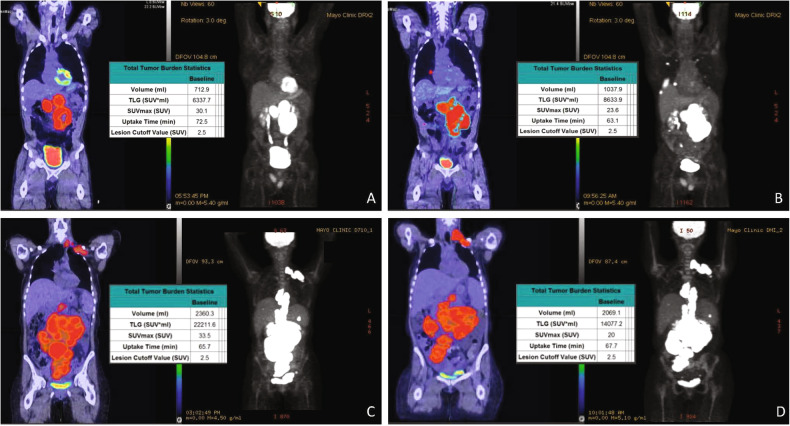
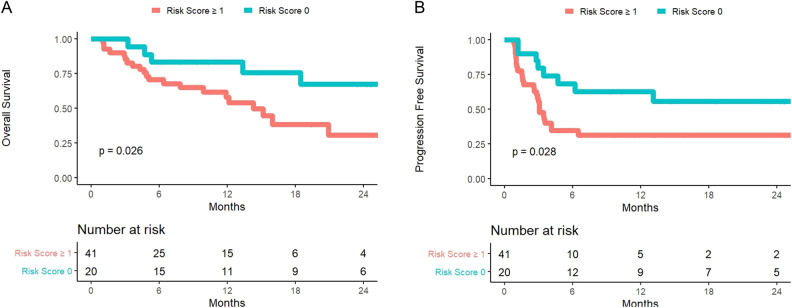
PET/CT is used to evaluate relapsed/refractory non-Hodgkin lymphoma (NHL) prior to chimeric antigen receptor T-cell (CAR-T) infusion at two time points: pre-leukapheresis (pre-leuk) and pre-lymphodepletion chemotherapy (pre-LD). We hypothesized that changes in PET/CT between these time points predict outcomes after CAR-T. Metabolic tumor volume (MTV), total lesion glycolysis (TLG), and other metrics were calculated from pre-leuk and pre-LD PET/CT scans in patients with NHL who received axicabtagene ciloleucel, and assessed for association with outcomes. Sixty-nine patients were analyzed. While single time point PET/CT characteristics were not associated with risk of PD or death, increases from pre-leuk to pre-LD in parenchymal MTV, nodal MTV, TLG of the largest lesion, and total number of lesions were associated with increased risk of death (p < 0.05 for all). LASSO analysis identified increasing extranodal MTV and increasing TLG of the largest lesion as strong predictors of death (AUC 0.74). Greater pre-LD total MTV was associated with higher risk of grade 3+ immune effector cell-associated neurotoxicity syndrome (ICANS) (p = 0.042). Increasing metabolic disease burden during CAR-T manufacturing is associated with increased risk of progression and death. A two variable risk score stratifies prognosis prior to CAR-T infusion and may inform risk-adapted strategies.
PET/CT 用于在嵌合抗原受体 T 细胞 (CAR-T) 输注前评估复发/难治性非霍奇金淋巴瘤 (NHL),在两个时间点进行:白细胞分离前 (pre-leuk) 和淋巴细胞耗竭化疗前 (pre-LD)。我们假设这些时间点之间的 PET/CT 变化可预测 CAR-T 后的结果。在接受 axicabtagene ciloleucel 的 NHL 患者的 pre-leuk 和 pre-LD PET/CT 扫描中计算代谢肿瘤体积 (MTV)、总病变糖酵解 (TLG) 和其他指标,并评估其与结果的相关性。分析了 69 例患者。虽然单点 PET/CT 特征与 PD 或死亡风险无关,但从 pre-leuk 到 pre-LD 的实质 MTV、淋巴结 MTV、最大病变的 TLG 和病变总数的增加与死亡风险增加相关(所有 p 值均 < 0.05)。LASSO 分析确定了增加的结外 MTV 和最大病变的 TLG 是死亡的强预测因素(AUC 为 0.74)。预 LD 总 MTV 越高,与 3+级免疫效应细胞相关神经毒性综合征 (ICANS) 的风险越高(p=0.042)。CAR-T 制造过程中代谢疾病负担的增加与进展和死亡的风险增加相关。两个变量风险评分在 CAR-T 输注前分层预后,并可能为风险适应策略提供信息。