• 文献检索
  • 文档翻译
  • 深度研究
  • 学术资讯
  • Suppr Zotero 插件Zotero 插件
  • 邀请有礼
  • 套餐&价格
  • 历史记录
应用&插件
Suppr Zotero 插件Zotero 插件浏览器插件Mac 客户端Windows 客户端微信小程序
定价
高级版会员购买积分包购买API积分包
服务
文献检索文档翻译深度研究API 文档MCP 服务
关于我们
关于 Suppr公司介绍联系我们用户协议隐私条款
关注我们

Suppr 超能文献

核心技术专利:CN118964589B侵权必究
粤ICP备2023148730 号-1Suppr @ 2026

文献检索

告别复杂PubMed语法,用中文像聊天一样搜索,搜遍4000万医学文献。AI智能推荐,让科研检索更轻松。

立即免费搜索

文件翻译

保留排版,准确专业,支持PDF/Word/PPT等文件格式,支持 12+语言互译。

免费翻译文档

深度研究

AI帮你快速写综述,25分钟生成高质量综述,智能提取关键信息,辅助科研写作。

立即免费体验

磁细菌在天体生物学中的复兴。

Renaissance for magnetotactic bacteria in astrobiology.

机构信息

Key Laboratory of Earth and Planetary Physics, Institute of Geology and Geophysics, Chinese Academy of Sciences, Beijing, 100029, China.

France-China Joint Laboratory for Evolution and Development of Magnetotactic Multicellular Organisms, Chinese Academy of Sciences, 100029, Beijing, China.

出版信息

ISME J. 2023 Oct;17(10):1526-1534. doi: 10.1038/s41396-023-01495-w. Epub 2023 Aug 17.

DOI:10.1038/s41396-023-01495-w
PMID:37592065
原文链接:https://pmc.ncbi.nlm.nih.gov/articles/PMC10504353/
Abstract

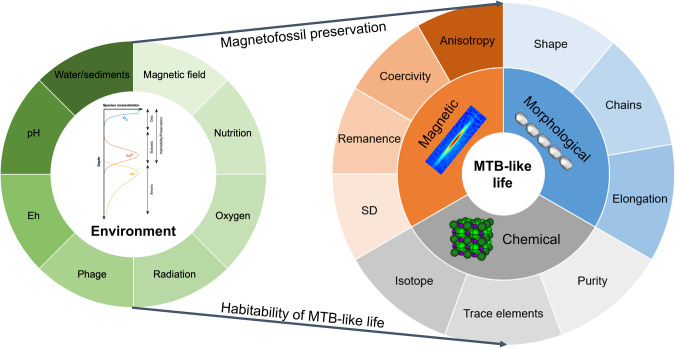
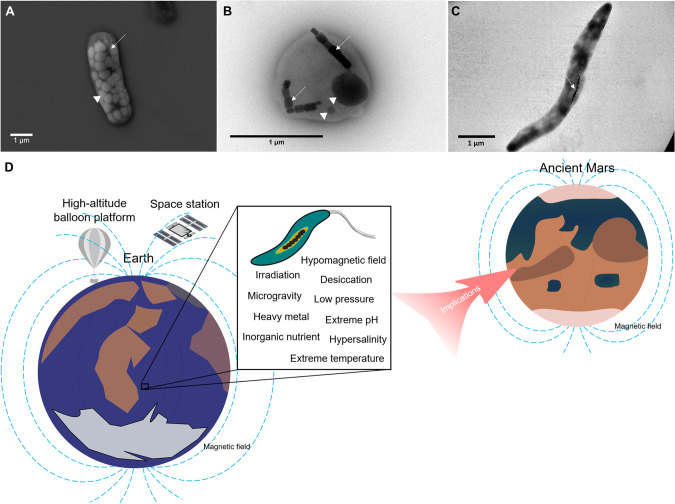
Capable of forming magnetofossils similar to some magnetite nanocrystals observed in the Martian meteorite ALH84001, magnetotactic bacteria (MTB) once occupied a special position in the field of astrobiology during the 1990s and 2000s. This flourish of interest in putative Martian magnetofossils faded from all but the experts studying magnetosome formation, based on claims that abiotic processes could produce magnetosome-like magnetite crystals. Recently, the rapid growth in our knowledge of the extreme environments in which MTB thrive and their phylogenic heritage, leads us to advocate for a renaissance of MTB in astrobiology. In recent decades, magnetotactic members have been discovered alive in natural extreme environments with wide ranges of salinity (up to 90 g L), pH (1-10), and temperature (0-70 °C). Additionally, some MTB populations are found to be able to survive irradiated, desiccated, metal-rich, hypomagnetic, or microgravity conditions, and are capable of utilizing simple inorganic compounds such as sulfate and nitrate. Moreover, MTB likely emerged quite early in Earth's history, coinciding with a period when the Martian surface was covered with liquid water as well as a strong magnetic field. MTB are commonly discovered in suboxic or oxic-anoxic interfaces in aquatic environments or sediments similar to ancient crater lakes on Mars, such as Gale crater and Jezero crater. Taken together, MTB can be exemplary model microorganisms in astrobiology research, and putative ancient Martian life, if it ever occurred, could plausibly have included magnetotactic microorganisms. Furthermore, we summarize multiple typical biosignatures that can be applied for the detection of ancient MTB on Earth and extraterrestrial MTB-like life. We suggest transporting MTB to space stations and simulation chambers to further investigate their tolerance potential and distinctive biosignatures to aid in understanding the evolutionary history of MTB and the potential of magnetofossils as an extraterrestrial biomarker.

摘要

能够形成类似于火星陨石 ALH84001 中观察到的一些磁铁矿纳米晶体的磁化石的趋磁细菌 (MTB),在 20 世纪 90 年代和 21 世纪初的天体生物学领域占据了特殊地位。由于声称非生物过程可以产生类似磁小体的磁铁矿晶体,因此对假定的火星磁化石的兴趣除了研究磁小体形成的专家之外,几乎都消失了。最近,我们对 MTB 赖以生存的极端环境及其系统发育遗产的了解迅速增加,这促使我们主张在天体生物学中重新研究 MTB。在过去的几十年中,在具有广泛盐度(高达 90 g/L)、pH 值(1-10)和温度(0-70°C)的自然极端环境中发现了活体趋磁细菌成员。此外,一些 MTB 种群被发现能够在辐照、干燥、富含金属、低磁或微重力条件下生存,并能够利用简单的无机化合物,如硫酸盐和硝酸盐。此外,MTB 可能在地球历史的早期就已经出现,这与火星表面被液态水以及强磁场覆盖的时期相吻合。MTB 通常在水生环境或沉积物的缺氧或有氧-缺氧界面中发现,类似于火星上的古老陨石坑湖,如盖尔陨石坑和杰泽罗陨石坑。综上所述,MTB 可以成为天体生物学研究中典型的模式微生物,如果曾经存在过古代火星生命,那么很可能包括趋磁微生物。此外,我们总结了多个可用于检测地球和外星 MTB 样生命的典型生物特征。我们建议将 MTB 运送到空间站和模拟室,以进一步研究它们的耐受潜力和独特的生物特征,以帮助理解 MTB 的进化历史和磁化石作为外星生物标志物的潜力。
https://cdn.ncbi.nlm.nih.gov/pmc/blobs/c650/10504353/4ba0c6026680/41396_2023_1495_Fig2_HTML.jpg
https://cdn.ncbi.nlm.nih.gov/pmc/blobs/c650/10504353/292f046e5ab7/41396_2023_1495_Fig1_HTML.jpg
https://cdn.ncbi.nlm.nih.gov/pmc/blobs/c650/10504353/4ba0c6026680/41396_2023_1495_Fig2_HTML.jpg
https://cdn.ncbi.nlm.nih.gov/pmc/blobs/c650/10504353/292f046e5ab7/41396_2023_1495_Fig1_HTML.jpg
https://cdn.ncbi.nlm.nih.gov/pmc/blobs/c650/10504353/4ba0c6026680/41396_2023_1495_Fig2_HTML.jpg

相似文献

1
Renaissance for magnetotactic bacteria in astrobiology.磁细菌在天体生物学中的复兴。
ISME J. 2023 Oct;17(10):1526-1534. doi: 10.1038/s41396-023-01495-w. Epub 2023 Aug 17.
2
Planning Implications Related to Sterilization-Sensitive Science Investigations Associated with Mars Sample Return (MSR).与火星样本返回(MSR)相关的对灭菌敏感的科学研究的规划意义。
Astrobiology. 2022 Jun;22(S1):S112-S164. doi: 10.1089/AST.2021.0113. Epub 2022 May 19.
3
Magnetic tests for magnetosome chains in Martian meteorite ALH84001.对火星陨石ALH84001中磁小体链的磁性测试。
Proc Natl Acad Sci U S A. 2004 Jun 1;101(22):8281-4. doi: 10.1073/pnas.0402292101. Epub 2004 May 20.
4
Elongated prismatic magnetite crystals in ALH84001 carbonate globules: potential Martian magnetofossils.ALH84001碳酸盐小球中的细长棱柱形磁铁矿晶体:潜在的火星磁化石。
Geochim Cosmochim Acta. 2000 Dec;64(23):4049-81. doi: 10.1016/s0016-7037(00)00481-6.
5
Quantifying the Potential for Nitrate-Dependent Iron Oxidation on Early Mars: Implications for the Interpretation of Gale Crater Organics.量化早期火星上硝酸盐依赖型氧化铁形成的可能性:对盖尔陨石坑有机物解释的启示。
Astrobiology. 2024 Jun;24(6):590-603. doi: 10.1089/ast.2023.0109. Epub 2024 May 24.
6
Magnetotactic bacteria on Earth and on Mars.地球上和火星上的趋磁细菌。
Astrobiology. 2003 Summer;3(2):263-70. doi: 10.1089/153110703769016361.
7
Truncated hexa-octahedral magnetite crystals in ALH84001: presumptive biosignatures.ALH84001中的截短六八面体磁铁矿晶体:推测的生物特征
Proc Natl Acad Sci U S A. 2001 Feb 27;98(5):2164-9. doi: 10.1073/pnas.051500898.
8
Magnetite biomineralization and ancient life on Mars.火星上的磁铁矿生物矿化与古代生命
Curr Opin Chem Biol. 2000 Apr;4(2):171-6. doi: 10.1016/s1367-5931(99)00072-1.
9
Magnetofossils from ancient Mars: a robust biosignature in the martian meteorite ALH84001.来自古代火星的磁化石:火星陨石ALH84001中一种可靠的生物特征。
Appl Environ Microbiol. 2002 Aug;68(8):3663-72. doi: 10.1128/AEM.68.8.3663-3672.2002.
10
Origin of carbonate-magnetite-sulfide assemblages in Martian meteorite ALH84001.火星陨石ALH84001中碳酸盐-磁铁矿-硫化物组合的成因
J Geophys Res. 1999 Feb 25;104(E2):3803-13. doi: 10.1029/1998je900034.

引用本文的文献

1
Understanding microbial biomineralization at the molecular level: recent advances.理解微生物生物矿化的分子水平:最新进展。
World J Microbiol Biotechnol. 2024 Sep 16;40(10):320. doi: 10.1007/s11274-024-04132-6.
2
Detecting life by behavior, the overlooked sensitivity of behavioral assays.通过行为检测生命:行为分析实验被忽视的敏感性。
Sci Rep. 2024 Aug 14;14(1):18904. doi: 10.1038/s41598-024-69942-y.

本文引用的文献

1
Astrovirology: how viruses enhance our understanding of life in the Universe.天体病毒学:病毒如何增进我们对宇宙生命的理解。
Int J Astrobiol. 2023 Aug;22(4):247-271. doi: 10.1017/s1473550423000058. Epub 2023 Apr 5.
2
Survival of the magnetotactic bacterium Magnetospirillum gryphiswaldense exposed to Earth's lower near space.趋磁细菌格氏嗜盐碱螺旋菌暴露于地球低近地空间后的存活情况。
Sci Bull (Beijing). 2022 Jul 15;67(13):1335-1339. doi: 10.1016/j.scib.2022.03.005. Epub 2022 Mar 5.
3
Silent gene clusters encode magnetic organelle biosynthesis in a non-magnetotactic phototrophic bacterium.
沉默基因簇编码非磁趋光光合细菌中磁性细胞器的生物合成。
ISME J. 2023 Mar;17(3):326-339. doi: 10.1038/s41396-022-01348-y. Epub 2022 Dec 14.
4
Recovery and genome reconstruction of novel magnetotactic Elusimicrobiota from bog soil.从沼泽土壤中回收和重建新型磁小体 Elusimicrobiota。
ISME J. 2023 Feb;17(2):204-214. doi: 10.1038/s41396-022-01339-z. Epub 2022 Oct 27.
5
Biogeochemical fingerprinting of magnetotactic bacterial magnetite.磁细菌磁铁矿的生物地球化学指纹图谱。
Proc Natl Acad Sci U S A. 2022 Aug 2;119(31):e2203758119. doi: 10.1073/pnas.2203758119. Epub 2022 Jul 28.
6
Magnetotactic bacteria and magnetofossils: ecology, evolution and environmental implications.趋磁细菌和磁化石:生态、进化及环境意义。
NPJ Biofilms Microbiomes. 2022 Jun 1;8(1):43. doi: 10.1038/s41522-022-00304-0.
7
Conservation of magnetite biomineralization genes in all domains of life and implications for magnetic sensing.所有生命领域中磁铁矿生物矿化基因的保守性及其对磁感受的意义。
Proc Natl Acad Sci U S A. 2022 Jan 18;119(3). doi: 10.1073/pnas.2108655119.
8
On the origin of microbial magnetoreception.论微生物磁受体的起源。
Natl Sci Rev. 2020 Feb;7(2):472-479. doi: 10.1093/nsr/nwz065. Epub 2019 May 21.
9
Expanding magnetic organelle biogenesis in the domain Bacteria.在域细菌中扩展磁细胞器生物发生。
Microbiome. 2020 Oct 30;8(1):152. doi: 10.1186/s40168-020-00931-9.
10
A Compass To Boost Navigation: Cell Biology of Bacterial Magnetotaxis.指南针助力导航:细菌趋磁生物学。
J Bacteriol. 2020 Oct 8;202(21). doi: 10.1128/JB.00398-20.