Key Laboratory of Earth and Planetary Physics, Institute of Geology and Geophysics, Chinese Academy of Sciences, Beijing, 100029, China.
Innovation Academy for Earth Science, Chinese Academy of Sciences, Beijing, 100029, China.
Microbiome. 2020 Oct 30;8(1):152. doi: 10.1186/s40168-020-00931-9.
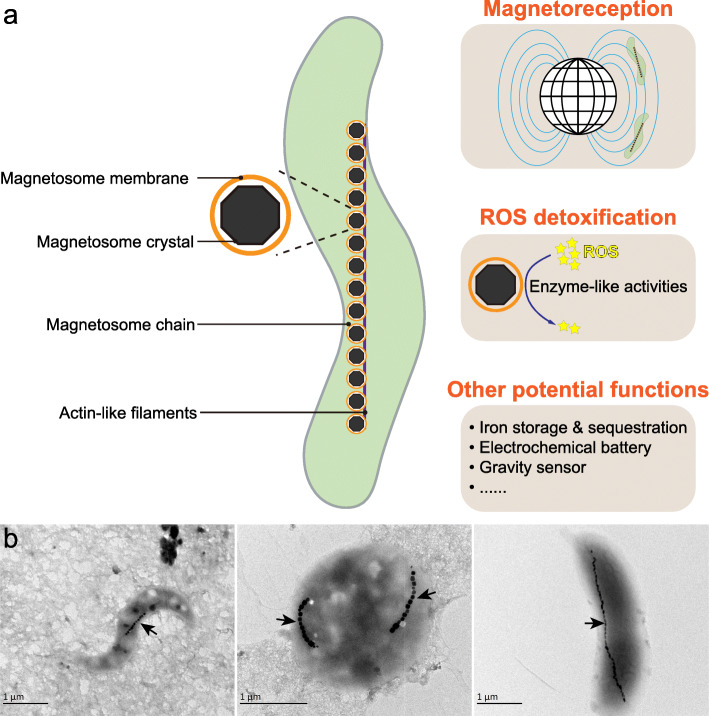
The discovery of membrane-enclosed, metabolically functional organelles in Bacteria has transformed our understanding of the subcellular complexity of prokaryotic cells. Biomineralization of magnetic nanoparticles within magnetosomes by magnetotactic bacteria (MTB) is a fascinating example of prokaryotic organelles. Magnetosomes, as nano-sized magnetic sensors in MTB, facilitate cell navigation along the local geomagnetic field, a behaviour referred to as magnetotaxis or microbial magnetoreception. Recent discovery of novel MTB outside the traditionally recognized taxonomic lineages suggests that MTB diversity across the domain Bacteria are considerably underestimated, which limits understanding of the taxonomic distribution and evolutionary origin of magnetosome organelle biogenesis.
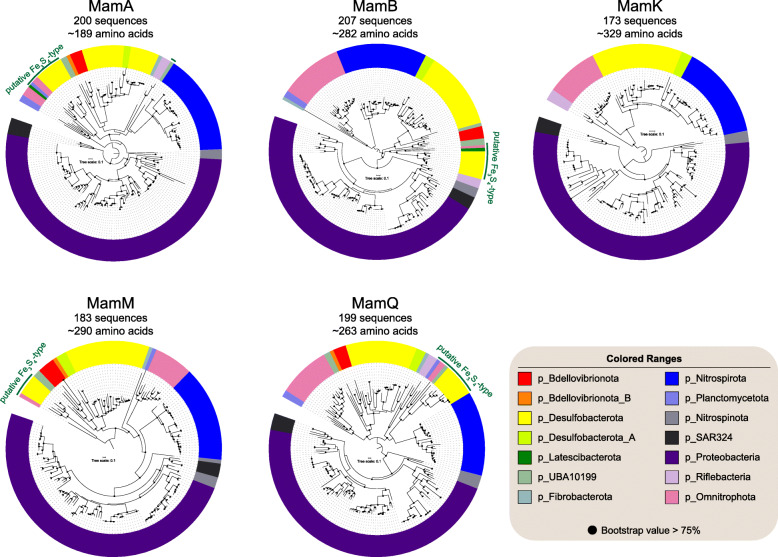
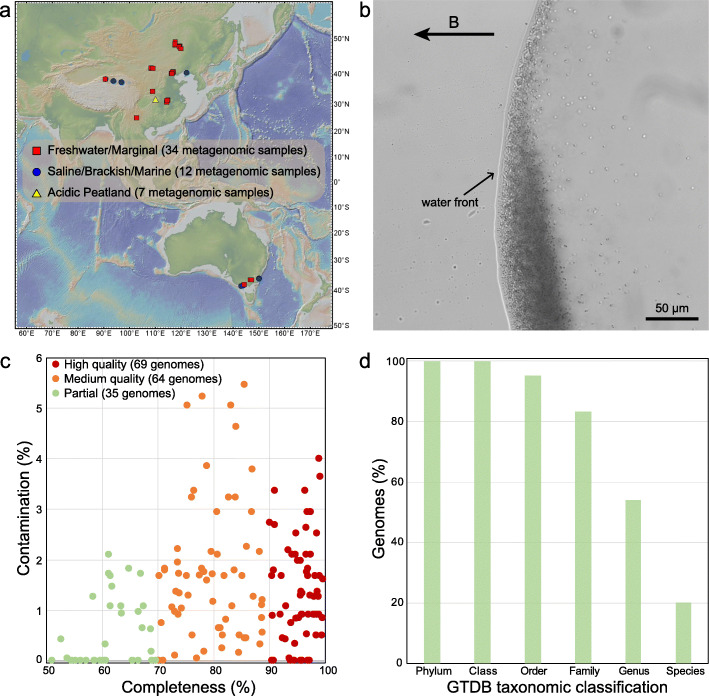
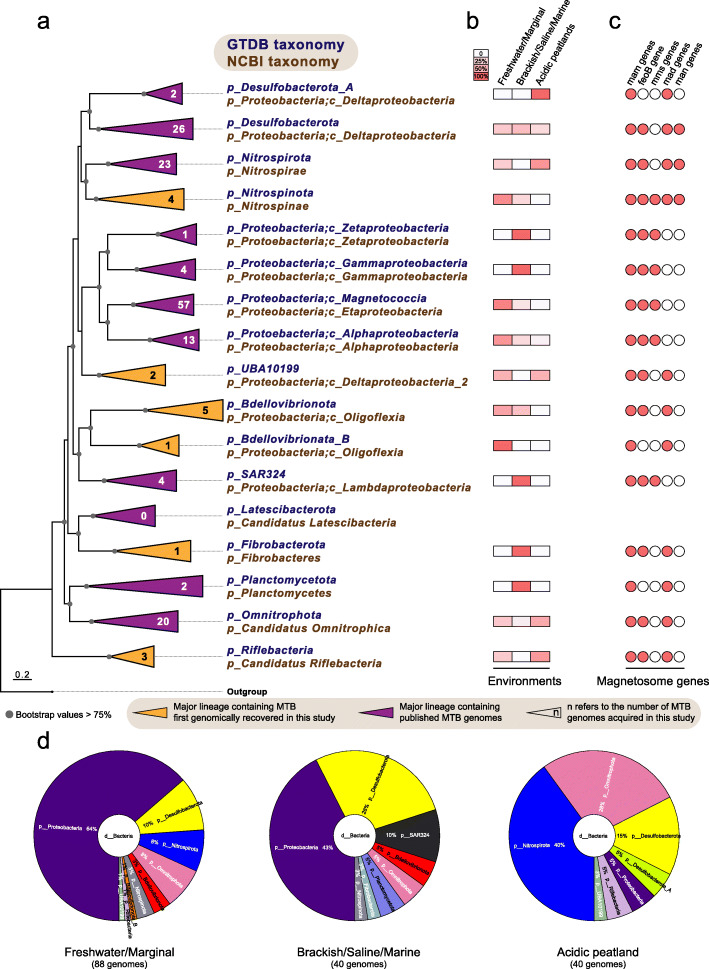
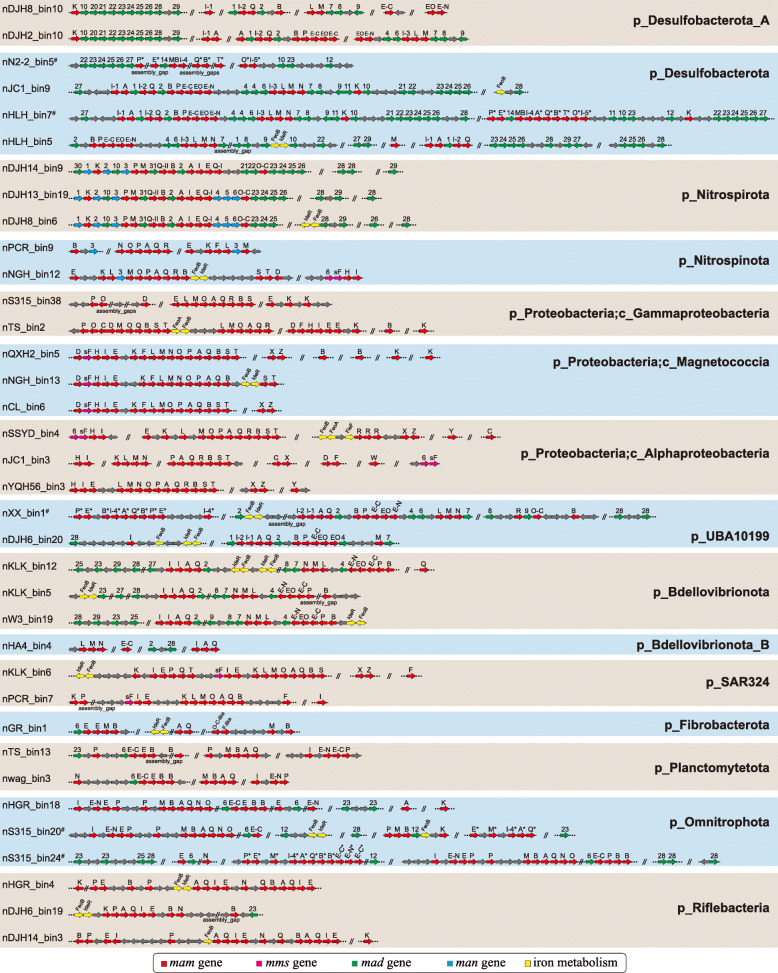
Here, we perform the most comprehensive metagenomic analysis available of MTB communities and reconstruct metagenome-assembled MTB genomes from diverse ecosystems. Discovery of MTB in acidic peatland soils suggests widespread MTB occurrence in waterlogged soils in addition to subaqueous sediments and water bodies. A total of 168 MTB draft genomes have been reconstructed, which represent nearly a 3-fold increase over the number currently available and more than double the known MTB species at the genome level. Phylogenomic analysis reveals that these genomes belong to 13 Bacterial phyla, six of which were previously not known to include MTB. These findings indicate a much wider taxonomic distribution of magnetosome organelle biogenesis across the domain Bacteria than previously thought. Comparative genome analysis reveals a vast diversity of magnetosome gene clusters involved in magnetosomal biogenesis in terms of gene content and synteny residing in distinct taxonomic lineages. Phylogenetic analyses of core magnetosome proteins in this largest available and taxonomically diverse dataset support an unexpectedly early evolutionary origin of magnetosome biomineralization, likely ancestral to the origin of the domain Bacteria.
These findings expand the taxonomic and phylogenetic diversity of MTB across the domain Bacteria and shed new light on the origin and evolution of microbial magnetoreception. Potential biogenesis of the magnetosome organelle in the close descendants of the last bacterial common ancestor has important implications for our understanding of the evolutionary history of bacterial cellular complexity and emphasizes the biological significance of the magnetosome organelle. Video Abstract.
在细菌中发现具有膜包裹、代谢功能的细胞器,改变了我们对原核细胞亚细胞复杂性的理解。磁细菌(MTB)在磁小体中生物矿化磁性纳米颗粒是原核细胞器的一个迷人例子。磁小体作为 MTB 中的纳米级磁性传感器,有助于细胞沿着局部地磁场导航,这种行为称为趋磁性或微生物磁感受。最近在传统分类群之外发现了新型 MTB,这表明细菌域中的 MTB 多样性被大大低估,这限制了对磁小体细胞器生物发生的分类分布和进化起源的理解。
在这里,我们对 MTB 群落进行了迄今为止最全面的宏基因组分析,并从不同的生态系统中重建了宏基因组组装的 MTB 基因组。在酸性泥炭土壤中发现 MTB 表明,除了水下沉积物和水体之外,MTB 还广泛存在于积水土壤中。总共重建了 168 个 MTB 草案基因组,这比目前可用的数量增加了近 3 倍,是基因组水平上已知的 MTB 物种的两倍多。系统发育分析表明,这些基因组属于 13 个细菌门,其中 6 个以前不知道包括 MTB。这些发现表明,磁小体细胞器生物发生在细菌域中的分类分布比以前认为的要广泛得多。比较基因组分析揭示了在这个最大的可用且分类多样化的数据集,涉及磁小体生物发生的磁小体基因簇在基因内容和同线性方面存在巨大的多样性,存在于不同的分类群中。对核心磁小体蛋白的系统发育分析支持磁小体生物矿化的起源比预期的更早,可能是细菌域起源的祖先。
这些发现扩展了细菌域中 MTB 的分类和系统发育多样性,并为微生物磁感受的起源和进化提供了新的线索。在最后一个细菌共同祖先的密切后代中磁小体细胞器的潜在生物发生对我们理解细菌细胞复杂性的进化历史具有重要意义,并强调了磁小体细胞器的生物学意义。视频摘要。