Solaini L, Cavaliere D, Rocco G, Avanzolini A, Di Pietrantonio D, Ercolani G
Department of Medical and Surgical Sciences-DIMEC, Alma Mater Studiorum-University of Bologna, Bologna, Italy.
General and Oncologic Surgery, Department of Surgery, Morgagni-Pierantoni Hospital, via C. Forlanini 29, 47121, Forlì, Italy.
Hernia. 2023 Oct;27(5):1123-1129. doi: 10.1007/s10029-023-02846-4. Epub 2023 Aug 17.
In this study, we aim to analyze the learning curve of each step of robotic transabdominal pre-peritoneal inguinal hernia repair (rTAPP) in two surgeons with varying degrees of expertise with the robotic platform but no experience with laparoscopic hernia repair.
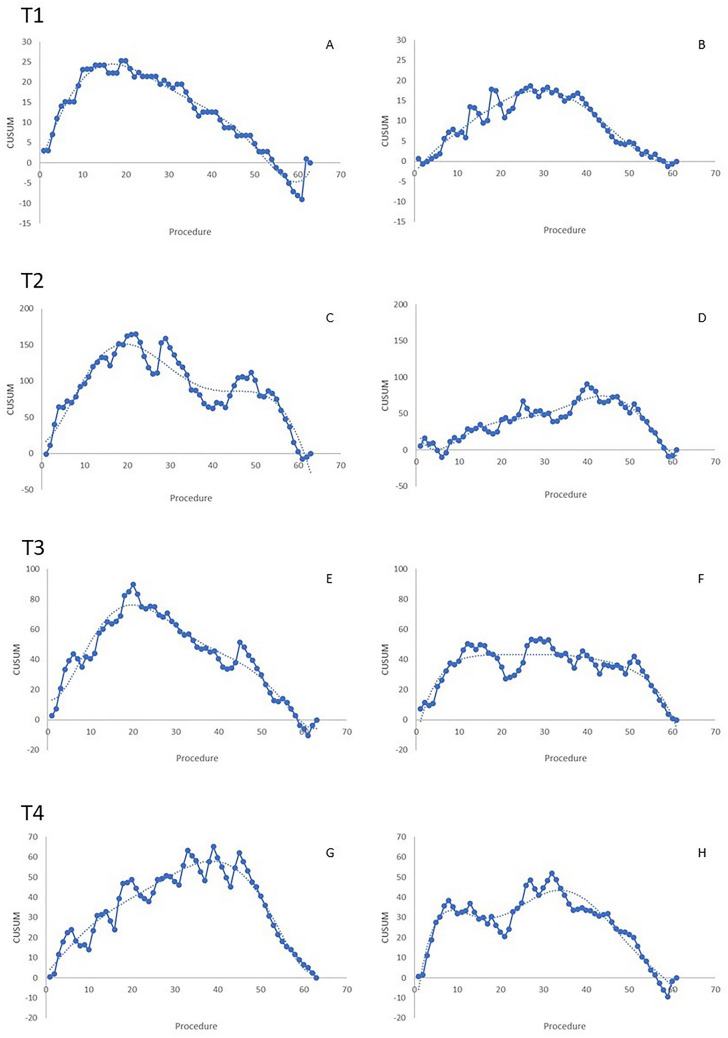
Data on 124 rTAPP cases performed by two surgeons were retrospectively reviewed. Cumulative sum (CUSUM) analysis was applied to visualize the learning curve of rTAPP on operation time of each step of the procedure [the peritoneal flap creation (T1), the completion of the critical view of the myopectineal orifice (T2), the mesh application (T3) and the peritoneal flap closure (T4)]. Each intraoperative and postoperative outcome was compared according to surgeon's experience with the robotic platform and learning phase. The robotic surgeon mentored the surgeon-in-training and was present during all surgeries in his learning period.
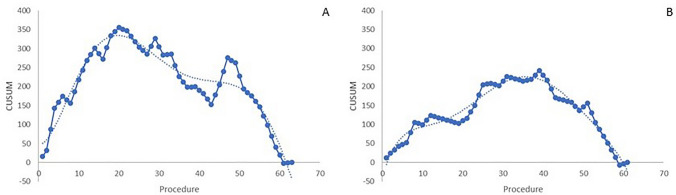
The surgeon in training with the robotic platform showed a learning phase till the 20th procedure followed by a gradual improvement in performances. The expert surgeon showed a learning phase till the 35th procedure after which a constant decrease of operative time was recorded till the last procedure included. The operative times of each step of the procedures of both surgeons were significantly improved after the learning phase. In the late phase, the surgeon in training could achieve operative times in T2 and T3, which are similar to those of an experienced robotic surgeon with no experience with TAPP before the completion of the learning phase.
In conclusion, the learning phase of rTAPP surgery may vary between 20 and 35 cases, depending on the surgeon's experience in robotic surgery.
在本研究中,我们旨在分析两位对机器人平台专业程度不同但无腹腔镜疝修补经验的外科医生进行机器人经腹腹膜前腹股沟疝修补术(rTAPP)各步骤的学习曲线。
回顾性分析两位外科医生进行的124例rTAPP病例的数据。应用累积和(CUSUM)分析来可视化rTAPP在手术各步骤(腹膜瓣创建(T1)、耻骨肌孔关键视野完成(T2)、补片应用(T3)和腹膜瓣关闭(T4))手术时间上的学习曲线。根据外科医生对机器人平台的经验和学习阶段比较术中及术后的各项结果。机器人外科医生指导实习医生,并在其学习期间的所有手术中全程在场。
使用机器人平台的实习医生在第20例手术前处于学习阶段,之后手术表现逐渐改善。专家外科医生在第35例手术前处于学习阶段,之后直至纳入的最后一例手术,手术时间持续下降。两位外科医生手术各步骤的手术时间在学习阶段后均有显著改善。在后期,实习医生在T2和T3步骤的手术时间能够达到与在学习阶段完成前无TAPP经验的经验丰富的机器人外科医生相似的水平。
总之,rTAPP手术的学习阶段可能在20至35例之间,具体取决于外科医生在机器人手术方面的经验。