Steno Diabetes Center Odense, Odense University Hospital, Kløvervænget 10, Entrance 112, 5000, Odense, Denmark.
Department of Clinical Research, University of Southern Denmark, Odense, Denmark.
Cardiovasc Diabetol. 2023 Aug 17;22(1):212. doi: 10.1186/s12933-023-01956-8.
While a low-carbohydrate diet (LCD) reduces HbA1c in patients with type 2 diabetes (T2D), the associated high intake of fat may adversely affect cardiovascular risk factors. To address this, we examined the effect of a non-calorie-restricted LCD high in fat on endothelial function and markers of low-grade inflammation in T2D over 6 months.
In an open-label randomized controlled trial, 71 patients with T2D were randomized 2:1 to either a LCD (< 20 E% carbohydrates, 50-60 E% fat) or a control diet (50-60 E% carbohydrates, 20-30 E% fat) for six months. Flow-mediated vasodilation (FMD) and nitroglycerine-induced vasodilation (NID) were assessed by ultrasound in the brachial artery together with plasma interleukin-6 (IL-6) and serum high-sensitivity C-reactive protein (hsCRP) in the participants at baseline (n = 70) and after six months (n = 64).
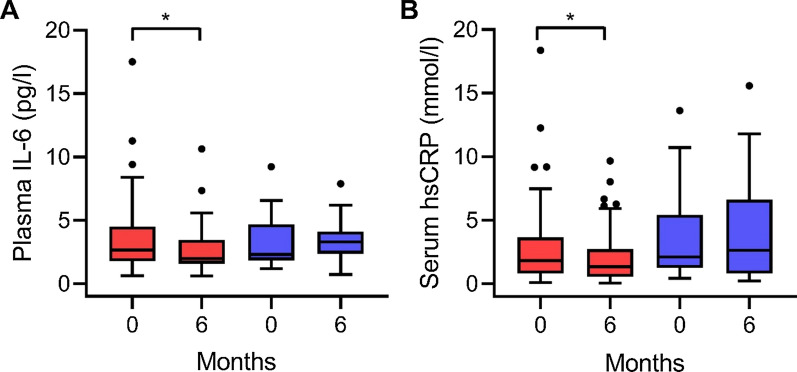
The FMD and NID were unaltered in both groups after six months, and there were no between-group differences in change of either FMD (p = 0.34) or NID (p = 0.53) in response to the interventions. The circulating hsCRP and IL-6 levels decreased only in response to LCD (both p < 0.05). However, comparing changes over time with the control diet, the LCD did not reduce either IL-6 (p = 0.25) or hsCRP (p = 0.07) levels. The lack of changes in FMD and NID in response to LCD persisted after adjustment for cardiovascular risk factors.
A LCD high in fat for six months does not adversely affect endothelial function or selected markers of low-grade inflammation, which suggests that this nutritional approach does not increase the risk of cardiovascular disease. Trial registration ClinicalTrials.gov (NCT03068078).
低碳水化合物饮食(LCD)可降低 2 型糖尿病(T2D)患者的 HbA1c,但随之而来的高脂肪摄入可能对心血管风险因素产生不利影响。为了解决这个问题,我们在 6 个月的时间里,检查了一种非热量限制的高脂肪低碳水化合物饮食对 T2D 患者内皮功能和低度炎症标志物的影响。
在一项开放标签的随机对照试验中,71 名 T2D 患者被随机分为 2:1 的比例,分别接受低碳水化合物饮食(<20 E%碳水化合物,50-60 E%脂肪)或对照饮食(50-60 E%碳水化合物,20-30 E%脂肪)治疗 6 个月。通过超声检测肱动脉的血流介导的血管扩张(FMD)和硝酸甘油诱导的血管扩张(NID),并在参与者的基线(n=70)和 6 个月(n=64)时检测血浆白细胞介素-6(IL-6)和血清高敏 C 反应蛋白(hsCRP)。
两组患者在 6 个月后 FMD 和 NID 均无变化,两组间 FMD(p=0.34)或 NID(p=0.53)的变化均无差异。只有在低碳水化合物饮食组中,循环 hsCRP 和 IL-6 水平下降(均 p<0.05)。然而,与对照饮食相比,低碳水化合物饮食并不能降低 IL-6(p=0.25)或 hsCRP(p=0.07)的水平。FMD 和 NID 对 LCD 的反应在调整心血管危险因素后仍然没有变化。
高脂肪低碳水化合物饮食 6 个月不会对内皮功能或低度炎症的某些标志物产生不利影响,这表明这种营养方法不会增加心血管疾病的风险。试验注册ClinicalTrials.gov(NCT03068078)。