Su Ziying, Cao Lei, Chen Hailong, Zhang Peng, Wu Chunwei, Lu Jing, He Ze
Changchun University of Traditional Chinese Medicine, Changchun, China.
The Affiliated Hospital of Changchun University of Traditional Chinese Medicine, Changchun, China.
Lipids Health Dis. 2025 May 14;24(1):176. doi: 10.1186/s12944-025-02589-4.
This study analyzes data from the 2009-2018 National Health and Nutrition Examination Survey (NHANES) to explore the relationship between the Aggregate Index of Systemic Inflammation (AISI), also referred to as the pan-immune-inflammation value (PIV), and Type 2 Diabetes Mellitus (T2DM) among adults in the United States. Furthermore, it evaluates the mediating effect of obesity indicators on this association.
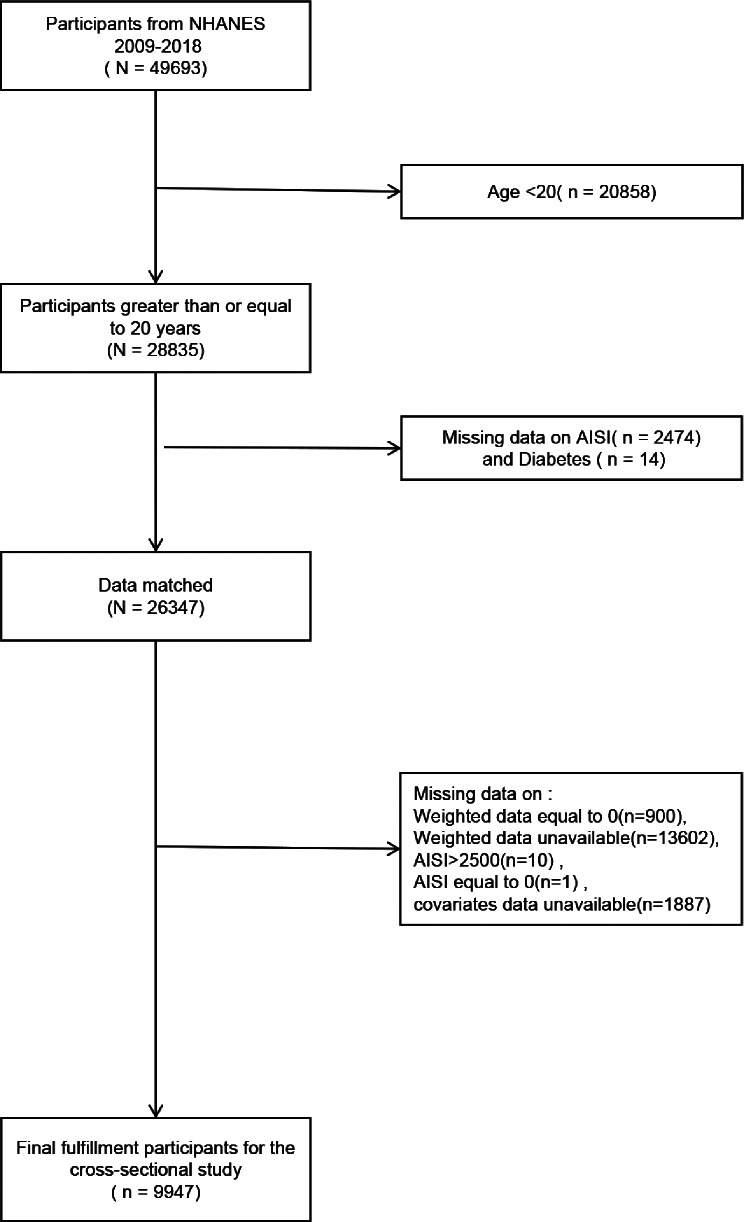
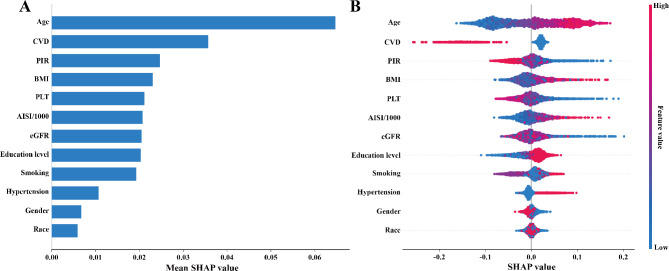
This study included 9,947 individuals from NHANES and applied appropriate weighting techniques. To examine the relationship between AISI and T2DM, we used various statistical models, including weighted multivariable logistic regression, smooth curve fitting, threshold effect analysis, subgroup analysis, trend tests, mediation analysis, and Shapley additive explanations (SHAP) models.
This research included a total of 9,947 participants, with 3,220 diagnosed with T2DM, while 6,727 remained undiagnosed. Weighted multiple logistic regression with all covariates adjusted indicated that with every one-unit increment in AISI/1000, there was an 88.3% likelihood of T2DM occurrence (OR: 1.883, 95% CI: 1.378-2.571). The stratified analysis identified significant differences in this association based on age, biological sex, level of education, poverty-income ratio (PIR), tobacco consumption status, and body mass index (BMI). Interaction tests revealed a positive association between AISI and T2DM, apart from PIR, BMI, age, education attainment, race, gender, tobacco use status, Estimated Glomerular Filtration Rate(eGFR), platelet count, and high blood pressure, with none of the interaction p-values falling below 0.05. Nevertheless, the occurrence of cardiovascular disease (CVD) among participants may affect the strength of this relationship, where an interaction p-value was less than 0.05. Additionally, smoothing curve fitting revealed a nonlinear relationship between AISI and T2DM, marking a significant change at AISI/1000 of 0.21. Mediation analysis indicated that five obesity-related indicators-LAP, VAI, WHtR, WWI and ABSI - partly mediated the association between AISI/1000 and T2DM.
An increase in AISI is associated with an elevated probability of T2DM, with obesity indicators potentially mediating this relationship. Reducing AISI and managing obesity may help prevent T2DM. However, with the cross-sectional design of this study, causal relationships cannot be established. Future research should utilize longitudinal studies to confirm these findings.
本研究分析了2009 - 2018年美国国家健康与营养检查调查(NHANES)的数据,以探讨全身炎症综合指数(AISI),也称为泛免疫炎症值(PIV),与美国成年人2型糖尿病(T2DM)之间的关系。此外,还评估了肥胖指标在这种关联中的中介作用。
本研究纳入了NHANES的9947名个体,并应用了适当的加权技术。为了研究AISI与T2DM之间的关系,我们使用了各种统计模型,包括加权多变量逻辑回归、平滑曲线拟合、阈值效应分析、亚组分析、趋势检验、中介分析和夏普利加法解释(SHAP)模型。
本研究共纳入9947名参与者,其中3220人被诊断为T2DM,6727人未被诊断。调整所有协变量后的加权多变量逻辑回归表明,AISI/1000每增加一个单位,发生T2DM的可能性增加88.3%(OR:1.883,95%CI:1.378 - 2.571)。分层分析发现,基于年龄、生物性别、教育水平、贫困 - 收入比(PIR)、烟草消费状况和体重指数(BMI),这种关联存在显著差异。交互作用检验显示,除了PIR、BMI、年龄、教育程度、种族、性别、烟草使用状况、估计肾小球滤过率(eGFR)、血小板计数和高血压外,AISI与T2DM之间存在正相关,且交互作用p值均未低于0.05。然而,参与者中心血管疾病(CVD)的发生可能会影响这种关系的强度,其中交互作用p值小于0.05。此外,平滑曲线拟合显示AISI与T2DM之间存在非线性关系,在AISI/1000为0.21时出现显著变化。中介分析表明,五个与肥胖相关的指标——LAP、VAI、腰高比(WHtR)、体重腰围指数(WWI)和体脂率指数(ABSI)——部分介导了AISI/1000与T2DM之间的关联。
AISI的升高与T2DM发生概率的增加相关,肥胖指标可能介导这种关系。降低AISI和控制肥胖可能有助于预防T2DM。然而,由于本研究的横断面设计,无法建立因果关系。未来的研究应利用纵向研究来证实这些发现。