Hardin Blake, Graboyes Melissa, Kosty Derek, Cioffi Camille
Department of Global Studies, University of Oregon, United States.
Department of History, University of Oregon, United States.
Prev Med Rep. 2023 Jul 22;35:102341. doi: 10.1016/j.pmedr.2023.102341. eCollection 2023 Oct.
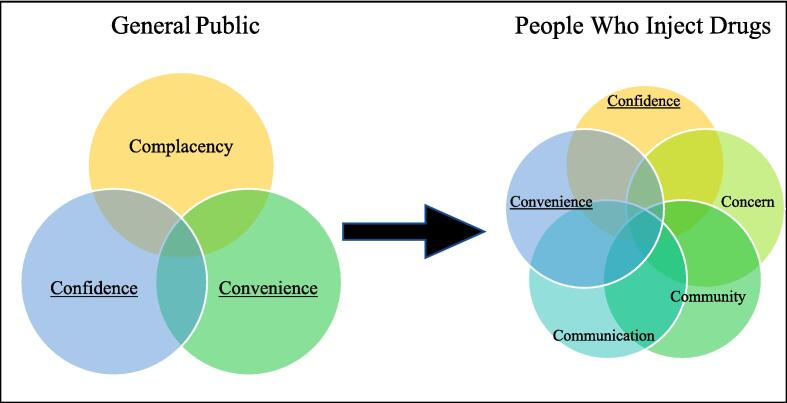
The objectives of this study were to 1) identify vaccination rates among PWID in Oregon at a time when vaccines were easily accessible, 2) quantitatively identify convergence with demographic correlates of vaccination willingness and uptake to promote generalizability, and 3) explore the factors PWID were considering when deciding whether or not to receive the COVID-19 vaccine. We conducted a mixed-methods study design including 260 quantitative surveys and 41 in-depth qualitative interviews with PWID, conducted July - September 2021 at syringe services programs in Lane County, Oregon. Among the 260 survey respondents, 37.3% indicated that they had received a COVID-19 vaccine by October 1, 2021. In the same period, an estimated 70.1% of the total Lane County population had completed their COVID-19 vaccinations (not including booster rounds). We explored alignment with the WHO's 3C model of vaccine hesitancy and identified, instead, five common factors as key motivators for vaccine decisions: confidence, convenience, concern, communication, and community implications among PWID. Interviews with PWID describe systemic barriers which prevented them from accessing healthcare resources. We highlight that our proposed 5C model may more accurately depict how PWID navigate vaccine decisions by incorporating the ways that social inequities, infrastructural barriers, and community values influence an individual's vaccine deliberation.
1)在疫苗易于获取时,确定俄勒冈州注射吸毒者中的疫苗接种率;2)定量确定与疫苗接种意愿和接种情况的人口统计学相关因素的趋同情况,以促进研究结果的普遍适用性;3)探讨注射吸毒者在决定是否接种新冠疫苗时所考虑的因素。我们采用了混合方法研究设计,于2021年7月至9月在俄勒冈州莱恩县的注射器服务项目中,对260名注射吸毒者进行了定量调查,并进行了41次深入的定性访谈。在260名调查受访者中,37.3%表示他们在2021年10月1日前接种了新冠疫苗。同期,莱恩县总人口中估计有70.1%完成了新冠疫苗接种(不包括加强针)。我们探讨了与世界卫生组织疫苗犹豫3C模型的一致性,相反,我们确定了五个共同因素,作为注射吸毒者疫苗决策的关键动机:信心、便利性、担忧、沟通以及社区影响。对注射吸毒者的访谈描述了阻碍他们获得医疗资源的系统性障碍。我们强调,我们提出的5C模型可能通过纳入社会不平等、基础设施障碍和社区价值观影响个人疫苗决策的方式,更准确地描述注射吸毒者如何做出疫苗决策。