Mareckova Klara, Pacinkova Anna, Marecek Radek, Sebejova Ludmila, Izakovicova Holla Lydie, Klanova Jana, Brazdil Milan, Nikolova Yuliya S
Brain and Mind Research, Central European Institute of Technology (CEITEC), Masaryk University (MU), Brno, Czechia.
1St Department of Neurology, St. Anne's University Hospital and Faculty of Medicine, Masaryk University, Brno, Czechia.
Front Aging Neurosci. 2023 Aug 1;15:1215957. doi: 10.3389/fnagi.2023.1215957. eCollection 2023.
The proportion of older adults within society is sharply increasing and a better understanding of how we age starts to be critical. However, given the paucity of longitudinal studies with both neuroimaging and epigenetic data, it remains largely unknown whether the speed of the epigenetic clock changes over the life course and whether any such changes are proportional to changes in brain aging and cognitive skills. To fill these knowledge gaps, we conducted a longitudinal study of a prenatal birth cohort, studied epigenetic aging across adolescence and young adulthood, and evaluated its relationship with brain aging and cognitive outcomes.
DNA methylation was assessed using the Illumina EPIC Platform in adolescence, early and late 20 s, DNA methylation age was estimated using Horvath's epigenetic clock, and epigenetic age gap (EpiAGE) was calculated as DNA methylation age residualized for batch, chronological age and the proportion of epithelial cells. Structural magnetic resonance imaging (MRI) was acquired in both the early 20 s and late 20 s using the same 3T Prisma MRI scanner and brain age was calculated using the Neuroanatomical Age Prediction using R (NAPR) platform. Cognitive skills were assessed using the Wechsler Adult Intelligence Scale (WAIS) in the late 20 s.
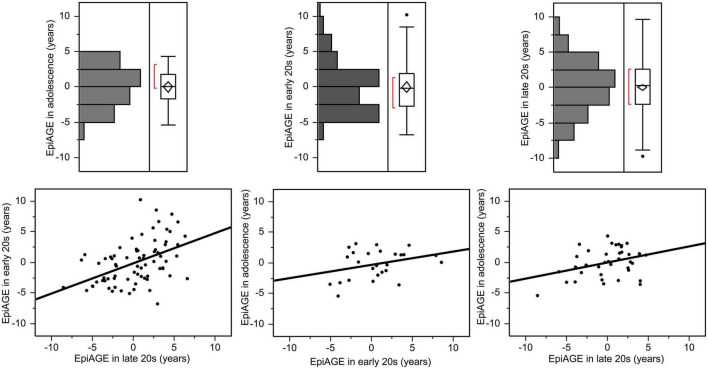
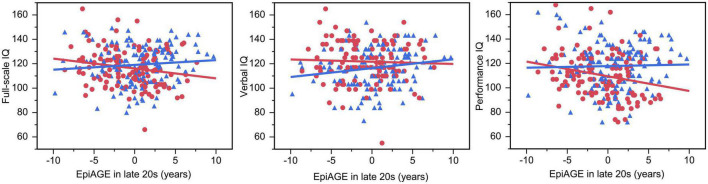
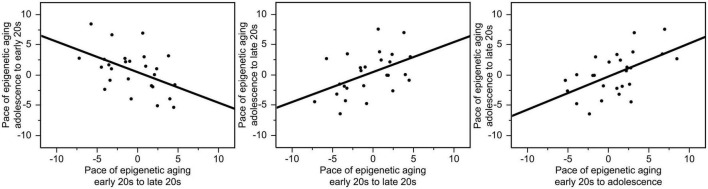
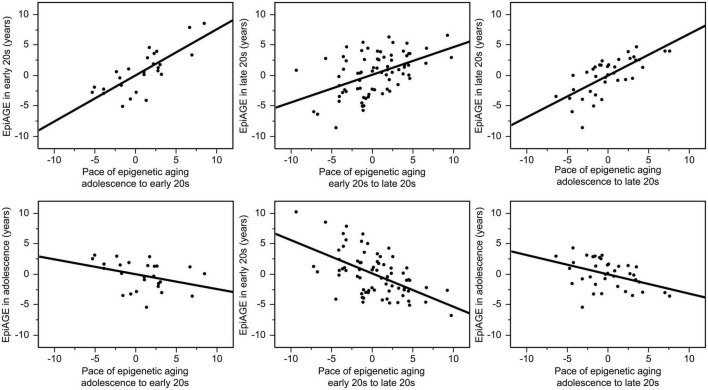
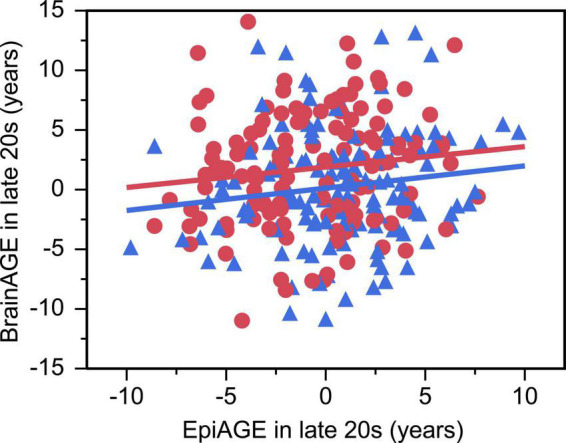
The EpiAGE in adolescence, the early 20 s, and the late 20 s were positively correlated ( = 0.34-0.47), suggesting that EpiAGE is a relatively stable characteristic of an individual. Further, a faster pace of aging between the measurements was positively correlated with EpiAGE at the end of the period ( = 0.48-0.77) but negatively correlated with EpiAGE at the earlier time point ( = -0.42 to -0.55), suggesting a compensatory mechanism where late matures might be catching up with the early matures. Finally, higher positive EpiAGE showed small (Adj = 0.03) but significant relationships with a higher positive brain age gap in all participants and lower full-scale IQ in young adult women in the late 20 s.
We conclude that the EpiAGE is a relatively stable characteristic of an individual across adolescence and early adulthood, but that it shows only a small relationship with accelerated brain aging and a women-specific relationship with worse performance IQ.
社会中老年人的比例正在急剧增加,更好地了解我们的衰老方式开始变得至关重要。然而,鉴于同时拥有神经影像学和表观遗传学数据的纵向研究较少,表观遗传时钟的速度在生命过程中是否会发生变化,以及任何此类变化是否与大脑衰老和认知技能的变化成正比,在很大程度上仍然未知。为了填补这些知识空白,我们对一个产前出生队列进行了纵向研究,研究了青少年期和青年期的表观遗传衰老,并评估了其与大脑衰老和认知结果的关系。
在青少年期、20岁早期和晚期使用Illumina EPIC平台评估DNA甲基化,使用Horvath的表观遗传时钟估计DNA甲基化年龄,并将表观遗传年龄差距(EpiAGE)计算为针对批次、实足年龄和上皮细胞比例进行残差调整后的DNA甲基化年龄。在20岁早期和晚期使用同一台3T Prisma MRI扫描仪采集结构磁共振成像(MRI),并使用基于R的神经解剖年龄预测(NAPR)平台计算脑年龄。在20岁晚期使用韦氏成人智力量表(WAIS)评估认知技能。
青少年期、20岁早期和晚期的EpiAGE呈正相关(= 0.34 - 0.47),表明EpiAGE是个体相对稳定的特征。此外,两次测量之间更快的衰老速度与该时期末的EpiAGE呈正相关(= 0.48 - 0.77),但与较早时间点的EpiAGE呈负相关(= -0.42至-0.55),这表明存在一种补偿机制,即发育较晚的人可能正在追赶发育较早的人。最后,较高的正EpiAGE在所有参与者中与较高的正脑年龄差距呈小(调整后= 0.03)但显著的关系,在20岁晚期的年轻成年女性中与较低的全量表智商呈显著关系。
我们得出结论,EpiAGE在青少年期和成年早期是个体相对稳定的特征,但它与加速的大脑衰老仅显示出小的关系,并且与较差的操作智商存在女性特异性关系。