Department of Hematology, Leiden University Medical Center, Leiden, Netherlands.
Department of Biomedical Data Sciences, Leiden University Medical Center, Leiden, Netherlands.
Front Immunol. 2023 Aug 1;14:1208814. doi: 10.3389/fimmu.2023.1208814. eCollection 2023.
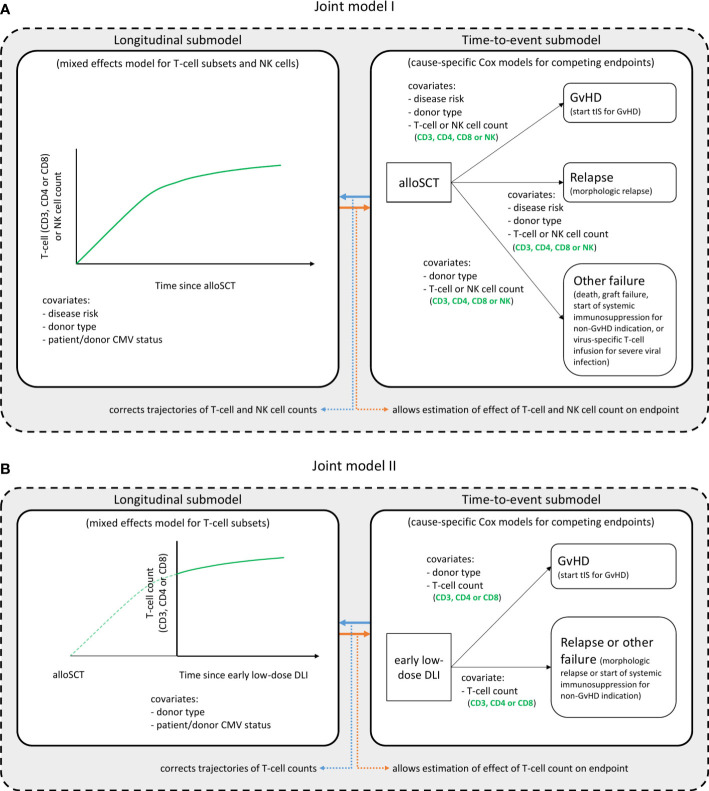
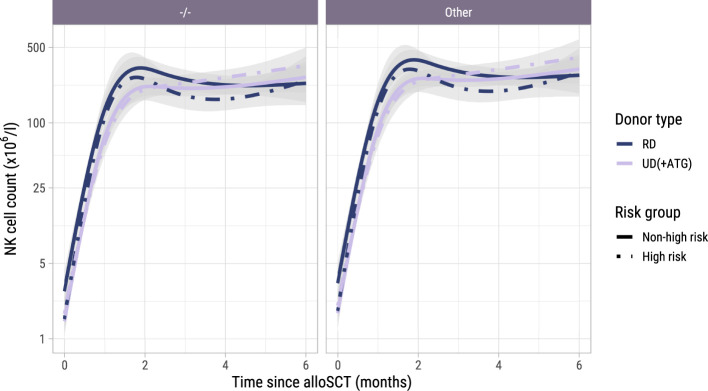
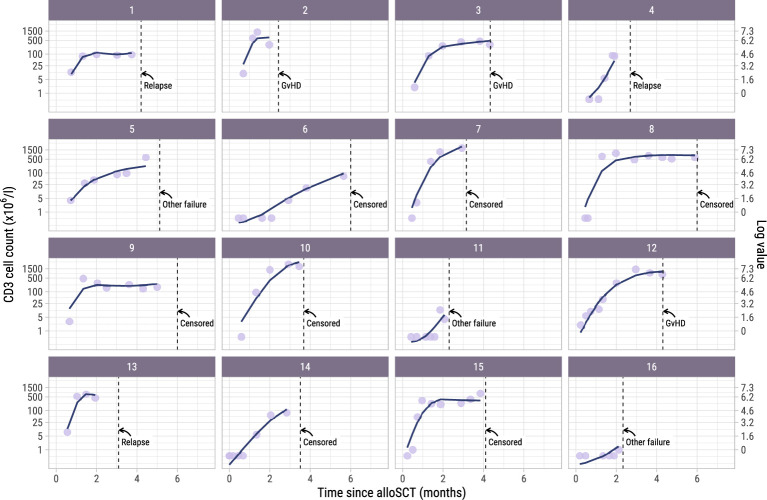
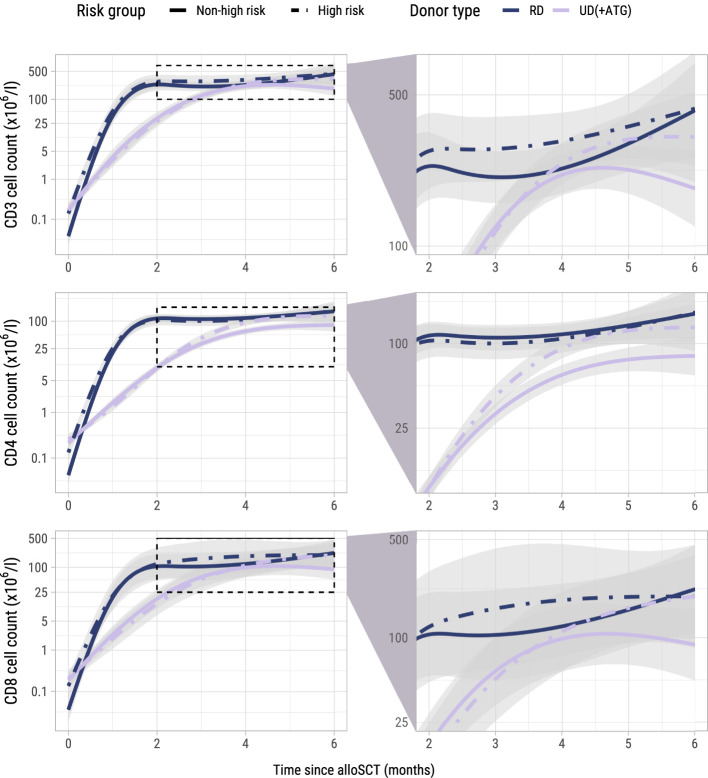
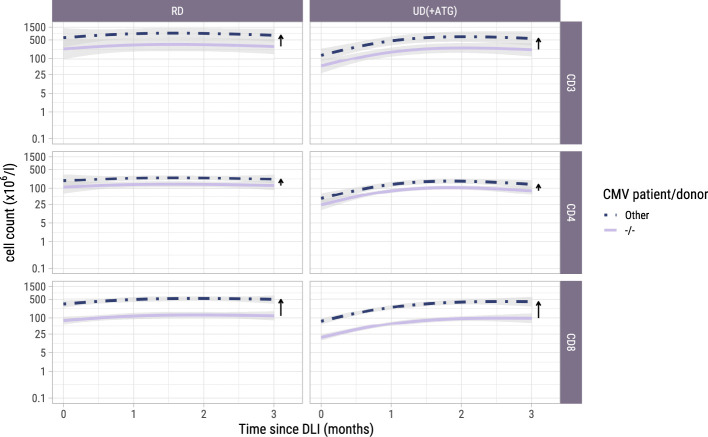
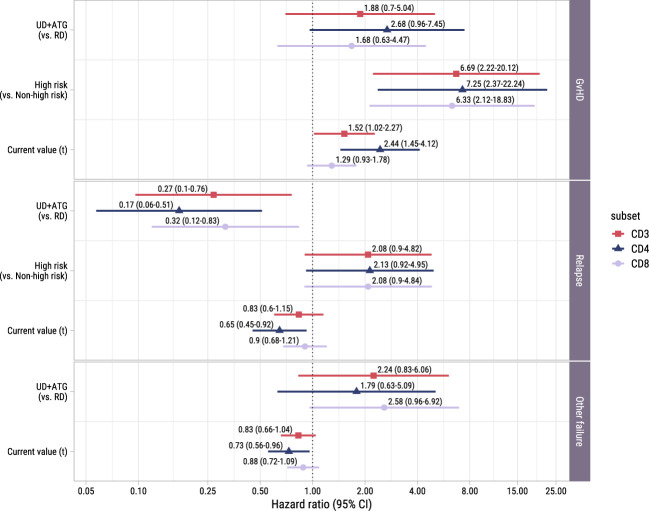
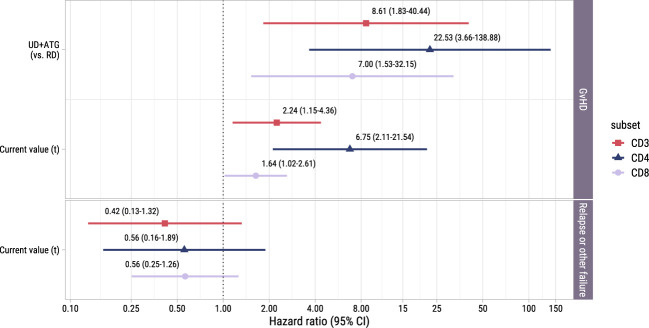
Alloreactive donor-derived T-cells play a pivotal role in alloimmune responses after allogeneic hematopoietic stem cell transplantation (alloSCT); both in the relapse-preventing Graft-versus-Leukemia (GvL) effect and the potentially lethal complication Graft-versus-Host-Disease (GvHD). The balance between GvL and GvHD can be shifted by removing T-cells via T-cell depletion (TCD) to reduce the risk of GvHD, and by introducing additional donor T-cells (donor lymphocyte infusions [DLI]) to boost the GvL effect. However, the association between T-cell kinetics and the occurrence of allo-immunological events has not been clearly demonstrated yet. Therefore, we investigated the complex associations between the T-cell kinetics and alloimmune responses in a cohort of 166 acute leukemia patients receiving alemtuzumab-based TCD alloSCT. Of these patients, 62 with an anticipated high risk of relapse were scheduled to receive a prophylactic DLI at 3 months after transplant. In this setting, we applied joint modelling which allowed us to better capture the complex interplay between DLI, T-cell kinetics, GvHD and relapse than traditional statistical methods. We demonstrate that DLI can induce detectable T-cell expansion, leading to an increase in total, CD4+ and CD8+ T-cell counts starting at 3 months after alloSCT. CD4+ T-cells showed the strongest association with the development of alloimmune responses: higher CD4 counts increased the risk of GvHD (hazard ratio 2.44, 95% confidence interval 1.45-4.12) and decreased the risk of relapse (hazard ratio 0.65, 95% confidence interval 0.45-0.92). Similar models showed that natural killer cells recovered rapidly after alloSCT and were associated with a lower risk of relapse (HR 0.62, 95%-CI 0.41-0.93). The results of this study advocate the use of joint models to further study immune cell kinetics in different settings.
同种异体造血干细胞移植(alloSCT)后,同种反应性供体来源的 T 细胞在同种免疫反应中发挥关键作用;既能预防移植物抗白血病(GvL)效应,又能预防潜在致命的移植物抗宿主病(GvHD)并发症。通过 T 细胞耗竭(TCD)去除 T 细胞来降低 GvHD 的风险,并通过引入额外的供体 T 细胞(供者淋巴细胞输注[DLI])来增强 GvL 效应,从而可以平衡 GvL 和 GvHD。然而,T 细胞动力学与同种免疫事件发生之间的关联尚未得到明确证明。因此,我们在接受基于阿仑单抗的 TCD alloSCT 的 166 例急性白血病患者队列中研究了 T 细胞动力学与同种免疫反应之间的复杂关联。其中,62 例预期复发风险高的患者计划在移植后 3 个月接受预防性 DLI。在这种情况下,我们应用联合建模,与传统统计方法相比,该方法能够更好地捕捉 DLI、T 细胞动力学、GvHD 和复发之间的复杂相互作用。我们证明 DLI 可诱导可检测的 T 细胞扩增,导致总 T 细胞、CD4+T 细胞和 CD8+T 细胞计数在 alloSCT 后 3 个月开始增加。CD4+T 细胞与同种免疫反应的发展相关性最强:较高的 CD4 计数增加了 GvHD 的风险(风险比 2.44,95%置信区间 1.45-4.12),降低了复发的风险(风险比 0.65,95%置信区间 0.45-0.92)。类似的模型表明,自然杀伤细胞在 alloSCT 后迅速恢复,与较低的复发风险相关(HR 0.62,95%-CI 0.41-0.93)。这项研究的结果主张使用联合模型进一步研究不同情况下免疫细胞动力学。