Section for Aquatic Biology and Toxicology, Centre for Biogeochemistry in the Anthropocene, Department of Biosciences, University of Oslo, Blindernv. 31, 0371, Oslo, Norway.
Norsk Institutt for Vannforskning (NIVA) Gaustadalléen 21, 0349, Oslo, Norway.
Commun Biol. 2023 Aug 18;6(1):862. doi: 10.1038/s42003-023-05237-8.
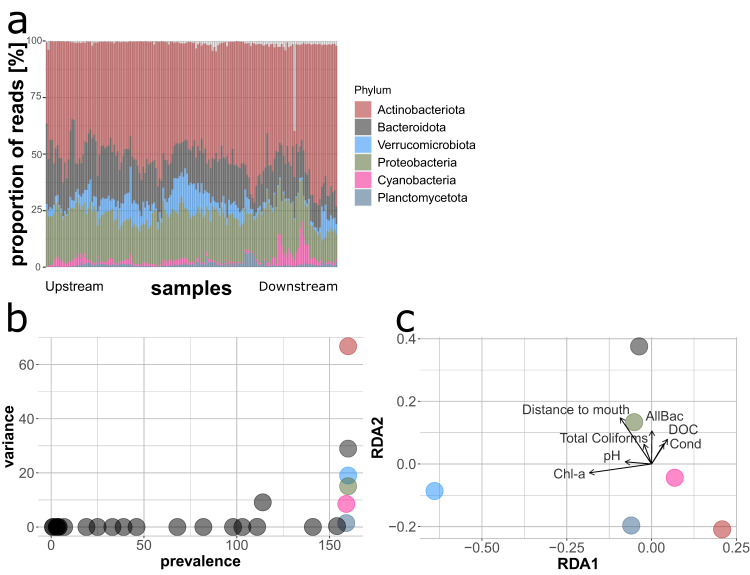
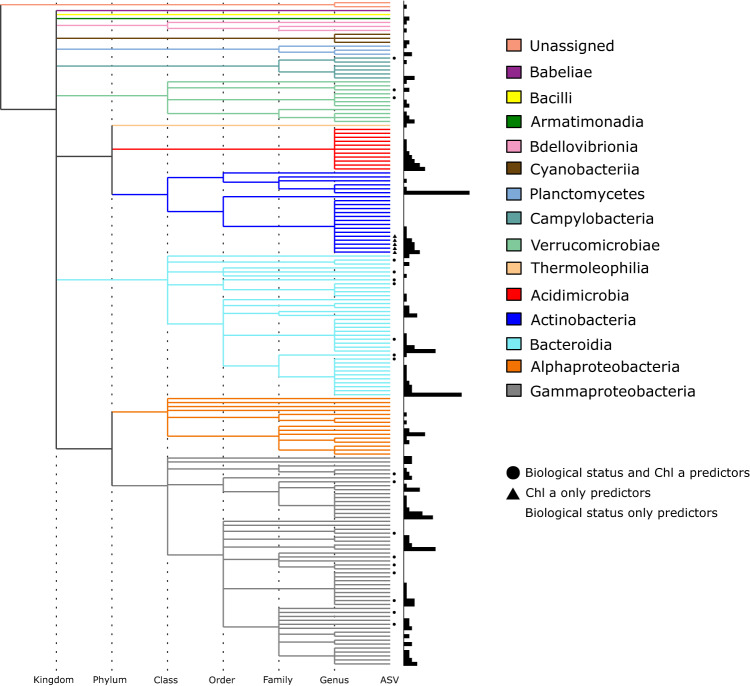
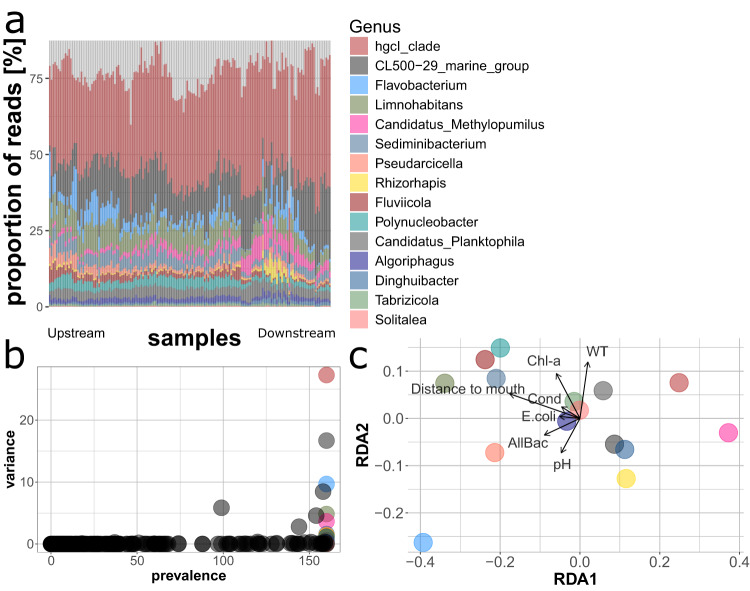
Despite the importance of bacteria in aquatic ecosystems and their predictable diversity patterns across space and time, biomonitoring tools for status assessment relying on these organisms are widely lacking. This is partly due to insufficient data and models to identify reliable microbial predictors. Here, we show metabarcoding in combination with multivariate statistics and machine learning allows to identify bacterial bioindicators for existing biological status classification systems. Bacterial beta-diversity dynamics follow environmental gradients and the observed associations highlight potential bioindicators for ecological outcomes. Spatio-temporal links spanning the microbial communities along the river allow accurate prediction of downstream biological status from upstream information. Network analysis on amplicon sequence veariants identify as good indicators genera Fluviicola, Acinetobacter, Flavobacterium, and Rhodoluna, and reveal informational redundancy among taxa, which coincides with taxonomic relatedness. The redundancy among bacterial bioindicators reveals mutually exclusive taxa, which allow accurate biological status modeling using as few as 2-3 amplicon sequence variants. As such our models show that using a few bacterial amplicon sequence variants from globally distributed genera allows for biological status assessment along river systems.
尽管细菌在水生生态系统中具有重要意义,并且它们在空间和时间上的多样性模式可以预测,但依赖于这些生物的状态评估生物监测工具仍然广泛缺乏。这部分是由于缺乏足够的数据和模型来识别可靠的微生物预测因子。在这里,我们展示了组合使用宏条形码、多元统计和机器学习可以识别现有生物状态分类系统的细菌生物指标。细菌β多样性动态遵循环境梯度,观察到的关联突出了潜在的生态结果生物指标。沿河流的微生物群落的时空联系允许从上游信息准确预测下游的生物状态。对扩增子序列变体的网络分析确定了作为良好指标的 Fluvicola、Acinetobacter、Flavobacterium 和 Rhodoluna 属,并且揭示了分类群之间的信息冗余,这与分类学相关性一致。细菌生物指标之间的冗余揭示了相互排斥的分类群,这允许使用尽可能少的 2-3 个扩增子序列变体来进行准确的生物状态建模。因此,我们的模型表明,使用来自全球分布属的少数几个细菌扩增子序列变体就可以沿河流系统进行生物状态评估。